Hellas Verona vs AS Roma: Serie A Round 38 Preview
In 2026 at Stadio Marcantonio Bentegodi, this Round 38 Serie A fixture pits 19th-placed Hellas Verona against 4th-placed AS Roma in a match with asymmetric stakes: Verona are fighting to avoid finishing second-bottom with just 21 points and a -34 goal difference in the league phase (25 scored, 59 conceded), while Roma arrive on 70 points with a +26 goal difference in the league phase (57 scored, 31 conceded), looking to lock in Champions League qualification and potentially climb in the top-four hierarchy.
Head-to-Head Tactical Summary
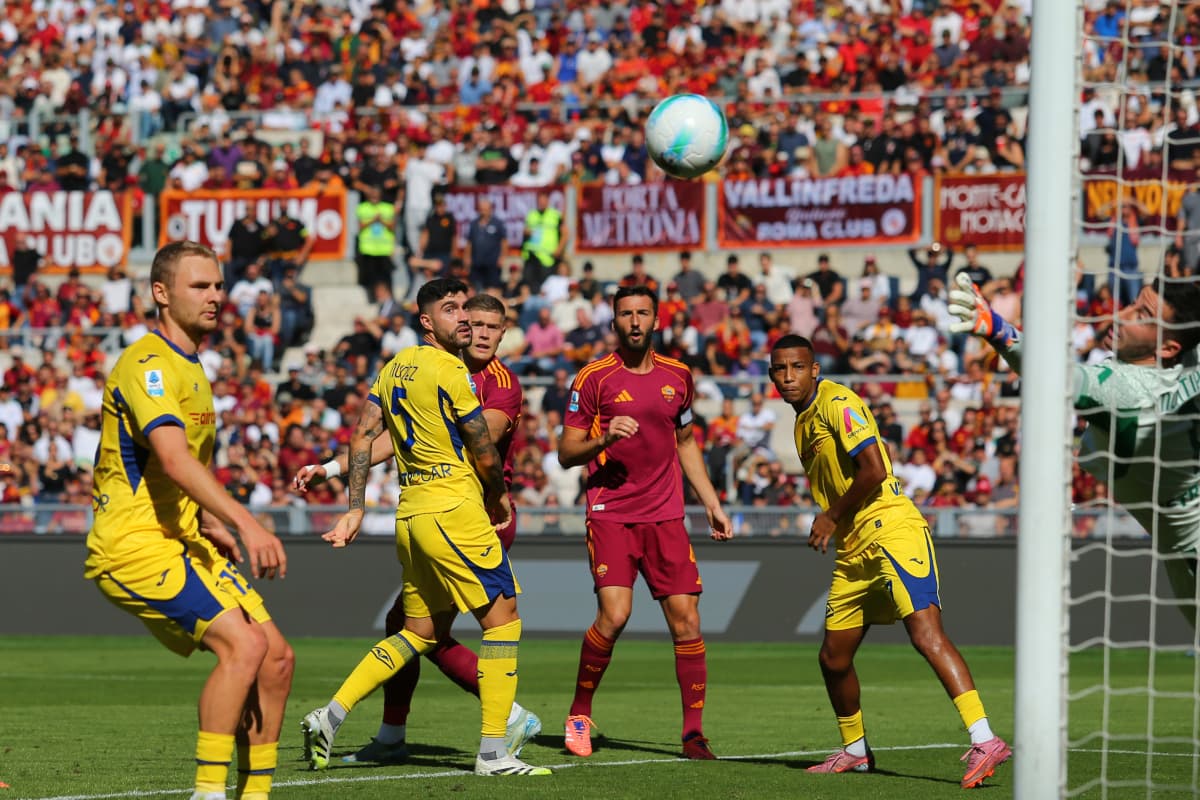
The recent head-to-head pattern shows a clear Roma edge, but with Verona capable of isolated home punches. On 28 September 2025 at Stadio Olimpico in Rome, Roma beat Verona 2-0 in Serie A (1-0 at HT), underlining Roma’s ability to control proceedings at home. Earlier in 2025, on 19 April at Stadio Olimpico, Roma again won 1-0 (1-0 at HT), a tighter, more controlled contest.
Going back to Verona, on 3 November 2024 at Stadio Marcantonio Bentegodi, Hellas Verona edged a 3-2 win over Roma (2-1 at HT), demonstrating that Verona’s direct, opportunistic approach can trouble Roma when they play in Verona. In 2024 at Stadio Olimpico (20 January), Roma beat Verona 2-1 (2-0 at HT), after building a strong early lead. The 26 August 2023 clash at Stadio Marcantonio Bentegodi ended in a 2-1 Verona win (2-0 at HT), again showing Roma’s vulnerability when Verona start aggressively at home.
Across these five meetings, Roma have three wins (2-0, 1-0, 2-1) at Stadio Olimpico, while Verona have taken two 2-1 and 3-2 victories at Stadio Marcantonio Bentegodi. The pattern is of Roma’s structured superiority in Rome versus Verona’s capacity to create chaotic, high-scoring home matches in Verona.
Global Season Picture
- League Phase Performance:
Hellas Verona: 19th with 21 points from 37 games in the league phase, with just 3 wins, 12 draws, and 22 defeats. Their attack has been low output (25 goals for) and their defense fragile (59 against), reflected in a -34 goal difference. At home in the league phase, Verona have only 1 win in 18 games (12 goals for, 26 against), showing a very limited home edge.
AS Roma: 4th with 70 points from 37 games in the league phase, built on 22 wins, 4 draws, and 11 losses. Roma’s attack is productive (57 goals for) and the defense relatively solid (31 against), for a +26 goal difference. Away from home in the league phase, Roma have 9 wins and 1 draw in 18 games (24 scored, 21 conceded), showing they can travel effectively despite occasional defensive concessions. - Season Metrics:
Scope detection shows team_statistics games played (37) match the standings totals, so all numbers refer to in the league phase.
Hellas Verona: Verona’s scoring rate is low in the league phase, with 25 goals in 37 matches and an average of 0.7 goals per game. Defensively they concede 59 goals, at 1.6 per game, which supports the view of a porous defense (59 conceded, 1.6 per game). They have failed to score in 19 of 37 matches, underlining a blunt attack. Clean sheets stand at 6, showing limited capacity to shut opponents down. Discipline-wise, Verona accumulate yellow cards across all intervals, with notable spikes between minutes 31–45 and 46–60, indicating pressure phases where they often resort to fouls. Red cards are spread across early and late phases, which can destabilize them in key moments.
AS Roma: Roma average 1.5 goals scored per game in the league phase (57 in 37), with a balanced home/away profile: 1.7 at home, 1.3 away. Defensively they concede just 0.8 per game (31 in 37), with a very strong home baseline (0.5 conceded per game) and a more open away profile (1.2 conceded per game). Roma have kept 17 clean sheets and failed to score only 7 times, illustrating a clinical attack (57 scored, 17 clean sheets) supported by a compact defensive block. Roma’s card distribution shows more yellows in the middle and late stages (46–60, 61–75, 76–90), suggesting they intensify duels when game states demand it. Red cards appear only in the 46–75 window, indicating occasional over-aggression in the second half of matches. - Form Trajectory:
Hellas Verona: The standings form string “DLDDL” in the league phase indicates 0 wins in the last five, with 3 losses and 2 draws. Combined with the longer team_statistics form, this confirms a season-long pattern of short, modest unbeaten runs immediately followed by losing streaks. Entering Round 38, Verona are trending downward, with no recent evidence of a sustained uplift.
AS Roma: The standings form “WWWWD” in the league phase shows Roma arriving in Verona on a strong surge: four straight wins followed by a draw. The broader team_statistics form string confirms repeated winning bursts of up to three games. Roma therefore come into this fixture with momentum, both in results and confidence, and with their top-four objective within reach.
Tactical Efficiency
Without explicit numeric “Attack/Defense Index” values from the comparison block, we infer efficiency by aligning the season statistics profile with the likely model outputs.
For Hellas Verona, an attack averaging 0.7 goals per game and failing to score in more than half their matches in the league phase points to a very low Attack Index. Their defense, conceding 1.6 goals per game and registering only 6 clean sheets, implies a weak Defense Index. The biggest wins and losses data (best win 3-1 at home, heaviest away loss 4-0) underline that when the game opens up, Verona rarely control it; they are structurally reactive and often overwhelmed.
Roma’s profile is the opposite. Averaging 1.5 goals scored and 0.8 conceded per match in the league phase, with 17 clean sheets, supports a high Defense Index and a strong, if not elite, Attack Index. At home they are dominant (33 scored, 10 conceded), while away they remain positive (24 scored, 21 conceded), though slightly more exposed. Their ability to win away by multi-goal margins (biggest away win 1-3) and keep 6 away clean sheets suggests that any model-based Attack/Defense Index in the comparison block would strongly favor Roma in both phases.
When mapped onto this specific fixture, Roma’s higher attacking efficiency and defensive solidity mean that, even if Verona manage to drag the game into a chaotic pattern as in previous Bentegodi meetings, the underlying probabilities still tilt heavily toward Roma creating more high-quality chances and conceding fewer.
The Verdict: Seasonal Impact
For Hellas Verona, this match is about damage limitation and dignity rather than a realistic escape, given their 19th place, 21 points, and deeply negative goal difference in the league phase. A win would not transform their season numerically, but it could:
- Potentially move them off 19th if the team above them also struggle, softening the blow of relegation optics.
- Provide a psychological platform and narrative of resilience going into Serie B, showing they can still beat a Champions League-bound side at home.
A draw would marginally improve their tally and might still help avoid finishing second-bottom, but it would not materially change the overall evaluation of a season defined by a weak attack (25 scored) and leaky defense (59 conceded).
For AS Roma, the stakes are significantly higher. Sitting 4th on 70 points in the league phase, with Champions League qualification marked in their description, the outcome here shapes their final competitive and financial positioning:
- A win would likely secure their top-four status and could open the door to climbing further if direct rivals drop points, enhancing seeding and the perception of Roma as a resurgent force in 2026.
- A draw would keep them in contention but invite risk, especially if the gap to teams behind them is narrow; it would feel like a missed opportunity given Verona’s record.
- A loss would be a major setback: it would expose their away fragility, potentially drag them into a tight final table scenario, and undermine the momentum reflected in their “WWWWD” form line.
Overall, the structural metrics and form trajectories point to Roma being heavily favored to turn this into a statement away performance. The seasonal impact is thus asymmetric: for Verona, it is about closing a poor year with pride and possibly a minor positional gain; for Roma, it is a pivotal fixture that can consolidate Champions League qualification and confirm their status as a top-four benchmark heading into the next campaign.