Netherlands vs Japan: Tactical Analysis of the 2-2 Draw
The 2-2 draw between Netherlands and Japan at AT&T Stadium unfolded as a clear clash of styles: Dutch territorial control and structured 4-3-3 possession against Japan’s compact 3-4-2-1 and razor-sharp transitions. Across 90 minutes, Netherlands’ 60% possession and 525 passes to Japan’s 342 framed a game where Ronald Koeman’s side dictated zones and tempo, but Hajime Moriyasu’s team repeatedly threatened by exploiting moments of Dutch imbalance. The xG numbers – 0.79 for Netherlands and 0.54 for Japan – underline a match of relatively low shot quality, where efficiency in key moments rather than sustained siege defined the scoring pattern.
First Half
Virgil van Dijk’s opener on 51 minutes, assisted by Ryan Gravenberch, captured the Dutch blueprint: controlled circulation from the back, then a decisive vertical action. With a 4-3-3 base, Jan Paul van Hecke and van Dijk stepped high to compress the pitch, while full-backs Denzel Dumfries and Micky van de Ven provided width to pin Japan’s wing-backs. In midfield, Frenkie de Jong, Gravenberch and Tijjani Reijnders formed a staggered triangle, de Jong typically as the deep connector, Reijnders more advanced on the left, and Gravenberch arriving late between the lines. That structure helped Netherlands generate 10 total shots, all from inside the box, reflecting a clear insistence on working the ball into central, high-value zones rather than speculative efforts from distance.
Equaliser
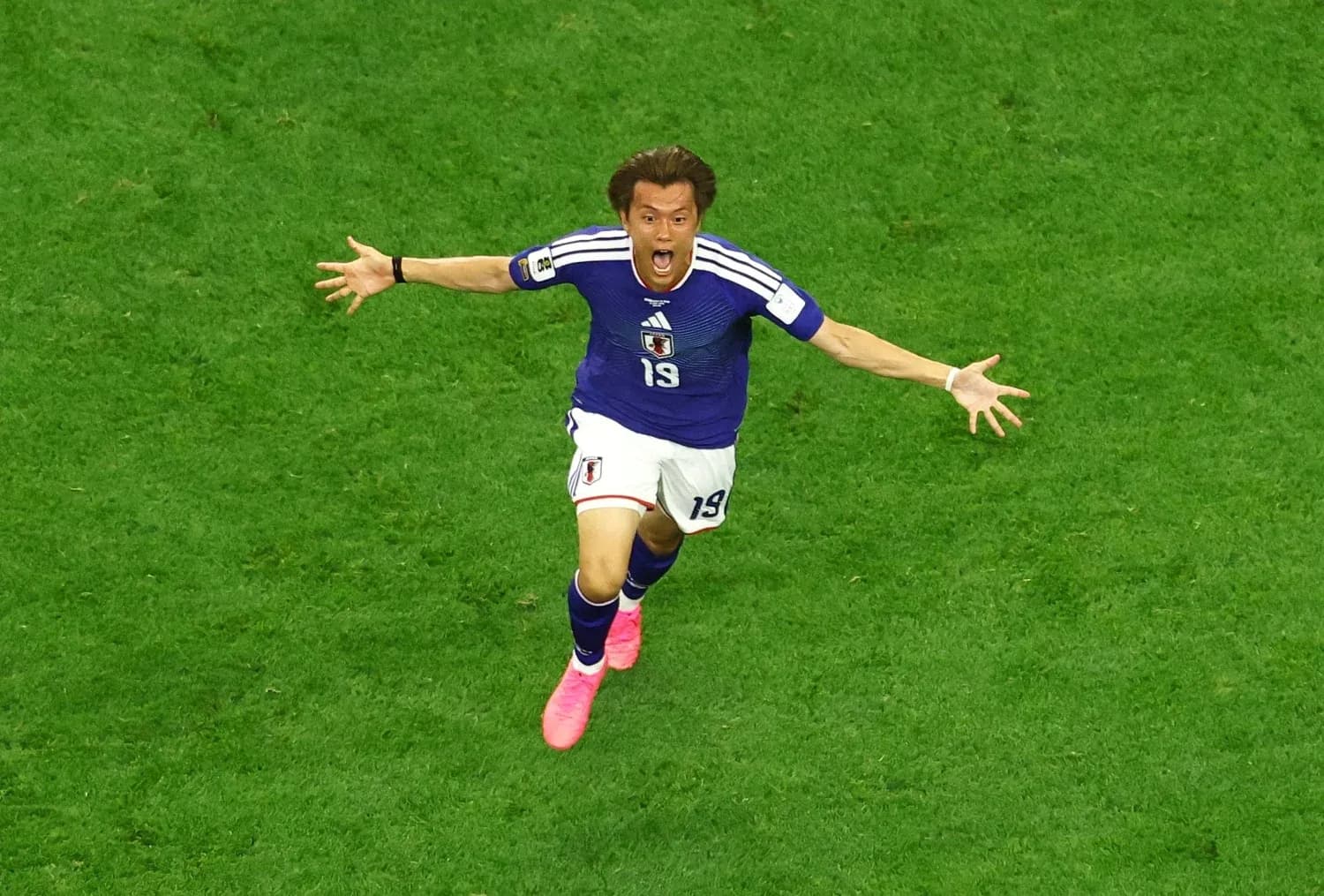
Japan’s equaliser on 57 minutes, through Keito Nakamura from a Takefusa Kubo assist, was a direct rebuttal to Dutch control. Moriyasu’s 3-4-2-1, with Daichi Kamada and Kubo floating behind Ayase Ueda, was designed to spring quickly once possession was regained. With only 40% of the ball and 10 shots (six inside the box, four outside), Japan accepted long spells without possession, then attacked quickly into the spaces behind Dumfries and van de Ven. The structure of the back three – Tsuyoshi Watanabe, Shogo Taniguchi and Hiroki Itō – stayed narrow, inviting play wide and relying on the double pivot of Kaishu Sano and Kamada to screen central lanes before triggering transition.
Second Half
Crysencio Summerville’s goal on 64 minutes, again supplied by Gravenberch, was the most coherent expression of Dutch wing play. From his right-sided role, Summerville profited from the overloads created when Dumfries pushed high and the right-sided midfielder (often Gravenberch rotating out) drew Japan’s wing-back inside. That pattern forced Japan’s outside centre-backs to make difficult decisions: step out and leave gaps in the line, or hold and concede time and space for deliveries or combinations. The fact that Netherlands produced six shots on goal from only 10 attempts, all in the box, shows how often those patterns ended with clear looks rather than half-chances.
Substitutions
Moriyasu’s substitutions around the 66–75 minute mark were explicitly tactical, not merely fresh legs. Junya Ito (IN) came on for Daizen Maeda (OUT) at 66', adding more direct running on the right to pin van de Ven deeper and stretch the Dutch back line. At 75', Koki Ogawa (IN) replaced Kubo (OUT), and Takehiro Tomiyasu (IN) came on for Ritsu Doan (OUT), while Yukinari Sugawara (IN) replaced Watanabe (OUT). Collectively, those changes stiffened Japan’s right flank and added an extra aerial and physical presence in Ogawa, preparing for a more direct late-game phase. The payoff came at 89', when Kamada, assisted by Ogawa, found the equaliser – a textbook example of a substitute reshaping the attacking reference points.
Koeman’s own triple change at 70' was aimed at consolidating control and adding fresh dynamism: Teun Koopmeiners (IN) for Reijnders (OUT), Quinten Timber (IN) for Summerville (OUT), and Memphis Depay (IN) for Donyell Malen (OUT). Later, Nathan Aké (IN) for Gravenberch (OUT) at 81' hinted at a desire to secure the left side defensively and manage the final minutes, while Brian Brobbey (IN) for Cody Gakpo (OUT) at 85' gave a more physical focal point up front. These moves nudged Netherlands slightly towards a 4-2-3-1 in phases, with Koopmeiners closer to de Jong and Depay dropping between the lines, but they did not prevent Japan from finding late space.
Discipline
Discipline played a subtle but telling role in the game’s rhythm. Netherlands collected three yellow cards, all with precise tactical context. At 61', Summerville (Netherlands) was booked — Foul — moments after his earlier attacking influence, a sign of the forwards’ responsibility in counter-pressing when possession was lost. At 83', Depay (Netherlands) received a yellow — Foul — illustrating the increased defensive workload on the attacking substitutes as Japan pushed forward. Finally, at 90+1', van de Ven (Netherlands) was cautioned — Professional foul — a classic late-game intervention to halt a dangerous transition, underlining how Japan’s threat in open field persisted to the end. Japan, by contrast, finished without a single card, consistent with their compact, reactive defensive posture and measured approach in duels.
Goalkeeping
In goal, Bart Verbruggen (Netherlands) and Zion Suzuki (Japan) each had distinct workloads. Netherlands’ statistics show one goalkeeper save and 0.62 goals prevented, indicating Verbruggen (Netherlands) faced relatively few on-target efforts but still added measurable value through positioning and shot-stopping in high-leverage moments. Japan’s data credits four goalkeeper saves and 0.62 goals prevented, reflecting Suzuki’s (Japan) heavier involvement as Netherlands converted possession into six shots on goal. The identical goals prevented values despite different shot volumes highlight how both keepers influenced the outcome in their own ways: Suzuki (Japan) through repeated interventions, Verbruggen (Netherlands) through efficiency on fewer but still dangerous attempts.
Passing Figures
The passing figures reinforce the tactical storyline. Netherlands completed 464 of 525 passes (88%), a high-precision display that underpinned their territorial dominance and ability to move Japan’s block side to side. Japan, with 287 accurate passes from 342 (84%), were more selective but still tidy enough to launch structured counters rather than hopeful clearances. With fouls level at 7–7 and blocked shots at 1–1, the game was not defined by attritional defending but by how each side managed space: Netherlands by compressing and circulating, Japan by absorbing and springing forward.
Conclusion
Ultimately, the statistical verdict matches the eye test. Netherlands’ higher possession, more shots on goal and superior pass volume speak to control, yet the modest xG of 0.79 shows they struggled to translate that dominance into a steady stream of clear chances. Japan’s 0.54 xG from fewer, more transition-based attacks underscores their efficiency and threat in broken play. The 2-2 scoreline, with both sides scoring twice from relatively low xG, reflects clinical finishing layered on top of a finely balanced tactical contest where neither overall form nor defensive index clearly outstripped the other.