Spain Triumphs Over Argentina in World Cup Final
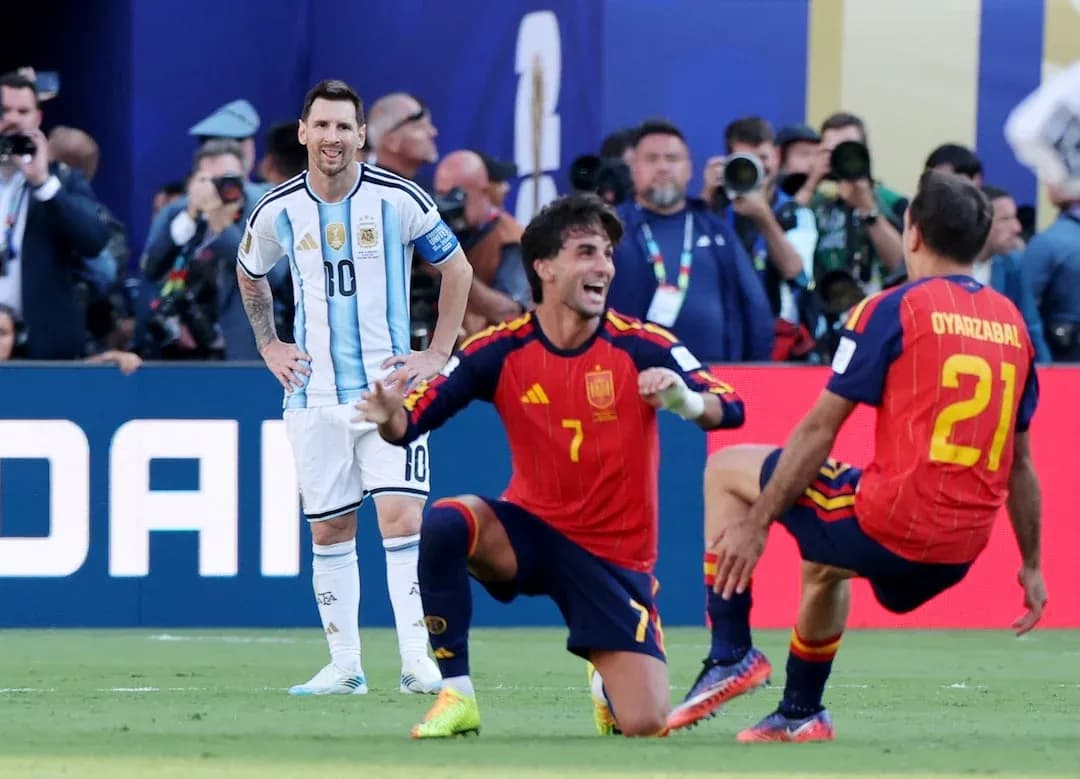
Under the lights of MetLife Stadium, a World Cup Final stretched to 120 minutes distilled the identities of Spain and Argentina as clearly as any pre-match data sheet ever could. Spain, crowned champions after a 1–0 extra-time win, arrived as the tournament’s most controlled machine; Argentina as its most explosive and volatile force. The final scoreline, and the way it was reached, was the logical collision of those two seasonal stories.
Spain's Campaign
Heading into this game, Spain’s campaign had been defined by control and denial. Overall they had played 8 matches, winning 7 and drawing 1, without a single defeat. Across the tournament they scored 14 goals in total and conceded just 1, an extraordinary defensive record underlined by 7 clean sheets overall. At home they had averaged 2.0 goals for and 0.2 against, and on their travels 1.3 scored with 0.0 conceded, but the real pattern was psychological: this was a team that almost never allowed chaos.
Argentina's Profile
Argentina, by contrast, thrived on it. They also came in with 7 wins from 8 fixtures overall, but their profile was far more combustible: 19 goals scored in total, 8 conceded. At home they averaged 2.8 goals for and 1.0 against; away, 1.7 scored and 1.0 conceded. Their goal difference overall in the group stage alone was 7 (8 scored, 1 conceded), compared to Spain’s 5 (5 scored, 0 conceded), but over the full tournament Spain’s defensive edge became the more decisive factor.
Tactical Setup
Luis de la Fuente doubled down on that identity with his starting XI and shape. Spain’s 4-2-3-1, the formation they had used in 6 of their 8 tournament lineups, was rolled out again: Unai Simón behind a back four of Pedro Porro, Pau Cubarsí, Aymeric Laporte and Marc Cucurella. Ahead of them, Rodri and Fabián Ruiz formed the double pivot, with Lamine Yamal, Dani Olmo and Álex Baena supporting Mikel Oyarzabal as the lone forward.
This structure was not just about possession; it was about territorial suffocation. Rodri’s role was to dictate tempo and close central lanes into Lionel Messi, while Fabián Ruiz could step higher to connect with the advanced trio. Lamine Yamal’s starting position in the right half-space, with Porro overlapping outside him, threatened Argentina’s left and forced Nicolás Tagliafico to choose between tucking in to protect Lisandro Martínez or stepping out to meet the winger.
Argentina answered with Lionel Scaloni’s trusted 4-4-2, a shape that had underpinned 5 of their 8 lineups in the competition. Emiliano Martínez started in goal, with Gonzalo Montiel, Cristian Romero, Lisandro Martínez and Nicolás Tagliafico forming a back four built for aggressive duels. In midfield, Rodrigo de Paul and Enzo Fernández patrolled the central channels, Alexis Mac Allister and Nicolás González worked the flanks, and up front the burden fell on Messi and Julián Álvarez.
Discipline and Timing
The tactical void for Argentina was discipline and defensive timing. Over the tournament they had taken most of their yellow cards late: 33.33% between 91-105 minutes and 20.00% from 106-120, with further clusters at 31-45, 46-60 and 76-90 minutes. They also had a red card in the 91-105 range. Spain, by contrast, were calm until the game stretched; their yellow cards were split between 31-45 minutes (33.33%) and 91-105 (50.00%), with almost nothing in the other ranges. In a final that went to extra time, that divergence in late-game discipline was always going to matter.
Bench Strength
On the personnel front, there were no official absences listed, which meant both coaches had their full bench of specialists. For Spain, that included attacking changes such as Ferran Torres, Borja Iglesias, Nico Williams and Yeremy Pino, plus structural options like Martín Zubimendi and Mikel Merino to reinforce midfield control. Argentina’s bench offered a different kind of volatility: Leandro Paredes as an enforcer, Exequiel Palacios and Thiago Almada as creative midfielders, Lautaro Martínez and Giovanni Simeone as penalty-box predators, and Valentín Barco as a disruptive wide option.
The Hunter vs Shield Duel
The “Hunter vs Shield” duel was stark. On one side stood Messi, the competition’s leading scorer and creator: 8 goals and 4 assists, 28 shots with 18 on target, 26 key passes and 27 successful dribbles from 38 attempts. Yet his penalty record in this tournament was fragile: 0 scored from 2 attempts, with 2 misses. Alongside him, Lautaro Martínez mirrored that strange efficiency profile in the top-scorer and top-assist tables, also listed with 8 goals, 4 assists and 2 penalties missed. Argentina’s season-long penalty record of 3 taken, 1 scored and 2 missed (33.33% conversion) underlined a genuine fault line.
Facing them was Spain’s collective shield. Conceding just 1 goal in 8 matches overall, with 4 home and 3 away clean sheets, they had built a system where Rodri’s screening and Laporte’s positioning reduced the volume and quality of shots reaching Unai Simón. Their biggest home win of 4-0 and away of 0-2 showed they could stretch games, but their defining trait was control of risk.
The Engine Room Matchup
In the “Engine Room” matchup, Enzo Fernández and Rodrigo de Paul were tasked with disrupting Spain’s metronome. Enzo arrived as one of Argentina’s most combative figures: 512 completed passes at 93% accuracy, 11 tackles, 1 block and 5 interceptions, but also 12 fouls committed and a yellow plus yellow-red combination across the tournament. His aggression was an asset and a liability against a Spain side that thrives on drawing opponents into late challenges between the lines. De Paul’s shuttling had to cover the half-spaces where Olmo and Baena operate, while Mac Allister’s positioning without the ball was critical in preventing Rodri from dictating unopposed.
Spain’s own hunter was Oyarzabal. With 5 goals and 1 assist across 8 appearances, 21 shots and 12 on target, he offered a different profile: less volume than Messi, but ruthless off the ball. His movement across the front line in this 4-2-3-1, drifting left to combine with Cucurella or dropping off to link with Olmo, was designed to drag Romero and Lisandro Martínez out of their ideal dueling zones. Once those centre-backs are forced to defend space rather than bodies, Lamine Yamal’s 1v1 threat and Baena’s late runs become more dangerous.
Statistical Prognosis
Statistically, the prognosis before a ball was kicked pointed to a tight, attritional final rather than a shootout. Spain’s overall averages of 1.8 goals for and 0.1 against suggested that even against Argentina’s 2.4 goals for and 1.0 against, the game would be pulled toward Spain’s tempo. Argentina’s vulnerability lay not only in conceding 8 goals overall but in their disciplinary curve and penalty inconsistency. In a match expected to be decided by fine margins, a side that had missed 2 penalties in the tournament and taken a red card late in a game was always walking a narrower line.
The Final Unfolds
The final unfolded along those predicted contours. Spain imposed their structure, Argentina searched for moments of individual brilliance, and as the minutes ticked into extra time, the calmer, more controlled side found the decisive breakthrough. Following this result, Spain’s defensive masterpiece of a campaign — 8 wins from 9 in all, just 1 goal conceded before the final and a clean sheet on the biggest stage — stands as the tactical backbone of their world title, while Argentina’s glorious volatility finally met a system it could not quite unhinge.