Spain's Tactical Domination in World Cup Final Victory
Spain’s 1-0 extra-time win over Argentina in the World Cup Final at MetLife Stadium was a tactical domination built on control, structure and relentless territorial pressure. Across 120 minutes, Spain turned a 4-2-3-1 into a suffocating positional machine, pinning a 4-4-2 Argentina so deep that the South Americans failed to register a single shot on target. The statistical profile — 65% possession, 20–2 shots, 1.94 vs 0.22 xG — underlines how comprehensively Luis de la Fuente’s side imposed their game, and how long Lionel Scaloni’s team were forced into pure survival mode before finally conceding in extra time.
I. Executive Summary
Spain’s structure with Rodri and Fabián Ruiz as the double pivot set the tone: calm circulation, constant recycling and early occupation of Argentina’s defensive line. The full-backs, Pedro Porro and Marc Cucurella, pushed high to lock Argentina’s wingers back, while Lamine Yamal and Alex Baena (then Nico Williams) attacked the half-spaces around Argentina’s compact 4-4-2 block. Spain’s pressing and counter-pressing were aggressive but controlled, accepting fouls (21) as the cost of territorial dominance.
Argentina, by contrast, were reactive from the outset. The 4-4-2 with Lionel Messi and Julián Alvarez up front was intended to offer transition threat, but the team’s inability to keep the ball — 463 passes at 77% accuracy to Spain’s 852 at 89% — meant the forwards were largely isolated. As the match wore on, Scaloni’s substitutions and a series of cards, culminating in Enzo Fernández’s dismissal, shifted Argentina further into a damage-limitation posture.
II. Scoring Sequence & Disciplinary Log
There was only one goal, but the card and substitution pattern reveals the tactical story.
Discipline, chronologically (using played minutes + extra time):
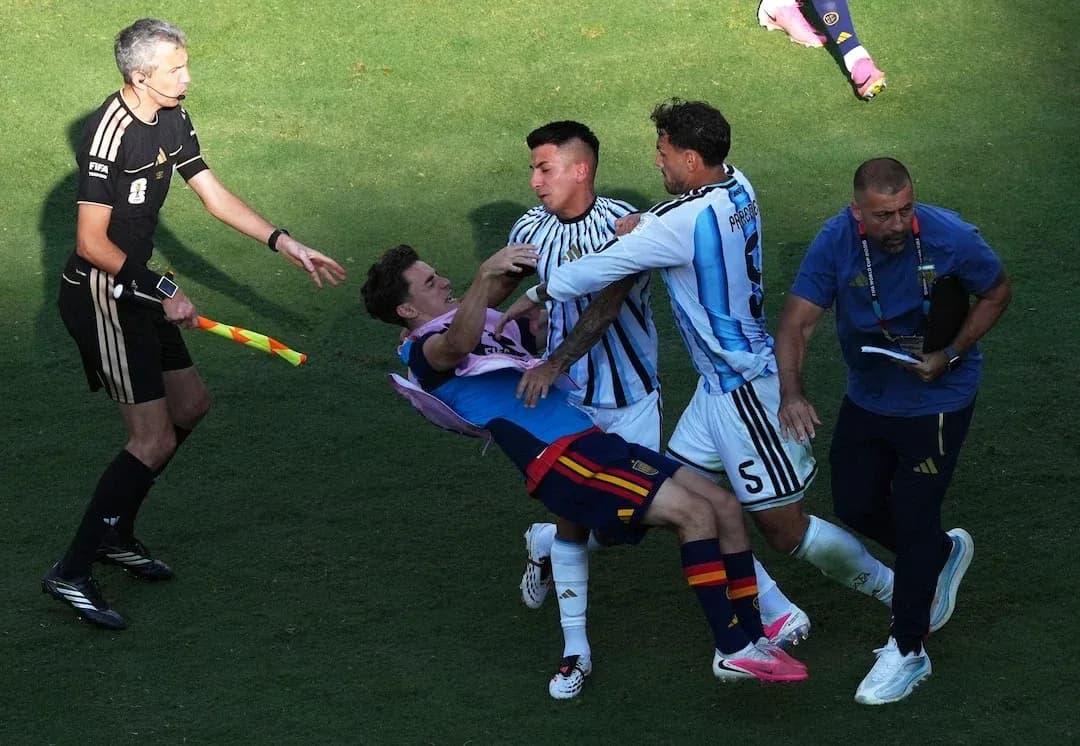
- -5' Cristian Romero (Argentina) — Yellow Card, Argument. A pre-kickoff flashpoint that foreshadowed Argentina’s emotional, confrontational approach.
- 41' Lisandro Martínez (Argentina) — Yellow Card, Foul. Punished for stepping out aggressively from the back line to break Spain’s between-the-lines play.
- 52' Leandro Paredes (Argentina) — Yellow Card, Unsporting behaviour. Reflects mounting frustration as Spain’s control grew.
- 83' Enzo Fernández (Argentina) — Yellow Card, Argument. Another emotional reaction under sustained pressure.
- 90+3' Enzo Fernández (Argentina) — Yellow Card, Foul.
- 90+3' Enzo Fernández (Argentina) — Red Card, Foul. The second caution and subsequent dismissal left Argentina to navigate extra time with ten men.
- 111' Alexis Mac Allister (Argentina) — Yellow Card, Foul. A late, tired challenge in a phase where Spain were managing the game and Argentina were chasing.
Total cards: Spain 0, Argentina 6 yellow cards and 1 red card, for 7 cards overall. The absence of any Spanish bookings underlines the asymmetry in emotional control and defensive burden.
Goal sequence (with running score):
- 106' Ferran Torres (Spain) — assisted by Nico Williams → Spain 1–0 Argentina. A decisive extra-time strike that finally converted Spain’s territorial and statistical superiority into a lead. The timing, after more than 100 minutes of dominance, reflects both Spain’s patience and Argentina’s gradual physical and numerical collapse.
III. Tactical Breakdown & Personnel
Spain (4-2-3-1)
Spain’s base structure was textbook positional play. Rodri and Fabián Ruiz formed a double pivot that constantly offered angles behind Argentina’s first line. With 852 passes and 89% accuracy, Spain built in short combinations, using Laporte and Pau Cubarsí as calm distributors, while Porro and Cucurella stretched the width.
Between the lines, Dani Olmo as the central attacking midfielder linked midfield to attack, while Lamine Yamal and Alex Baena initially, then Nico Williams, attacked the channels outside Argentina’s central midfielders. This created repeated 2v1s against the full-backs, forcing Argentina’s wide midfielders to retreat and flatten the 4-4-2 into a back six at times.
Spain’s shot profile — 20 total shots, 12 on goal, 9 from inside the box — shows how effectively they moved Argentina’s block laterally until spaces opened centrally. Three blocked shots and a 1.94 xG indicate not speculative long-range attempts, but high-quality entries into dangerous zones.
In possession, Spain’s rest defence was solid: Rodri and the centre-backs formed a triangle behind the ball, with Porro or Cucurella tucking in depending on the side of attack. That structure, combined with immediate counter-pressing, limited Argentina to just 2 shots (1 off target, 1 blocked) and 0.22 xG across 120 minutes.
Unai Simón (Spain) did not have to make a single save. Spain’s out-of-possession work — compact lines, early pressure on the ball-carrier, and disciplined defensive distances — meant Argentina rarely reached the final third in settled possession.
Substitutions from de la Fuente were about maintaining tempo and adding verticality. Pedri and Mikel Merino reinforced central control, Nico Williams added direct 1v1 threat and the assist for Ferran Torres, while Ferran’s own introduction gave a more penalty-box-oriented presence. Later, Martín Zubimendi and Eric García allowed Spain to keep defensive solidity and fresh legs for managing the lead in extra time.
Argentina (4-4-2)
Scaloni’s starting 4-4-2 aimed to combine defensive compactness with the transition threat of Messi and Julián Alvarez. However, with only 35% possession and 463 passes at 77% accuracy, Argentina spent most of the match defending deep.
The early yellow for Lisandro Martínez and the pre-match card for Romero hinted at a back line on edge. As Spain circulated the ball, Argentina’s midfield four were repeatedly forced to shuffle laterally, with Rodrigo De Paul and Enzo Fernández doing heavy defensive work. This defensive load contributed to late fouls and cards — especially Fernández’s double caution and red card at 90+3', which decisively shifted the balance in extra time.
Emiliano Martínez (Argentina) was central to Argentina’s resistance, making 11 saves. With Spain registering 12 shots on goal, his performance, combined with 1.81 goals prevented for Argentina, shows how much he delayed the inevitable. Argentina’s own offensive metrics — 0 shots on goal, 2 total shots, 4 corners, 1 offside — underline how rarely they could transition into threatening positions.
Substitutions reflected a gradual move from proactive to reactive: Otamendi for Lisandro Martínez and Nahuel Molina for Gonzalo Montiel aimed to refresh a stressed back line; Leandro Paredes and later Facundo Medina and Giuliano Simeone were attempts to add legs and possibly outlets, but the red card to Enzo Fernández forced Argentina into a low, narrow 4-4-1. In this shape, Messi and later other forwards were starved of service, and Argentina’s plan reduced to last-ditch defending and reliance on Emiliano Martínez.
IV. The Statistical Verdict
The numbers frame this final as one-sided in everything but the scoreline’s narrowness. Spain’s 65% possession, 20–2 shot count, 9–4 corner advantage and near-doubling of passes reflect sustained territorial siege. Their 1.94 xG versus Argentina’s 0.22 confirms that this was not sterile dominance; Spain created significantly more and better chances.
Defensively, Spain’s clean sheet with Unai Simón (Spain) making 0 saves is remarkable in a World Cup Final and speaks to their control of space and transitions. Argentina’s defensive resilience is equally evident: 11 saves from Emiliano Martínez (Argentina) and 1.81 goals prevented show how close Spain came to a wider margin.
Discipline was heavily tilted: Spain finished without a single card, while Argentina collected 6 yellows and 1 red. This imbalance reflects the strain on Argentina’s block, the constant need to break up Spain’s rhythm, and the emotional toll of defending for so long without an attacking outlet.
In tactical terms, Spain’s 4-2-3-1 outplayed Argentina’s 4-4-2 in all structural dimensions: build-up, occupation of half-spaces, rest defence and pressing. The late Ferran Torres winner simply aligned the scoreboard with a statistical and territorial reality that had been evident for most of the 120 minutes.