Spain Crowned World Champions After Extra Time Victory Over Argentina
Spain 1-0 Argentina (after extra time) at MetLife Stadium, East Rutherford, crowns Spain as world champions after a tense World Cup Final in which their territorial control and patience on the ball eventually broke Argentina’s resistance. Spain, who came through the tournament as group winners from Group H, add a World Cup title to their modern-era honours, while Argentina’s bid to retain the trophy falls one step short despite another deep run from the Group J winners.
Match Report
The final unfolded as a war of attrition more than a spectacle of chances, with the key incidents compressed into a handful of decisive moments.
At 41' Argentina collected the first card of the evening: Lisandro Martínez (Argentina) — yellow card (Foul) after a late challenge as Spain tried to accelerate through midfield.
Three minutes later, at 44', Argentina were forced into a defensive reshuffle when Nicolás Otamendi replaced Lisandro Martínez (Argentina), the booked centre-back making way before half-time, hinting at concerns over both his fitness and disciplinary risk.
On the stroke of the interval at 45', Argentina made a second change in the front line: Leandro Paredes replaced Nicolás Iván Gonzalez (Argentina), adding an extra controller in midfield to cope with Spain’s growing dominance of possession.
Early in the second half, Argentina’s discipline continued to fray. At 52' Leandro Paredes (Argentina) — yellow card (Argument) was cautioned after protesting a decision, underlining the pressure Spain’s sustained ball circulation was exerting.
At 58' Argentina adjusted again on the right side of defence, with Nahuel Molina replacing Gonzalo Montiel (Argentina), seeking fresher legs to handle Lamine Yamal’s threat and Spain’s overlapping full-backs.
Spain responded with a double attacking change at 62' to inject more penetration. Ferrán Torres replaced Mikel Oyarzabal (Spain), and in the same minute Pedri replaced Fabián Ruiz (Spain), giving Luis de la Fuente additional creativity between the lines and more direct movement in the front line.
Argentina’s back line was further reconfigured at 70' when Facundo Medina replaced Cristian Romero (Argentina), and moments later Giuliano Simeone Baldini replaced Rodrigo De Paul (Argentina), a bold move that traded midfield industry for extra attacking presence as Scaloni searched for an out-ball against Spain’s pressure.
Spain matched those alterations with another double substitution at 75'. Nico Williams replaced Alejandro Baena Rodríguez (Spain), adding 1v1 dribbling threat from wide areas, while Mikel Merino replaced Daniel Olmo Carvajal (Spain) to refresh the interior midfield role and maintain the high pressing tempo.
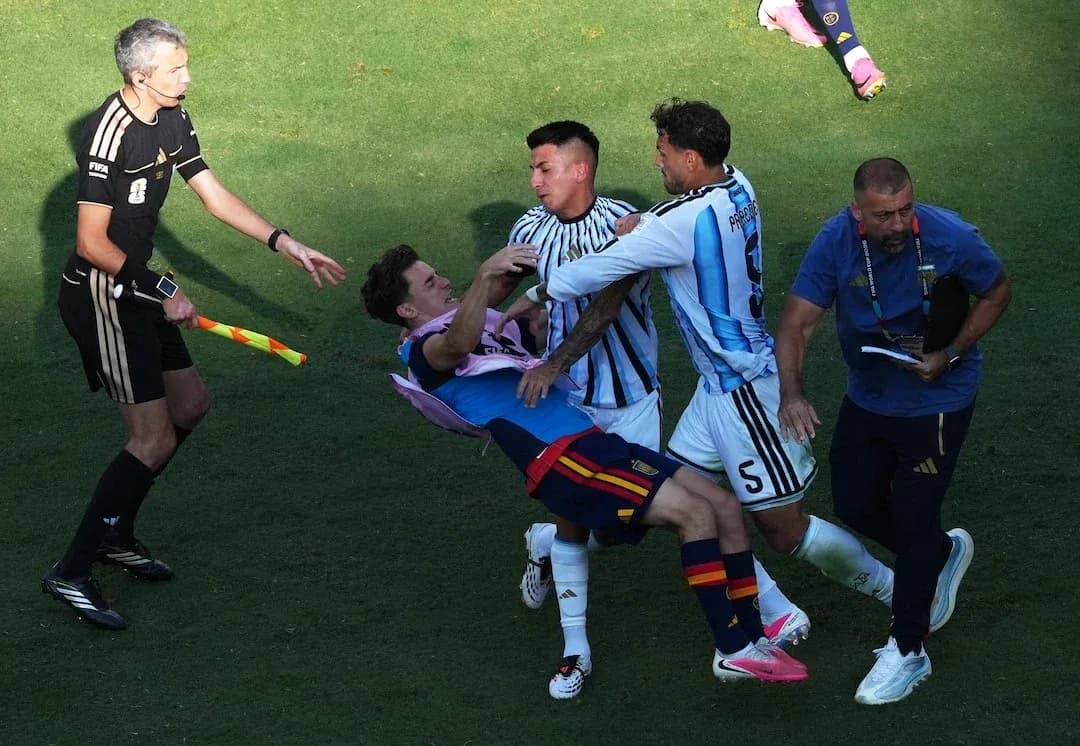
Argentina’s frustrations resurfaced at 82' when Enzo Fernández (Argentina) — yellow card (Dissent) went into the book for protesting, and again deep into stoppage time of normal play at 90+2' Cristian Romero (Argentina) — yellow card (Dissent) was cautioned from the bench after earlier being substituted, reflecting the emotional strain on the Albiceleste camp as Spain continued to dictate the ball.
With the match goalless after 90 minutes, extra time began with Spain tightening their structure. At 99' Martín Zubimendi replaced Rodrigo Hernandez Cascante (Spain), and Eric García replaced Aymeric Laporte (Spain), reinforcing the defensive base and ensuring fresh legs to defend transitions while still allowing Spain to keep their high line and aggressive rest defence.
Argentina’s response at 102' was an attacking roll of the dice: Marcos Senesi replaced Julián Álvarez (Argentina), a surprising like-for-like in terms of personnel positions that nevertheless suggested Scaloni wanted additional aerial and set-piece security while pushing other players higher up.
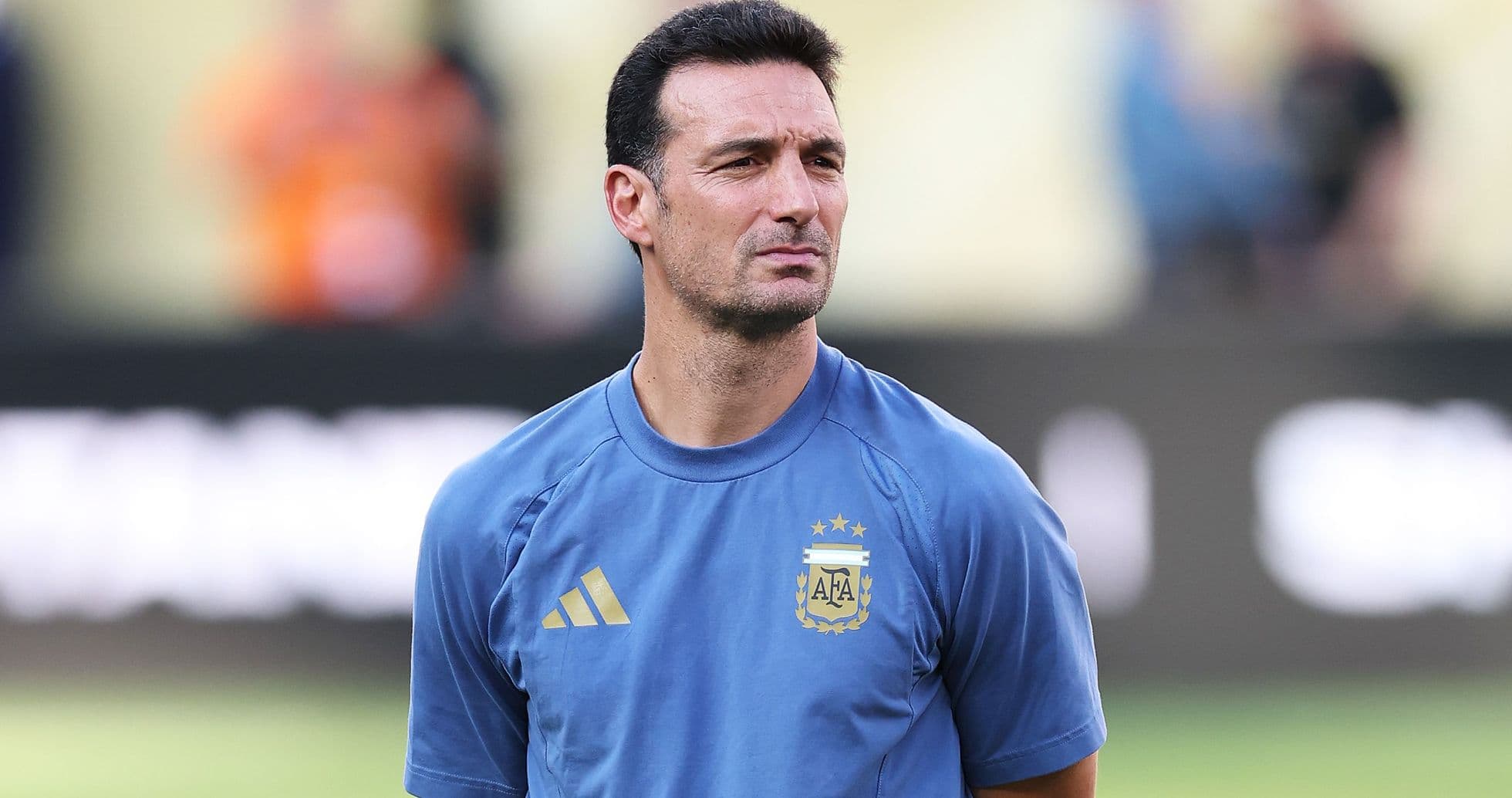
The tension on the touchline finally spilled over at 104' when Lionel Sebastián Scaloni (Argentina) — yellow card (Dissent) was booked, the Argentina coach punished for his protests as Spain continued to pen his team in.
The decisive moment arrived at 106' Spain goal — Ferrán Torres (assisted by Nico Williams). Williams, introduced earlier to stretch the Argentine defence, drove at his full-back on the flank before delivering a low, precise ball into the box, where Ferrán Torres timed his run perfectly to finish from close range. The goal, coming at the start of the second period of extra time, gave Spain a 1-0 lead and finally converted their territorial superiority into a tangible advantage.
Argentina, forced to chase the game, pushed numbers forward but continued to struggle to create clear chances. Their frustration culminated again at 111' when Alexis Mac Allister (Argentina) — yellow card (Foul) was booked for a late challenge as Spain managed the tempo and broke up any Argentine momentum. Spain then saw out the remaining minutes with controlled possession and structured pressing, conceding almost no threat en route to securing the 1-0 extra-time victory.
Fixture Statistics & Tactical Audit
- xG: — not provided for either side
- Possession: Spain 65% vs 35% Argentina
- Shots on Target: Spain 12 vs 0 Argentina
- Goalkeeper Saves: Spain 0 vs 11 Argentina
- Blocked Shots: Spain 3 vs 1 Argentina
The statistical profile underlines how one-sided the contest became in terms of territory and shot quality, even if the scoreline remained narrow. Spain were dominant (65% possession) in their usual positional play structure, circulating the ball through Rodri and later Zubimendi, and repeatedly creating shooting opportunities from both inside (9 attempts) and outside the box (11 attempts). Their 12 shots on target forced Emiliano Martínez into 11 saves, illustrating how often Spain managed to work clean looks at goal rather than speculative efforts.
Argentina, by contrast, were extremely limited (only 2 total shots, 0 on target), a reflection of Spain’s effective rest defence and counter-press. The Albiceleste struggled to connect their midfield to Lionel Messi and Julián Álvarez, frequently losing the ball under Spain’s pressure and rarely progressing through central zones. Their four corners and a near parity in free kicks (21 to Spain’s 23) hint at some set-piece opportunities, but they never translated into meaningful attempts on goal.
Without explicit xG numbers, the shot volume and on-target data still point to a result that was more than fair. Spain’s performance was clinical in chance suppression (0 shots on target conceded) and persistent in chance creation (12 on target), while Argentina’s low output underscores how comprehensively their attacking patterns were disrupted.
Standings Update & Seasonal Impact
Spain entered the knockout phase from Group H with 7 points, 5 goals scored and none conceded. Adding this 1-0 win in the Final moves them to 10 points in their overall World Cup campaign, with new figures of 6 goals for, 0 against and a goal difference of +6. Beyond the raw numbers, this victory confirms Spain’s evolution from group-stage frontrunners into world champions, validating Luis de la Fuente’s commitment to a possession-heavy, high-pressing model on the biggest stage.
Argentina arrived as Group J winners with 9 points, 8 goals scored and just 1 conceded. Defeat here leaves them on 9 points overall in the tournament, with their new totals at 8 goals for, 2 against and a goal difference of +6. Statistically, they still close the campaign with an impressive defensive record, but the Final exposed limitations against elite, ball-dominant opposition: their attack, so prolific in earlier rounds, was completely stifled, and they finish as runners-up rather than back-to-back champions.
Lineups & Personnel
Spain Starting XI
- GK: Unai Simón
- DF: Pedro Porro, Pau Cubarsí Paredes, Aymeric Laporte, Marc Cucurella
- MF: Rodri, Dani Olmo, Fabián Ruiz, Álex Baena
- FW: Lamine Yamal, Mikel Oyarzabal
Argentina Starting XI
- GK: E. Martínez
- DF: G. Montiel, C. Romero, Lisandro Martínez, N. Tagliafico
- MF: R. De Paul, E. Fernández, A. Mac Allister
- FW: N. González, L. Messi, J. Álvarez
Post-Match Verdict
Spain’s triumph was built on structural superiority rather than moments of individual brilliance. Their display was dominant (65% possession, 20 total shots to 2) in controlling territory and tempo, and clinical in defensive organisation (0 shots on target conceded), ensuring that Unai Simón was effectively a spectator. The full-backs’ advanced positioning, combined with a rotating midfield triangle, pinned Argentina deep and allowed repeated waves of attacks that eventually wore down the Albiceleste block.
Argentina’s performance, by contrast, was vulnerable in ball progression (only 463 total passes to Spain’s 852, with 358 accurate) and toothless in attack (2 shots, 0 on target). Their frequent disciplinary issues — five yellow cards to Spain’s none — reflected a team increasingly reactive, resorting to fouls and dissent as they chased shadows. Emiliano Martínez’s 11 saves kept the scoreline respectable, but they also highlighted how much Argentina relied on last-line heroics rather than collective control.
In the end, Ferrán Torres’s extra-time winner, crafted by Nico Williams, was the logical conclusion of a match Spain had largely owned. The champions married their traditional possession identity with an aggressive press and deep squad utilisation, while Argentina’s attempt to sit compact and counter never truly materialised. On balance of play and numbers, Spain’s 1-0 victory after extra time was a deserved coronation.