France vs England: Tactical Analysis of World Cup 3rd Place Final
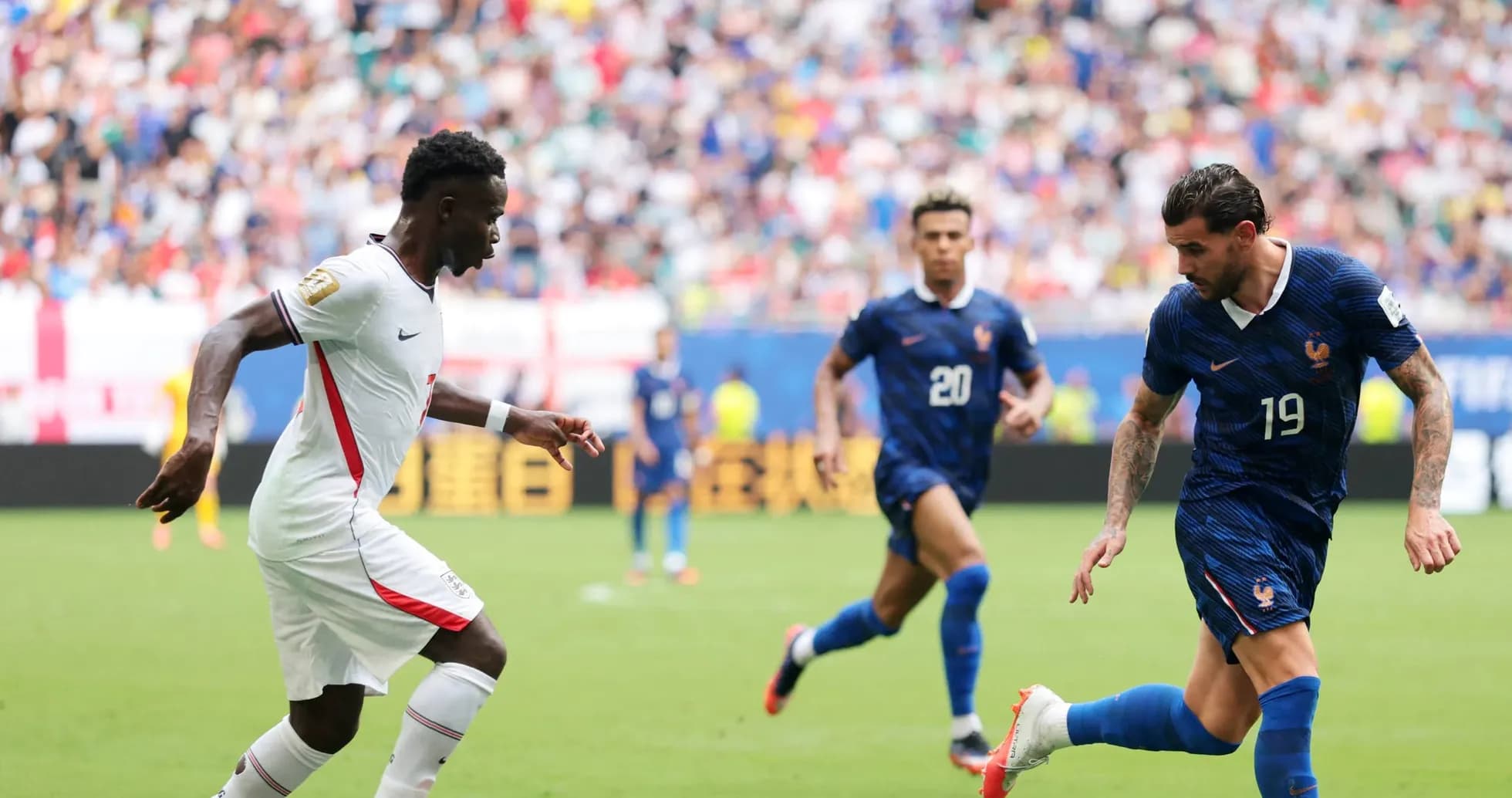
France’s 6-4 defeat to England in the World Cup 3rd Place Final at Hard Rock Stadium, Miami Garden was shaped less by volume of chances than by structure, transitions, and how each side managed extreme game states. Both teams finished with 19 total shots, yet England’s early control, superior penalty-box occupation, and game-management around the interval created an advantage France’s late surge could not fully overturn.
England’s Tactical Approach
England’s approach without the ball was the first major tactical hinge. With Thomas Tuchel on the bench, England accepted France having slightly less of the ball (France 46% possession, England 54%) but focused on compressing the central lane in front of the back four. Declan Rice anchored the midfield, screening passes into Kylian Mbappé’s feet and forcing France to circulate laterally. The impact showed in shot geography: England produced 16 shots inside the box to France’s 12, turning similar overall shot volume into higher-quality, closer-range looks.
First Half Overview
The first half was defined by England’s efficiency and France’s structural looseness. England struck after just 3 minutes through Rice, capitalising on France’s slow defensive staggering in front of the back line. Ezri Konsa’s goal at 18 minutes, again from an England player stepping into a gap, underlined how France’s midfield unit – Warren Zaïre-Emery and Adrien Rabiot ahead of an unprotected back four – struggled to track late runs and second balls around the box.
Bukayo Saka’s double (37’ and 45+1’) exposed France’s wide coverage. With Djed Spence and Saka combining down the right and Marcus Rashford drifting inside, France’s left side, marshalled by Theo Hernández and Maxence Lacroix, was repeatedly overloaded. England’s 4-0 half-time lead matched the pattern of play: France’s back line was often pinned deep, while the midfield failed to prevent clean entries into the final third.
Half-Time Changes
Didier Deschamps’ response at the break was radical and decisive. Four substitutions at 46 minutes – Bradley Barcola (IN) for Désiré Doué (OUT), Ousmane Dembélé (IN) for Rayan Cherki (OUT), Dayot Upamecano (IN) for Ibrahima Konaté (OUT), and Lucas Digne (IN) for Theo Hernández (OUT) – effectively redrew France’s structure. The changes added directness on both flanks and greater defensive aggression in the first line of pressure.
Second Half Dynamics
The second half became a different match. With Dembélé and Barcola stretching England’s full-backs, Mbappé could operate more centrally between the lines rather than being isolated high. France’s xG of 2.87 across the 90 minutes reflects this shift: the bulk of their best chances came after the interval, driven by more vertical passing and higher regains. Michael Olise, now with better outlets ahead of him, became a key conduit between midfield and attack, supplying Mbappé’s goals at 48 and 66 minutes.
England, meanwhile, adjusted to protect the lead but never fully lost their offensive edge. Even as France tilted the field, England still generated 11 shots on target to France’s 9, reflecting their continued threat on the break and from structured attacks. The introduction of Jude Bellingham, Ollie Watkins, Elliot Anderson, and later Reece James and Trevoh Chalobah allowed England to refresh their pressing lines and maintain enough ball security to relieve pressure.
Goalkeeper Performances
In goal, Mike Maignan (France) and Dean Henderson (England) both had to live with open, chance-heavy phases. Maignan (France) made 4 saves with 0.05 goals prevented, numbers that underline how exposed he was by first-half defensive breakdowns rather than individual errors. Henderson (England) produced 5 saves and also 0.05 goals prevented, reflecting a performance where he absorbed France’s second-half surge without needing to deliver an extraordinary shot-stopping display; the defensive structure in front of him, particularly in the first half, had already done the heavy lifting.
Passing and Control
Passing data reveals how both sides tried to control tempo. France completed 405 of 445 passes (91%), England 467 of 515 (91%). The near-identical accuracy masks a subtle difference in usage: England’s higher pass count and greater share of possession reflect a more deliberate, circulation-heavy build-up, especially in the first half, while France’s passing became progressively riskier and more vertical as they chased the game. France’s 3 corner kicks to England’s 4 also hint at how England’s attacks more often reached the byline or forced last-ditch interventions.
Defensive Strategies
Defensively, France’s 14 fouls to England’s 8 point to a side frequently reacting rather than dictating. Many of these infringements came as France tried to halt England’s transitions or disrupt rhythm after turnovers. England, by contrast, defended more through positioning and compactness than constant duels, which helped them avoid disciplinary trouble and keep control of game flow.
Late Game Management
The late phases illustrated game-state management. At 4-3, with France surging, England drew a penalty that Saka converted on 87 minutes, a classic example of using individual quality to stabilise a wobbling game. Even when Dembélé pulled it back to 5-4 deep into added time, Bellingham’s late goal at 90+8’ reasserted England’s superiority in exploiting space once France had committed numbers forward.
Overall Analysis
Overall, the tactical story is of a match split in two: England’s first-half structural dominance and ruthless finishing built a margin that France’s second-half tactical correction and attacking quality could not quite erase. France’s attacking metrics – 19 shots, 9 on target, xG 2.87 – show how dangerous they became once the system was adjusted, but England’s balance between control (54% possession, 515 passes) and direct threat (16 shots in the box, 11 on target) ultimately defined a chaotic but deserved 6-4 win.