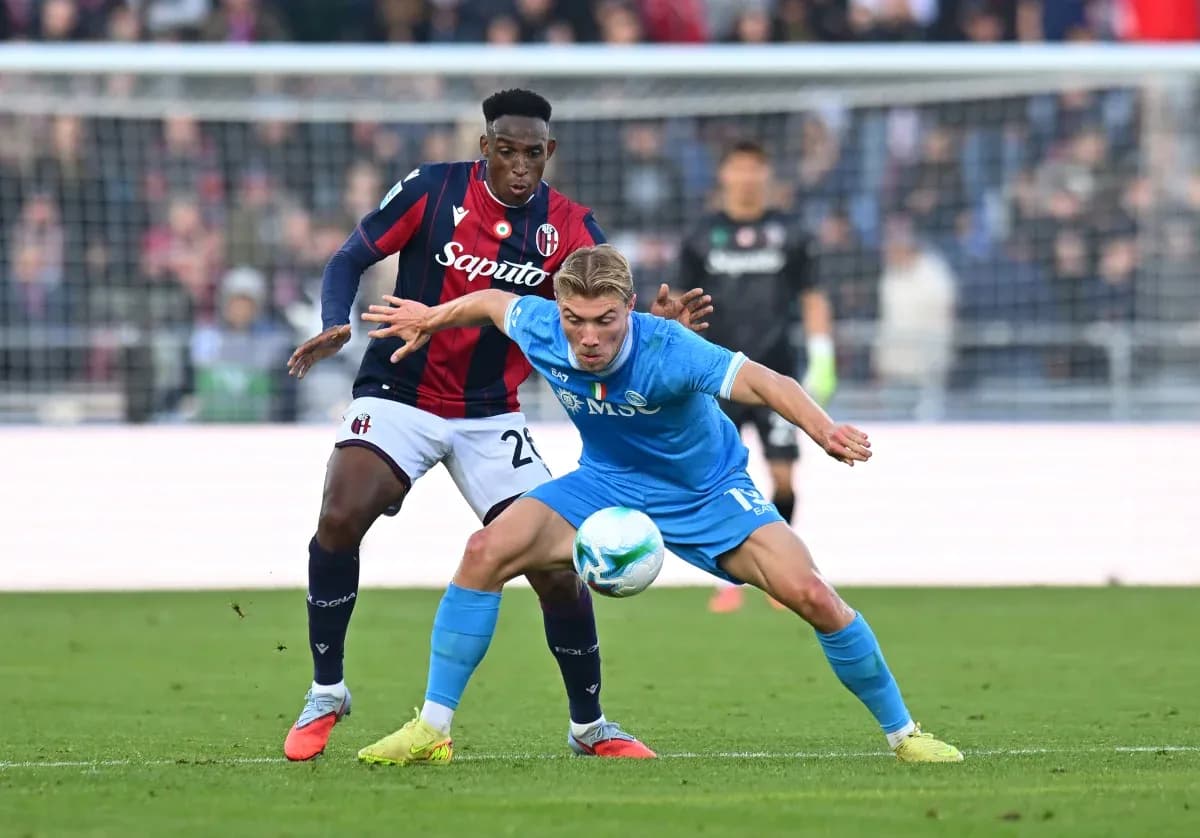
Napoli vs Bologna: Tactical Analysis of a Key Serie A Clash
Under the lights of Stadio Diego Armando Maradona, a title‑chasing Napoli side met an ambitious Bologna in a match that felt like a tactical stress test for both projects. Following this result, the 3–2 away win did more than dent Napoli’s push from 2nd place on 70 points; it underlined how Vincenzo Italiano’s structure can unpick even one of Serie A’s most balanced outfits, and how Antonio Conte’s evolving 3‑4‑2‑1 still has fault lines when exposed at full tilt.
I. The Big Picture: Structures, Stakes and Seasonal DNA
Napoli arrived with the confidence of a team whose overall campaign has been built on control and efficiency. Overall they have scored 54 goals and conceded 36, a goal difference of 18 that reflects a clean statistical spine: 1.5 goals scored on average in total, 1.0 conceded. At home, they have been even more ruthless, with 12 wins from 18, averaging 1.8 goals for and 1.0 against.
Conte doubled down on that identity with his preferred 3‑4‑2‑1: V. Milinkovic-Savic behind a back three of G. Di Lorenzo, A. Rrahmani and A. Buongiorno; a four‑man band of M. Gutierrez, S. McTominay, S. Lobotka and M. Politano across midfield; and a fluid attacking trident of Giovane and Alisson Santos tucked in behind R. Hojlund.
Bologna, 8th with 52 points and a modest overall goal difference of 2 (45 scored, 43 conceded), came to Naples with a very different seasonal profile: more volatile, more streak‑based, but dangerous on their travels. Away, they have taken 9 wins from 18, scoring 29 and conceding 23, with a punchy 1.6 goals scored on average on their travels. Italiano shifted from his usual 4‑2‑3‑1 to a 4‑3‑3: M. Pessina in goal; a back four of Joao Mario, E. Fauske Helland, J. Lucumi and J. Miranda; a midfield triangle of T. Pobega, R. Freuler and L. Ferguson; and a front three of R. Orsolini, S. Castro and F. Bernardeschi.
The scoreline at half-time – Napoli 1, Bologna 2 – told the story of the opening act: Bologna’s front three stretching the back three, and Napoli’s wing‑backs pinned deeper than Conte would have liked.
II. Tactical Voids: Absences, Discipline and Emotional Edges
Both managers were forced to redraw their attacking maps before a ball was kicked. Napoli’s list of absentees was brutal in terms of profile: David Neres (ankle injury), K. De Bruyne (eye injury) and R. Lukaku (hip injury) all missing this fixture. That stripped Conte of a natural wide one‑v‑one specialist, an elite final‑third passer and a pure penalty‑box reference point. The burden of creation shifted even more heavily onto M. Politano between the lines and S. McTominay’s late surges from midfield.
On the Bologna side, K. Bonifazi (inactive), N. Cambiaghi (muscle injury), N. Casale (calf injury) and M. Vitik (ankle injury) were all unavailable. The headline loss here was Cambiaghi, whose season includes 3 goals, 4 assists and a red card that underlines his aggressive edge. Without him, Italiano leaned into the technical craft of Orsolini and Bernardeschi rather than the more chaotic, dribble‑heavy threat Cambiaghi offers.
Disciplinary trends framed the emotional temperature. Heading into this game, Napoli’s yellow cards peaked in the 61–75 minute window at 31.91%, with a late‑game red‑card spike: 100.00% of their reds arriving between 76–90 minutes. Bologna, meanwhile, showed a similar tendency to boil over late, with 27.27% of their yellows between 61–75 minutes and 25.76% between 76–90, plus a red‑card distribution that stretches across almost every phase of the match. This was always likely to become a second‑half contest of nerves and control.
III. Key Matchups: Hunter vs Shield, Engine Room vs Enforcer
Hunter vs Shield: R. Hojlund vs Bologna’s back four
R. Hojlund came into this fixture as Napoli’s primary “hunter”: 10 league goals and 4 assists in 31 appearances, with 42 shots (22 on target) and 30 key passes. His game is built on vertical runs and physical duels – 299 duels contested, 107 won – and a willingness to stretch the last line.
Against him stood a Bologna defence that, overall, concedes 1.2 goals per match, but is more vulnerable away at 1.3 on their travels. Italiano’s choice of E. Fauske Helland and J. Lucumi as the central pairing was about managing Hojlund’s depth runs: one stepping into his back, one covering the space. With Joao Mario and J. Miranda tasked to squeeze Politano and Alisson Santos inside, Bologna essentially tried to funnel Napoli’s attacks into crowded central zones where R. Freuler and T. Pobega could collapse around the Dane.
The 3–2 scoreline suggests Hojlund and the supporting cast found moments, but Bologna’s structural plan – compressing the central lane, trusting their full‑backs in wide one‑v‑ones – ultimately forced Napoli into lower‑percentage shots and crosses rather than the clean, through‑ball finishes Conte prefers.
Engine Room: McTominay and Lobotka vs Freuler and Ferguson
The true battleground lay in midfield. S. McTominay, with 9 goals and 3 assists this season, is not a conventional holder; he is a vertical disruptor, with 69 shots, 28 tackles and 13 blocked shots. Next to him, S. Lobotka is the metronome, responsible for Napoli’s rhythm and rest‑defence positioning.
Bologna countered with R. Freuler as the screening pivot and L. Ferguson as the all‑action shuttler. Freuler’s job was clear: deny McTominay the ability to arrive unmarked into the box and cut passing lanes into Hojlund’s feet. Ferguson, meanwhile, was tasked with driving transitions the other way, exploiting the spaces that open when Napoli’s wing‑backs step high.
The first half, with Bologna scoring twice, showed that balance: every Napoli turnover in the middle third became a springboard for Orsolini and Bernardeschi to attack the channels outside Di Lorenzo and Buongiorno, forcing Rrahmani into uncomfortable wide duels.
On the flanks, M. Politano’s creative burden was heavy. With 5 assists, 36 key passes and 66 attempted dribbles (33 successful), he is Napoli’s leading chance‑creator. Bologna’s response was to shade Ferguson and Joao Mario toward his side, accepting that Giovane and Alisson Santos might see more ball on the opposite flank but betting that Politano was the real conduit they had to suffocate.
IV. Statistical Prognosis: xG Logic and Defensive Solidity
Even without explicit xG numbers, the season’s data allows a clear probabilistic read on how this match tilted.
Heading into this game, Napoli’s overall attacking profile – 1.5 goals per match in total, 1.8 at home – combined with Bologna’s away concession rate of 1.3 on their travels pointed toward Napoli generating the higher xG, especially through volume. Bologna’s own away scoring average of 1.6, though, hinted that every transition they crafted would carry real threat.
Napoli’s 13 clean sheets overall and Bologna’s 11 suggest both sides are capable of defensive discipline, but Bologna’s red‑card spread – with dismissals appearing in multiple time windows – and their late yellow‑card surges made it likely they would live dangerously in the closing stages. Conversely, Napoli’s tendency to pick up yellows between 61–75 minutes and their concentration of reds in the 76–90 window implied that if the match remained tight, Conte’s side might over‑commit emotionally.
The 3–2 Bologna win fits that statistical and tactical blueprint: a game where Napoli probably accumulated territorial dominance and shot volume, but where Bologna’s transitions, sharper in the key moments, translated into higher‑quality chances. Hojlund’s profile and Napoli’s home averages suggest their xG would have been strong, yet Italiano’s compact 4‑3‑3, anchored by Freuler and amplified by Orsolini’s cutting edge (9 goals, 4 penalties scored but 2 missed this season), found just enough clarity in front of goal.
Following this result, Napoli are reminded that even a side with a +18 goal difference overall and Champions League certainty cannot afford structural lapses against a travelling Bologna team that thrives in chaos. For Italiano, this is the template: disciplined mid‑block, ruthless in transition, and tactically flexible enough to bend the shape without breaking the core principles that made this 3–2 in Naples feel less like an upset and more like the logical extreme of Bologna’s season‑long away identity.