Mexico Dominates South Africa in World Cup Opener
Under the lights of Estadio Azteca, Mexico’s World Cup campaign began with the kind of controlled authority that turns an opening group game into a statement. In a Group A fixture that finished 2–0, Javier Aguirre’s side not only banked three points but also revealed a clear tactical identity: a 4-1-4-1 built on positional discipline, vertical running from midfield and a centre-forward willing to do the dirty work between the lines.
South Africa, lining up in a 5-3-2 under Hugo Broos, came to contain and counter. Instead, they left Mexico City bottom of the group, with a goal difference of -2 after conceding twice and failing to score, their back five stretched and their midfield eventually broken by Mexico’s rotations.
I. The Big Picture: Structure and Control
Following this result, Mexico sit top of Group A with 3 points and a goal difference of 2, having scored 2 and conceded 0 in total. Their season numbers so far mirror the scoreline: in total this campaign they average 2.0 goals for and 0.0 against, with their biggest result a 2–0 win at home – this very match. The clean sheet column already reads 1 in total, and the failed-to-score tally is still at 0.
South Africa’s reflection is harsher. On their travels they have played 1, lost 1, scored 0 and conceded 2, with an average of 0.0 goals for and 2.0 against in total. The only line in their “biggest” section that matters now is a 2–0 away defeat.
On the pitch, the numbers are given life by the shapes. Mexico’s 4-1-4-1 saw Érik Lira anchor the midfield, shielding a back four of I. Reyes, C. Montes, J. Vasquez and J. Gallardo, while the advanced line of R. Alvarado, B. Gutiérrez, Álvaro Fidalgo and J. Quiñones buzzed behind Raúl Jiménez. South Africa’s 5-3-2 placed R. Williams behind a line of five defenders, with T. Mokoena, Y. Sithole and J. Adams tasked with compressing central spaces and feeding the front pair of I. Rayners and L. Foster.
From the first whistle, Mexico used the Azteca’s width and altitude to suffocate. The lone pivot allowed the full-backs to step high, with Lira dropping between centre-backs when needed. South Africa’s wing-backs, K. Mudau and A. Modiba, were pinned back, turning the 5-3-2 into a flat back five.
II. Tactical Voids and Discipline
There were no listed injury absences, so both coaches had their full squads. The voids that emerged were tactical and emotional rather than medical.
Mexico’s only notable disciplinary blot in the early tournament data is a single yellow card arriving in the 16–30 minute window and a red card registered between 91–105 minutes across their season stats. In this match context, B. Gutiérrez embodies that edge: he collected 1 yellow card in his 66 minutes, committing 2 fouls while still producing 3 key passes. He played on the line between creator and risk, a theme for Aguirre’s midfield.
South Africa’s disciplinary profile is more alarming. Their season card distribution already shows yellow cards split evenly between 16–30 minutes (50.00%) and 61–75 minutes (50.00%), but it is the red cards that frame their narrative: 1 red between 46–60 minutes and another between 76–90 minutes. On the individual level, S. Sithole and T. Zwane both carry red cards in this World Cup. Sithole, who played 49 minutes, committed 3 fouls and blocked 2 shots before his dismissal; Zwane, on for 23 minutes, also saw red. The pattern is clear: when South Africa are stretched, they foul deep and they foul late, and it costs them.
That ill-discipline compounds tactical gaps. Once Sithole departed, Mokoena was left as an overworked “6–8 hybrid,” forced to both screen and build. Mexico’s substitutes – L. Chávez, G. Mora, E. Álvarez and A. Vega – entered into a game already tilting, adding fresh legs and secure passing (Chávez completed 28 passes at 100% accuracy; Mora 14 at 100%) against a tiring, numerically reduced midfield.
III. Key Matchups: Hunter vs Shield, Engine Room vs Enforcer
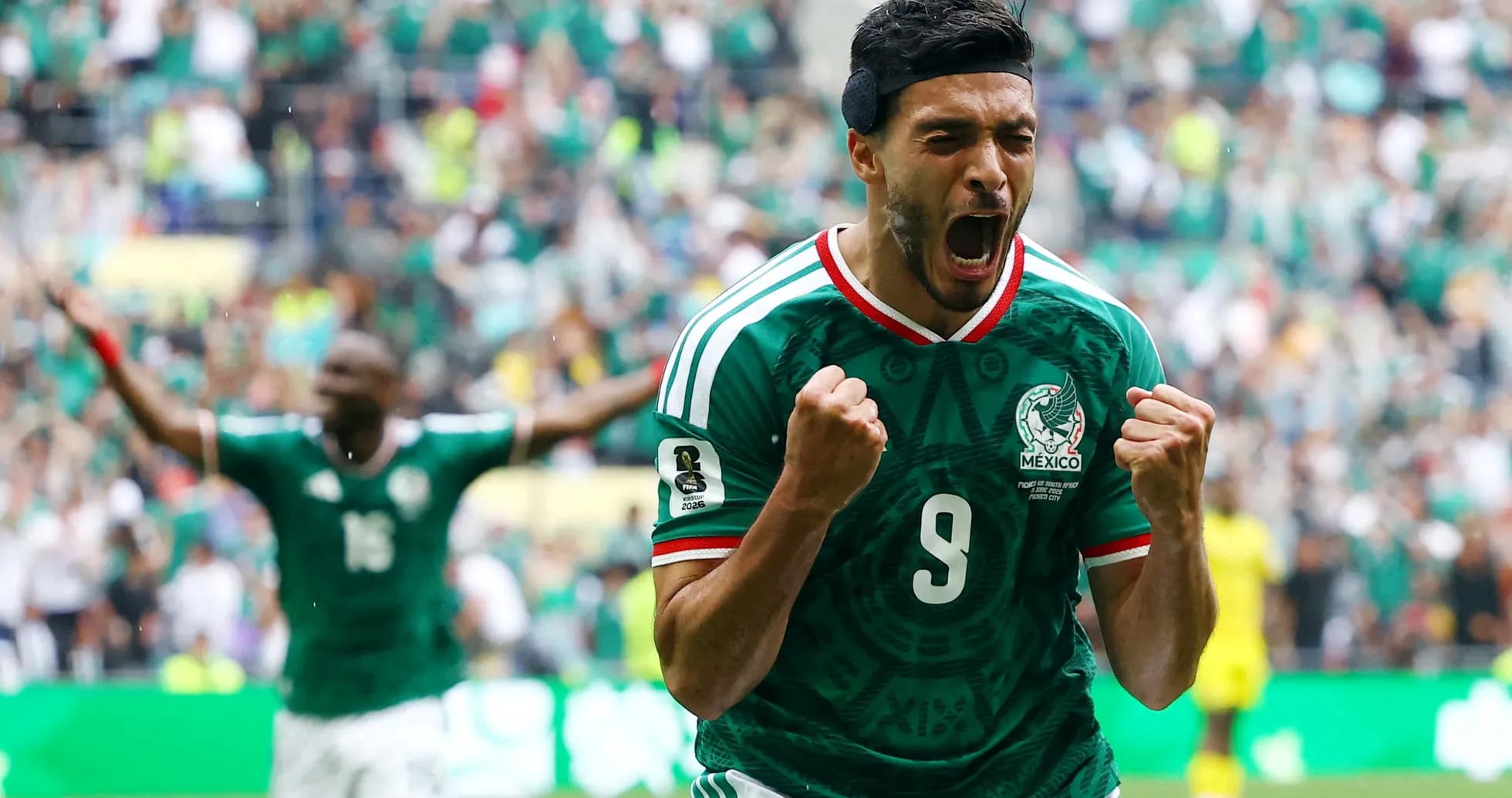
The headline duel was Raúl Jiménez against South Africa’s central defence. Jiménez’s numbers tell the story of a complete centre-forward performance: 1 goal from 3 shots (2 on target), 19 passes with 2 key passes, and 10 duels contested, 6 of them won. He did not just finish; he linked, screened and dragged defenders into zones they did not want to occupy.
Opposite him, Nkosinathi Sibisi was South Africa’s main defensive reference. He completed 50 passes at 82% accuracy and made 1 interception, but he also conceded 1 foul and took a yellow card. In a back five that should, in theory, compress the box, Jiménez repeatedly found half-spaces between Sibisi and I. Okon or M. Mbokazi, using his physical presence to pin the line and open corridors for runners.
If Jiménez was the hunter, the true architect was J. Quiñones. From the left half-space, Quiñones scored 1 goal, took 4 shots (2 on target), completed 33 passes at 84% with 2 key passes, and attempted 6 dribbles, succeeding with 5. His duel numbers – 10 contested, 7 won – underline how often he simply overpowered or outmanoeuvred South Africa’s right side. Mudau, Sibisi and Sithole were all dragged into uncomfortable, lateral footraces they could not win.
In the engine room, Érik Lira and Teboho Mokoena staged a subtler battle. Lira’s 45 passes at 93% accuracy, with 1 key pass and 1 assist, made him both metronome and launchpad. He read danger with 1 interception and won all 4 of his duels in the top-scorer data, then 5 of 5 in the assists dataset – an immaculate screening performance that allowed Mexico’s full-backs and interiors to commit forward.
Mokoena, by contrast, was firefighting. He still managed 42 passes at 92% accuracy, 1 key pass and 2 interceptions, and he won 4 of 7 duels. But too often he was isolated, forced to shuffle laterally as Sithole and Adams were pulled away or, in Sithole’s case, dismissed. The midfield zone that should have been South Africa’s first shield became a corridor for Mexico’s runners.
IV. Statistical Prognosis: What This Tells Us Going Forward
Following this result, the numbers sketch two divergent trajectories.
Mexico’s offensive efficiency – 2.0 goals per game in total, with no penalties taken and none missed – suggests a side creating and finishing from open play. With Jiménez already on 1 goal, and Quiñones adding another from midfield, Aguirre has dual threats: a penalty-box reference and a dribbling creator who can score from broken play. Behind them, Alvarado’s 35 passes at 91% accuracy, 2 key passes and 1 assist, plus 5 tackles and 9 duels won, mark him as the two-way winger every 4-1-4-1 craves.
Defensively, a goals-against average of 0.0 in total and 1 clean sheet from 1 home match speak to early solidity. Even with C. Montes carrying a red card on his record in the broader card data, Mexico’s structure in this match was rarely breached, thanks in part to Lira’s screening and the late-game assurance of Edson Álvarez, who came in, completed 15 passes at 93% and won 2 of 2 duels.
South Africa’s prognosis is more fragile. They have failed to score in total this campaign, with 0.0 goals for and 2.0 against on average. Their front line shows flashes – Evidence Makgopa won all 3 of his duels in 13 minutes, Oswin Appollis completed 6 of 6 passes and won his only duel – but these are cameos, not sustained threat. The spine is undermined by discipline: two central midfielders, Sithole and Zwane, already carry red cards, and the team’s seasonal red-card distribution, with dismissals in both the 46–60 and 76–90 minute windows, points to recurring late-game collapses.
In pure xG terms – though not explicitly provided – the pattern of shots, entries and possession tilts heavily Mexico’s way. Their defensive solidity, underlined by a clean sheet and strong duel numbers in central areas, suggests they will continue to keep opponents at arm’s length, especially at home. South Africa, unless they reduce the red-card chaos and find a way to transition from their back five into coherent attacks, look more likely to be chasing games than controlling them.
In Mexico City, the opening chapter of Group A framed Mexico as a composed, tactically coherent contender, and South Africa as a side whose structure and discipline must evolve quickly. The scoreboard read 2–0, but the deeper story was of a team already playing to a clear blueprint against one still searching for its own.