Ivory Coast Edges Ecuador 1-0 in Tactical Battle
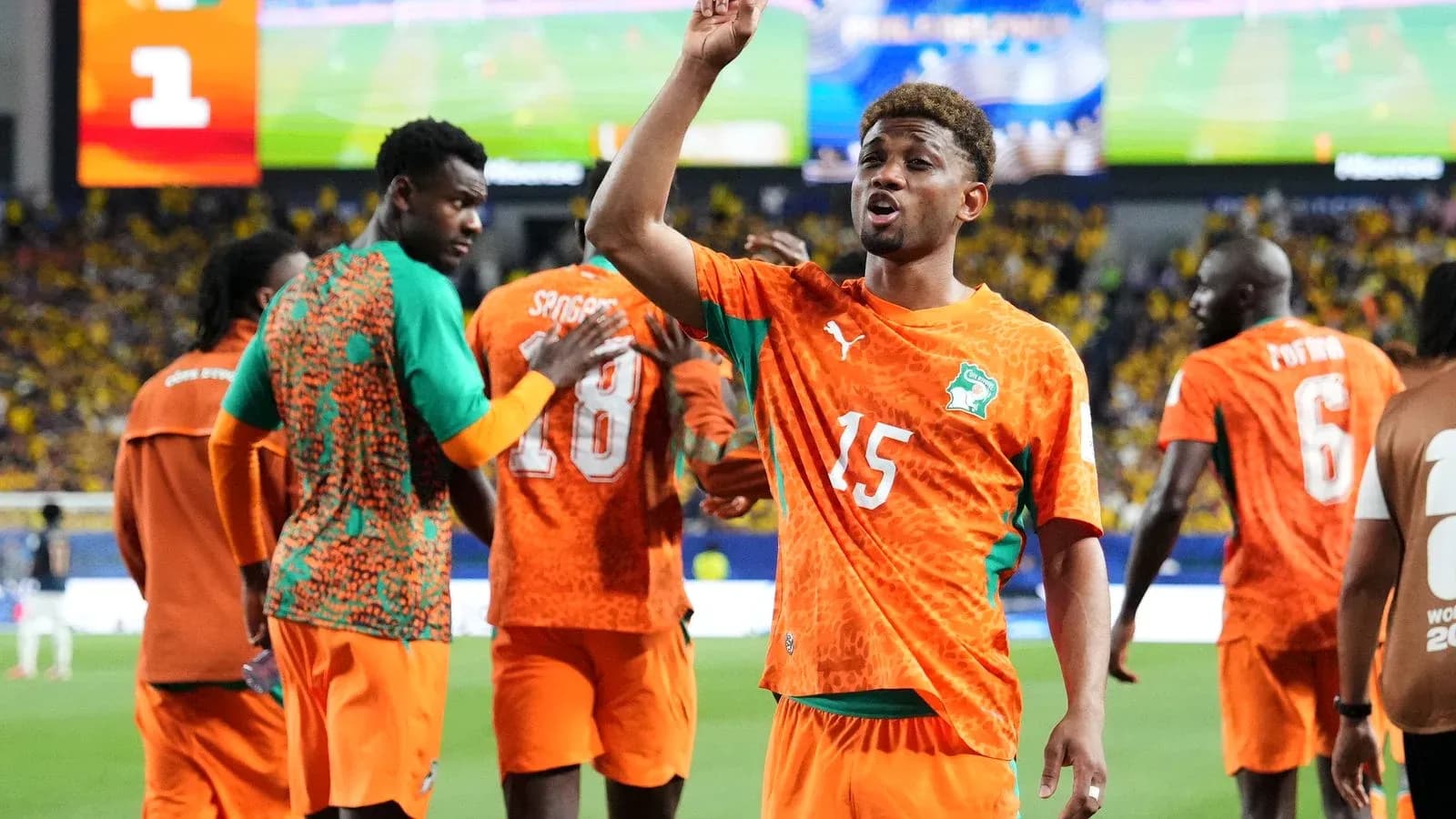
Ivory Coast’s 1-0 win over Ecuador at Lincoln Financial Field was a classic case of a side using structure and vertical aggression to edge a more ball-dominant opponent. In a World Cup group opener where Ecuador held 52% of possession and completed more passes (492 to 470), Emerse Fae’s Ivory Coast leaned on a compact 4-4-2, direct wing play, and a decisive bench intervention to secure the points, with Amad Diallo finishing the only goal at 90'.
I. Executive Summary
Both teams lined up in mirrored 4-4-2 systems, but their interpretations diverged. Ivory Coast’s 4-4-2 was front-footed and transitional, with emphasis on wide surges and late runs from midfield. Ecuador’s 4-4-2 under Sebastian Beccacece was more methodical, seeking control through Moisés Caicedo and Pedro Vite in central areas and rotations with Gonzalo Plata and Enner Valencia. The shot profile and xG underline Ivory Coast’s slightly clearer chances (15 shots, xG 1.52) versus Ecuador’s more speculative efforts (12 shots, xG 1.01), and the decisive tactical swing came from Ivory Coast’s substitutions reshaping the front line and right corridor.
II. Tactical Breakdown
Ivory Coast’s initial 4-4-2 featured Yahia Fofana in goal behind a back four of Guéla Doué, Wilfried Singo, Emmanuel Agbadou and Ghislain Konan. The midfield band of Bazoumana Touré, Seko Fofana, Franck Kessié and Yan Diomande sat relatively narrow out of possession, allowing the front two, Nicolas Pépé and Elye Wahi, to screen Ecuador’s double pivot. The Ivorian plan was clear: concede a slight possession deficit but compress central spaces and spring quickly once the ball was won.
Defensively, the structure worked. Ecuador managed only 1 shot on goal from 12 attempts, with 5 inside the box. Ivory Coast’s back line held a relatively high line but was protected by Kessié and Seko Fofana collapsing aggressively on any vertical pass into Enner Valencia’s feet. The three first-half yellow cards for Ivory Coast reflected this intensity: Seko Fofana (28', “Roughing”), Kessié (38', “Tripping”) and Doué (40', “Tripping”) all took bookings for assertive interventions that prevented Ecuador from turning in midfield or breaking beyond the first line. The downside was disciplinary risk; the upside was that Ecuador rarely generated clean central combinations.
In possession, Ivory Coast’s 48% share was purposeful rather than patient. Their 15 total shots included 8 from inside the box, indicating that when they did progress, they reached dangerous zones. The passing profile – 470 passes, 397 accurate (84%) – shows a team technically secure enough to build but willing to accelerate quickly. Singo and Konan were important in this: Singo stepping out from right centre-back into the half-space, Konan pushing high on the left to pin Alan Franco and John Yeboah.
Ecuador’s 4-4-2 had Hernán Galíndez in goal behind a back four of Piero Hincapié, Willian Pacho, Joel Ordóñez and Alan Franco. In midfield, Alan Minda and John Yeboah offered width, with Caicedo and Vite orchestrating inside, while Plata and Enner Valencia formed a flexible front pair. Ecuador’s 492 passes (419 accurate, 85%) and 52% possession underline a side comfortable circulating the ball, but the Ivorian block forced many of their 7 shots from outside the box and limited them to just 1 effort on target.
The key structural issue for Ecuador was their inability to destabilize Ivory Coast’s double pivot. Caicedo often dropped to assist first-phase build-up, but that left Vite isolated between Ivorian lines. When the ball did reach wide zones, Ivory Coast’s full-backs and wide midfielders doubled aggressively, accepting fouls when needed. Ecuador’s 13 fouls and single booking – Jackson Porozo at 73' (“Holding”) after coming on – contrasted with Ivory Coast’s earlier cautions, showing that Beccacece’s side increasingly resorted to disruptive defending once the game tilted late on.
III. Substitutions and the Winning Pattern
The match’s tactical hinge came around the 56' mark. Ecuador introduced Nilson Angulo for Alan Minda, looking for more direct running from wide areas. Simultaneously, Ivory Coast reshaped their attack: Ange-Yoan Bonny (IN) came on for Elye Wahi (OUT), while Amad Diallo (IN) replaced Bazoumana Touré (OUT). This effectively shifted Ivory Coast towards a more fluid 4-2-3-1/4-2-4, with Diallo operating between the lines and Bonny providing a more physical reference up front.
Ecuador responded at 62' by introducing Ángelo Preciado (IN) for John Yeboah (OUT) and Jackson Porozo (IN) for Alan Franco (OUT), rebalancing their right side with more defensive security and aerial presence. Later, at 77', Kevin Rodriguez (IN) replaced Enner Valencia (OUT), a move that maintained depth running but sacrificed some of Valencia’s link play. For Ivory Coast, Ibrahim Sangaré (IN) came on for Seko Fofana (OUT) at 77', adding fresh legs and defensive security in midfield, while Christ Inao Oulaï (IN) replaced Nicolas Pépé (OUT), injecting dribbling and ball-carrying from wide areas. Odilon Kossounou (IN) for Guéla Doué (OUT) at 89' further solidified the back line for the closing phase.
These changes culminated in the decisive 90' action: Amad Diallo finished from a Wilfried Singo assist, a pattern entirely consistent with the second-half tactical shift. Singo, stepping higher from the right side, had more license to overlap once Kossounou’s introduction allowed a secure defensive base. Diallo’s positioning between Ecuador’s lines and his timing into the box exploited the slight disorganization in Ecuador’s reconfigured back line, especially with Porozo and Preciado still adjusting to their roles.
IV. Goalkeeper and Statistical Verdict
Yahia Fofana (Ivory Coast) was statistically underworked, officially required to make 1 save. However, his positioning and command of the area helped neutralize Ecuador’s 5 shots inside the box, reflected in Ivory Coast’s defensive efficiency and the team’s goals prevented figure of 0.22. Hernán Galíndez (Ecuador) made 3 saves, with his own goals prevented also at 0.22, indicating he broadly performed to xG expectation but could not intervene on Diallo’s late, high-quality chance.
The xG balance – 1.52 for Ivory Coast versus 1.01 for Ecuador – mirrors the scoreboard: a marginal but deserved 1-0. Both sides blocked 3 shots, underlining committed defending, but Ivory Coast’s ability to generate more shots inside the box (8 to Ecuador’s 5) and more shots on goal (4 to 1) was decisive.
Discipline-wise, Ivory Coast finished with 3 yellow cards, Ecuador with 1, for a total of 4. The Ivorian bookings were the cost of an aggressive, central-protection strategy that ultimately succeeded in limiting Ecuador’s high-value chances. Ecuador’s single booking to Porozo reflected a more reactive late-game defending as they chased the match.
In summary, Ivory Coast’s win was built on a compact 4-4-2 base, intelligent game-state management, and impactful attacking substitutions that turned a balanced contest into a narrow but tactically coherent 1-0 victory.