Hellas Verona vs AS Roma: Serie A Season Finale
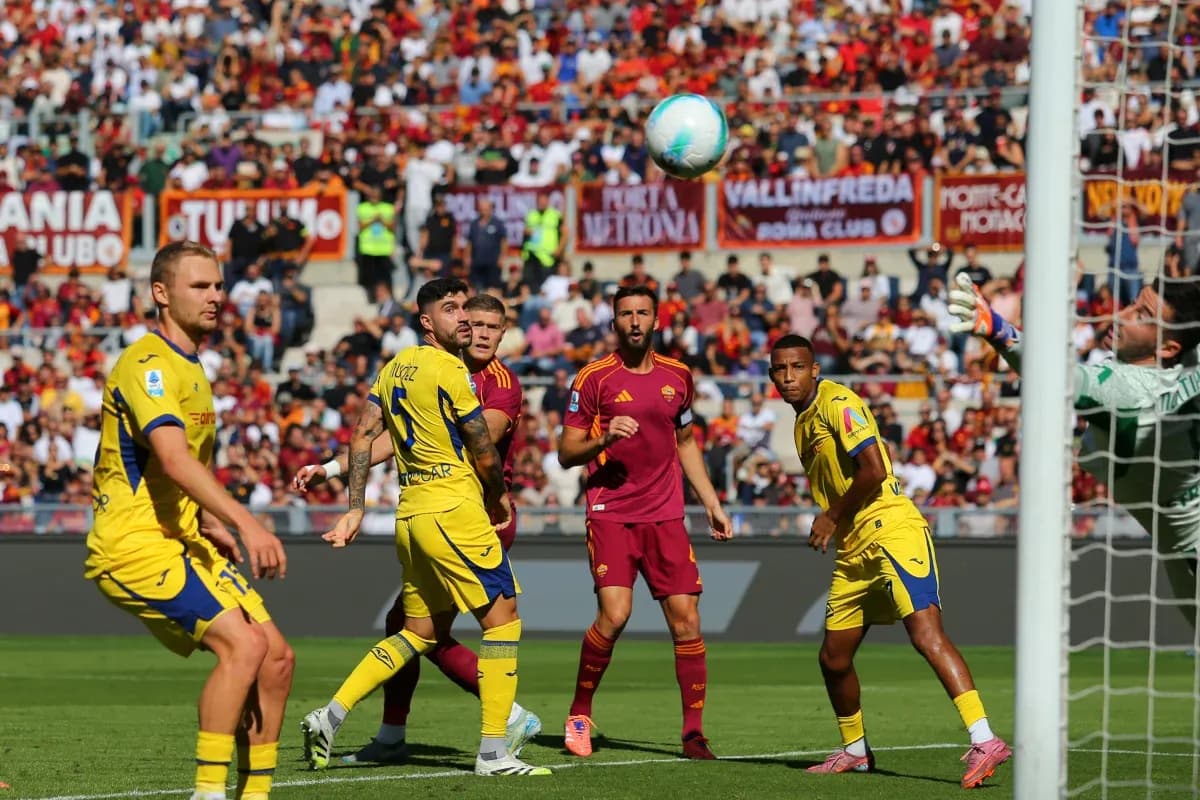
Under the Verona evening sky at Stadio Marcantonio Bentegodi, this was a finale that distilled an entire season’s story into 90 unforgiving minutes. Hellas Verona, already locked into 19th place with 21 points and a goal difference of -36 (25 scored, 61 conceded in total), closed a bruising Serie A campaign with a 2-0 home defeat to third‑placed AS Roma, who finished on 73 points and a total goal difference of 28 (59 for, 31 against).
The contrast in seasonal DNA could hardly have been starker. Heading into this game, Verona had won just 3 of 38 league matches in total, scoring only 25 goals at an average of 0.7 per game overall. At home, they had a single league victory, with 12 goals scored at an average of 0.6 and 28 conceded at 1.5 per match. Roma, by comparison, travelled with the swagger of a side destined for the Champions League: 23 wins from 38 in total, 59 goals at 1.6 per game overall, and a defence conceding just 0.8 on average. On their travels, Roma still carried a solid attacking edge, with 26 away goals at 1.4 per match and 21 conceded at 1.1.
Within that macro-gap, the lineups told their own tactical tale. Paolo Sammarco doubled down on Verona’s season-long identity, rolling out the familiar 3-5-2 that has been his most-used structure (26 league games in this shape). L. Montipo sat behind a back three of N. Valentini, A. Edmundsson and V. Nelsson, a trio asked to compress space centrally and absorb Roma’s vertical surges. The wing lanes were entrusted to M. Frese on the left and R. Belghali on the right, with S. Lovric, J. Akpa Akpro and A. Harroui forming a combative, hard‑running central band. Up front, T. Suslov floated between the lines alongside K. Bowie, more second strikers than classic penalty-box poachers.
For Roma, Piero Gasperini Gian kept faith with the 3-4-2-1 that has been his structural backbone (30 league games in that system). M. Svilar anchored a back three of M. Hermoso, D. Ghilardi and G. Mancini, a unit comfortable defending high and stepping into midfield. The width came from D. Rensch and Z. Celik, nominally listed as midfielders but functionally wing-backs, while B. Cristante and N. Pisilli patrolled the engine room. Ahead of them, M. Soule and P. Dybala operated as dual creators behind central spearhead D. Malen.
The tactical voids on both sides were significant. Verona were stripped of R. Gagliardini through suspension for yellow cards, a major loss in their midfield steel. Across the season he had been their disciplinary lightning rod, collecting 10 yellow cards and making 73 tackles, 13 successful blocks and 54 interceptions. Without him, Verona’s ability to disrupt Roma’s between-the-lines play was inevitably diminished. Injuries to D. Mosquera, D. Oyegoke, J. Peci and S. Serdar further thinned Sammarco’s options, particularly in defensive rotation and ball-winning.
Roma’s absences were more creative and structural. L. Pellegrini and B. Zaragoza were both out with thigh and knee issues respectively, while K. Tsimikas missed out through illness and E. Ndicka was sidelined with a thigh injury. Wesley Franca, one of Serie A’s standout red‑card figures, was also suspended after his own dismissal. The Brazilian’s season had been a paradox of aggression and influence: 5 goals, 1 straight red and a yellow‑red combination underline both his impact and volatility. E. Ferguson’s ankle injury removed another attacking option from Roma’s bench.
Disciplinary trends across the season framed the emotional temperature of this contest. Verona’s yellow cards peaked between 46-60 minutes with 24.72% of their cautions, followed by a 31-45 minute band at 21.35%. Their reds clustered in the 46-60 and 76-90 windows, each accounting for 40.00% of dismissals – a profile of a side that often lost control as matches opened up. Roma’s bookings, by contrast, surged late: 23.53% of their yellows came in both the 61-75 and 76-90 periods, while their rare reds were concentrated between 46-75 minutes. This statistical backdrop hinted at a second half where Verona’s desperation and Roma’s game management might collide in a flurry of fouls and cautions.
The “Hunter vs Shield” duel centred unmistakably on D. Malen. With 14 league goals in 18 appearances, 49 shots (31 on target) and an xG profile that clearly underpins his 7.23 average rating, he arrived as one of Serie A’s deadliest forwards. His penalty record told a nuanced story: 3 scored but 1 missed, proof that even his ruthlessness has a human margin. Against him stood a Verona defence that had conceded 61 goals overall at 1.6 per game, including 28 at home at 1.5 per match. The structural numbers favoured Malen heavily; the question was whether Valentini, Edmundsson and Nelsson could compress the central lane tightly enough to force him into low‑value shots.
In the “Engine Room” battle, P. Dybala and M. Soule were tasked with prising open a Verona midfield missing its primary destroyer. Dybala’s 6 assists, 55 key passes and 683 completed passes at 83% accuracy underline his status as Roma’s creative metronome, even in a season where he scored only 2 league goals. Soule added a more vertical threat: 6 goals, 5 assists, 46 key passes and 95 dribble attempts with 35 successes. Together, they attacked the very zone where Verona were most weakened by Gagliardini’s suspension. Akpa Akpro, himself a serial card collector with 9 yellows and 44 tackles, was left to shoulder an outsized share of the screening work, supported by Lovric and Harroui.
On Roma’s side of the shield, G. Mancini and M. Hermoso embodied a defence that conceded just 31 goals overall at 0.8 per game, and only 21 on their travels at 1.1. Mancini’s 52 tackles, 14 successful blocks and 49 interceptions, coupled with Hermoso’s 36 tackles and 29 interceptions, formed a barrier that Verona’s misfiring attack – 25 goals in total, failing to score in 20 league games – struggled to meaningfully threaten. M. Frese, so often Verona’s outlet with 2 goals, 31 key passes and 84 tackles from deep, was pinned back more than Sammarco would have liked, forced into a primarily defensive role.
Following this result, the statistical prognosis of the campaign feels brutally logical. Roma’s attacking volume, driven by Malen’s movement and the creative axis of Dybala and Soule, aligned with the underlying numbers: a side averaging 1.4 away goals per game in the league found two more against a defence that has leaked 1.5 at home. Verona’s structural frailties – low scoring output, high concession rate, and a disciplinary profile that hinted at late‑game fatigue and loss of control – were all exposed one final time.
In narrative terms, this match was less an upset and more an epilogue. Roma, with their 18 clean sheets in total and perfect penalty record (5 scored from 5, no misses), played like a side whose metrics have pointed toward Europe all season. Verona, with just 6 clean sheets overall and a campaign-long flirtation with danger, bowed out of Serie A exactly where the numbers said they would: on the back foot, chasing shadows, and ultimately overpowered by a squad built for a very different tier of the table.