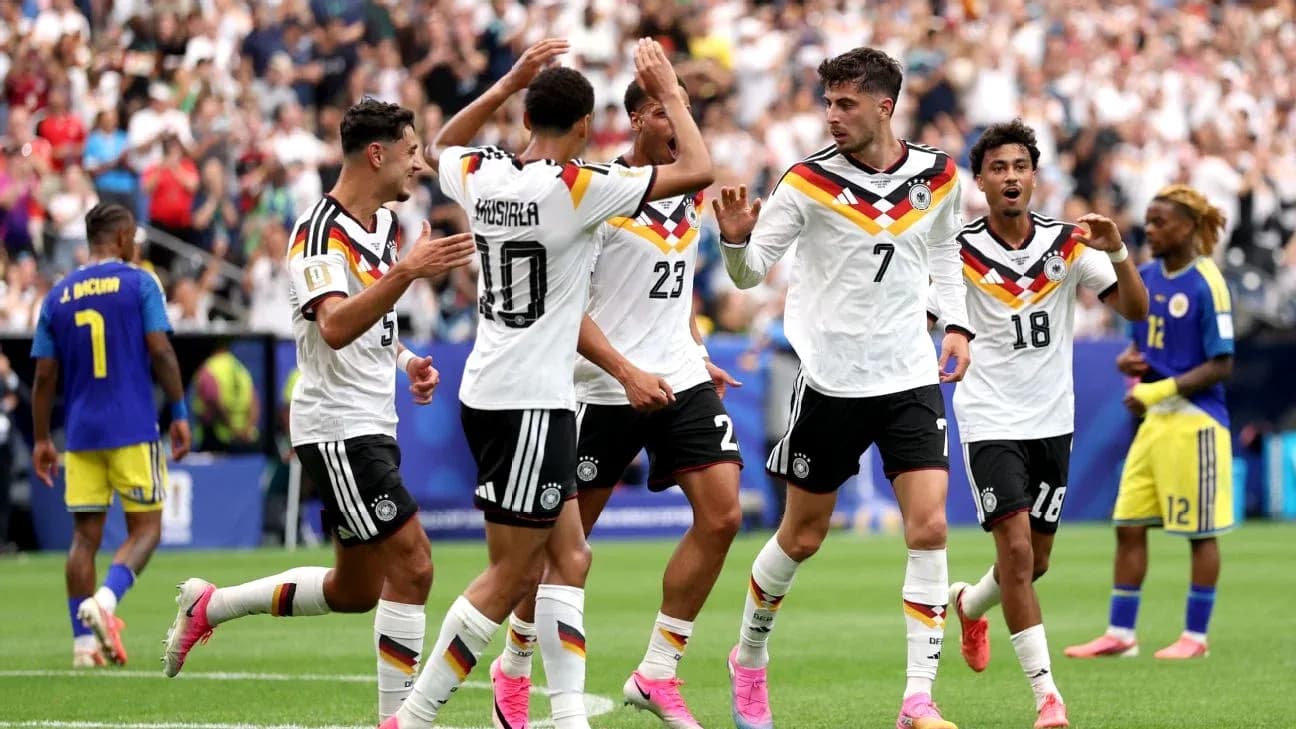
Germany's Tactical Domination Over Curaçao: A 7-1 Analysis
Germany’s 7-1 dismantling of Curaçao at NRG Stadium was a tactical domination rooted in structure, pressing triggers, and intelligent use of half-spaces. Julian Nagelsmann’s 4-2-3-1 consistently overloaded central zones, while Dick Advocaat’s 4-3-1-2 never solved the problem of protecting the space in front of its back four. The statistical profile – 65% possession, 27 total shots (12 on goal) and an xG of 3.91 for Germany versus Curaçao’s 0.4 xG and 8 shots – underlines how one side controlled both territory and shot quality.
Germany’s base shape was clear: Manuel Neuer behind a back four of Joshua Kimmich, Jonathan Tah, Nico Schlotterbeck and Nathaniel Brown; a double pivot of Felix Nmecha and Aleksandar Pavlović; a fluid line of three in Leroy Sané, Jamal Musiala and Florian Wirtz behind Kai Havertz. In possession, this often morphed into a 2-3-5: Kimmich and Brown pushed high and wide, Pavlović dropped between or just ahead of the centre-backs, while Nmecha stepped into the right half-space alongside Musiala and Wirtz. The result was a stable rest-defense with numerical superiority against Curaçao’s two strikers, and constant five-man occupation of the last line.
The opening goal at 6' encapsulated the plan. Germany created central overloads to draw Curaçao’s midfield narrow, then combined quickly between the lines. Felix Nmecha arrived from deep to finish, assisted by Florian Wirtz, exploiting the gap between Curaçao’s midfield three and their back four. This vertical run from the double pivot was a recurring theme: Nmecha’s role was not just to recycle possession but to break lines with late surges, forcing Curaçao’s defenders to step out and destabilizing their compactness.
Curaçao’s equaliser at 21', through Livano Comenencia, came more from an isolated attacking moment than sustained structure. Their 4-3-1-2 relied on Tahith Chong as a link and on Jürgen Locadia and Sontje Hansen stretching Germany’s centre-backs, but with only 35% possession and just 4 shots inside the box, they rarely pinned Germany back. When they did advance, their full-backs Sherel Constancio Floranus and Deveron Fonville had to push high, leaving large spaces behind that Germany repeatedly targeted in transition.
Germany’s second goal at 38' – Nico Schlotterbeck finishing from a Nathaniel Brown assist – highlighted their set-piece and wide threat. Brown’s advanced positioning on the left created a de facto wing-back role; his delivery and timing into the final third were rewarded with both an assist and a later goal. Curaçao struggled to track late arrivals from Germany’s defenders, a symptom of being overloaded and forced to defend both the box and the cut-back zones simultaneously.
The penalty converted by Kai Havertz at 45+5' reflected Germany’s constant presence in the penalty area: 22 shots inside the box tell the story of relentless occupation of dangerous zones. Havertz operated as a hybrid 9, frequently dropping into midfield to link with Musiala and Wirtz, dragging centre-backs out and opening lanes for third-man runs. This movement pattern was central to the penalty incident and to Germany’s ability to keep Curaçao defending facing their own goal.
At half-time, with Germany 3-1 up and Curaçao already chasing, Advocaat’s substitution at 46' – Jeremy Antonisse (IN) came on for Sontje Hansen (OUT) – tried to inject pace and vertical threat. But Germany immediately killed any hope of a comeback. At 47', Jamal Musiala scored from a Joshua Kimmich assist, a classic example of Kimmich’s inverted full-back role: stepping into midfield, he created an extra central playmaker, then released Musiala breaking into the right half-space. Curaçao’s midfield three were consistently outnumbered and could neither press Kimmich effectively nor protect the channels.
Nagelsmann’s in-game management then shifted the attacking reference points without sacrificing structure. At 64', Jamal Musiala (OUT) was replaced by Deniz Undav (IN), while Jearl Margaritha (IN) came on for Jürgen Locadia (OUT) for Curaçao. Undav’s introduction moved Germany closer to a two-striker look in some phases, with Havertz and Undav alternating between dropping and pinning the line. This paid off at 68', when Nathaniel Brown scored from an Undav assist: Germany exploited the left side again, with Undav drifting to combine and Brown attacking the space vacated by Curaçao’s right-back.
Germany refreshed their back line and midfield protection at 73': Antonio Rüdiger (IN) came on for Jonathan Tah (OUT), David Raum (IN) came on for Nathaniel Brown (OUT), and Leon Goretzka (IN) came on for Felix Nmecha (OUT). These changes maintained defensive stability while preserving attacking thrust from full-back, with Raum providing fresh legs and crossing threat. Curaçao, still in a 4-3-1-2 framework, could not adjust their pressing angles and remained pinned deep.
At 78', Germany’s fifth came via Deniz Undav, again assisted by Joshua Kimmich. This goal underlined how Germany’s right side became a playmaking hub: Kimmich, now with more space against a tiring block, repeatedly found the free man between lines. Undav’s movement between centre-back and full-back was too sharp for Curaçao’s back four, which lacked compactness both vertically and horizontally at this stage.
The final substitution wave at 83' – Waldemar Anton (IN) for Joshua Kimmich (OUT) and Gervane Kastaneer (IN) for Tahith Chong (OUT) – saw Germany lock the game down with more defensive profiles, while Curaçao looked for fresh attacking legs. Yet the pattern remained the same: Germany circulating with patience (633 passes, 550 accurate at 87%) against Curaçao’s 336 passes (276 accurate, 82%), then accelerating through the half-spaces. The final goal at 88', Kai Havertz finishing from a Deniz Undav assist, illustrated the dominance of Germany’s central combinations; Curaçao’s lines were broken too easily, and their centre-backs were repeatedly isolated 2v2 or 3v2 in the box.
From a defensive perspective, Manuel Neuer (Germany) faced little sustained pressure, with Germany allowing only 2 shots on goal and needing just 1 save. Eloy Room (Curaçao), by contrast, made 4 saves but was overwhelmed by volume and quality of chances, with Curaçao’s goals prevented figure of -2.47 matching Germany’s, indicating that both keepers conceded more than xG would predict. The difference was structural: Germany’s rest-defense – anchored by Schlotterbeck, Tah/Rüdiger, and the double pivot – smothered transitions, while Curaçao’s lacked the compactness and cover to cope with Germany’s rotations.
Statistically, the verdict aligns perfectly with the tactical picture. Germany’s 27 shots to 8, 12 on goal to 2, and 8 blocked shots speak to constant territorial pressure and repeated shot creation even against a deepening block. Their 3.91 xG versus Curaçao’s 0.4 underlines the gulf in chance quality, not just quantity. Fouls (18 for Germany, 11 for Curaçao) suggest Germany were aggressive in counter-pressing, willing to stop transitions early rather than defend long counters.
The 7-1 scoreline is thus less an outlier and more the logical outcome of a game in which Germany controlled structure, tempo, and space from the first minute to the last, using their 4-2-3-1 as a flexible platform to overwhelm Curaçao’s narrower 4-3-1-2 in every key zone of the pitch.