Germany Dominates Curaçao 7-1 in World Cup Opener
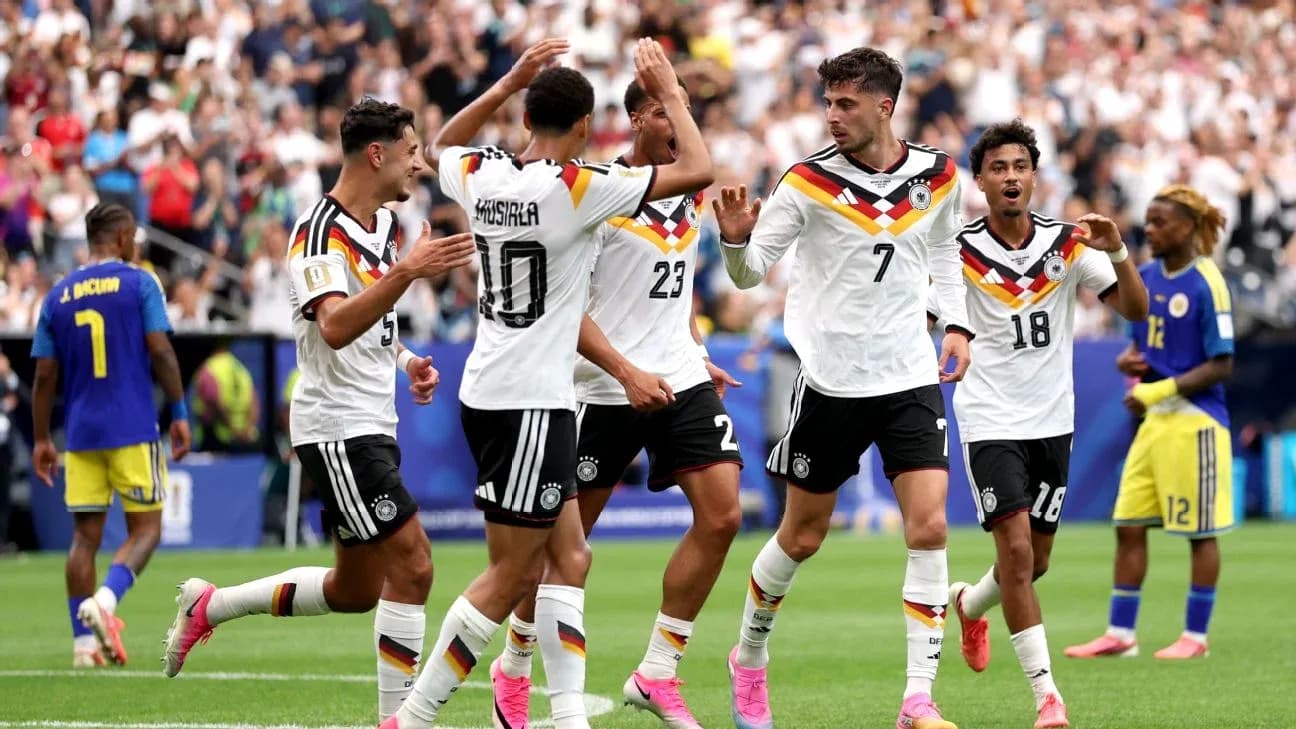
Under the closed roof of NRG Stadium in Houston, Germany’s World Cup campaign began with a statement that echoed far beyond Group E. A 7-1 demolition of Curaçao in this Group Stage - 1 fixture did more than deliver three points; it crystallised the tactical identities of both sides and sketched out the power dynamics that will define the rest of their tournament.
Following this result, Germany sit 1st in Group E on 3 points, with a goal difference of +6 (7 goals for, 1 against) from 1 match. Curaçao, beaten heavily in their first outing, are 4th with 0 points and a goal difference of -6 (1 goal for, 7 against). The raw numbers from this single-game sample are extreme: Germany have scored 7.0 goals per game in total and conceded 1.0, while Curaçao have managed 1.0 goal per game on their travels and shipped 7.0.
I. The Big Picture – Nagelsmann’s blueprint takes shape
Julian Nagelsmann’s 4-2-3-1 was not just a formation graphic; it was a carefully layered system. M. Neuer anchored from goal, behind a back four of J. Kimmich, J. Tah, N. Schlotterbeck and N. Brown. Ahead of them, the double pivot of F. Nmecha and A. Pavlovic acted as the stabilising hinge, allowing the front four of L. Sane, J. Musiala, F. Wirtz and K. Havertz to rotate and overload between the lines.
The statistical output validates the design. Overall, Germany’s attack is currently the most explosive in the competition: 7 goals in total from 1 fixture, with their biggest win at home already recorded as 7-1. They have yet to keep a clean sheet, but the balance of risk and reward is clearly tilted towards ruthless attacking.
Curaçao, under Dick Advocaat, lined up in a 4-3-1-2 that sought to compress central spaces. E. Room started in goal behind a back line of S. Floranus, R. Bazoer, A. Obispo and D. Fonville. The midfield trio of L. Comenencia, L. Bacuna and J. Bacuna sat beneath T. Chong as a nominal 10, feeding the front two J. Locadia and S. Hansen. On paper it offered numbers in the middle; in practice, it was constantly stretched and pulled apart by Germany’s positional play.
II. Tactical Voids – where the structures cracked
There were no listed absentees from either side, which meant both coaches were working with full decks. That placed the spotlight firmly on tactical execution rather than personnel excuses.
Germany’s only real “void” is a statistical one: despite their dominance, they have not yet recorded a clean sheet at home or in total this campaign (0 clean sheets from 1 match). The single goal conceded underlines that their high, aggressive structure can still be punctured in transition.
Curaçao’s void is far more severe. On their travels they have conceded 7 goals in 1 game, with an away average of 7.0 goals against per match and no clean sheets. The 4-3-1-2 shape, without intense collective pressing, left the full-backs repeatedly isolated against Germany’s wide rotations. With no card data recorded for either side, there is no evidence yet of a disruptive, foul-heavy plan to slow superior opponents; Curaçao tried to defend structurally and were simply outplayed.
III. Key Matchups – Hunter vs Shield, and the battle for control
Hunter vs Shield was brutally one-sided. K. Havertz, already among the World Cup’s top scorers with 2 goals in total from 1 appearance, led the line with ruthless efficiency. He took 2 shots, both on target, scoring twice and adding a penalty conversion to underline Germany’s 100.00% record from the spot so far (1 penalty in total, 1 scored, 0 missed). His 41 passes at 92% accuracy and 1 key pass show he was more than a finisher; he was a connector at the top of the structure.
Facing that was a Curaçao defence that, overall, has conceded 7 goals in 1 match, with their biggest defeat on their travels already logged as 7-1. R. Bazoer and A. Obispo were continually forced into reactive defending, dragged out by Havertz’s movement and the late-arriving runs of Musiala and Wirtz. The “Shield” never truly formed; it was constantly being broken apart before it could set.
In the Engine Room, Germany’s playmaking depth overwhelmed Curaçao’s central trio. J. Musiala, operating as the 10, delivered 1 goal from 1 shot on target, plus 2 key passes and 5 dribble attempts with 4 successful. He was the chaos agent between the lines, turning L. Bacuna and J. Bacuna repeatedly and forcing them to defend facing their own goal.
Out wide and from deep, J. Kimmich and N. Brown functioned almost as auxiliary playmakers. Kimmich, from right-back, produced 73 passes with 5 key passes and 2 assists, all while maintaining 89% accuracy. Brown, on the left, matched that creative thrust with 1 goal, 1 assist, 3 key passes and 36 completed passes at 88% accuracy. For Curaçao, L. Comenencia and the Bacuna brothers were outnumbered and outmanoeuvred; their 4-3-1-2 never established a stable press on Germany’s build-up.
The bench only sharpened the contrast. D. Undav, one of the competition’s leading assist providers, came in as a substitute and in 26 minutes produced 1 goal and 2 assists, with 3 key passes and 1 shot on target. His impact underlines the depth Nagelsmann can call upon when games open up.
IV. Statistical Prognosis – what this result projects
Following this result, the numbers point towards Germany as a heavyweight already operating at full throttle. Overall they have 1 win from 1, a perfect record in front of goal (failed to score in 0 matches), and a formation – 4-2-3-1 – that has been used in 100% of their fixtures so far. The attacking output of Havertz, Musiala, Brown, Kimmich and Undav suggests that their xG profile will be elite: multiple high-quality chances created, shared across several threats.
Curaçao, conversely, have 1 loss from 1 on their travels, with 1.0 goal for and 7.0 against in total. Their inability to prevent volume and quality of chances hints at a fragile defensive xG against, especially against top-tier opposition. Without a clean sheet and with no evidence yet of a conservative, low-block alternative, they risk being repeatedly exposed by sides that can match Germany’s tempo and movement, even if not their finishing.
In narrative terms, this 7-1 is both an arrival and a warning. Germany have announced themselves as a contender with a modern, fluid structure and multiple in-form attackers. Curaçao have been handed a brutal diagnostic: their current 4-3-1-2, as deployed here, cannot survive against elite positional play. The rest of Group E will now adjust accordingly—either by bracing for Germany’s storm, or by targeting the same structural seams in Curaçao that Nagelsmann’s side so ruthlessly tore open in Houston.