France's Tactical Masterclass in 3-1 Victory Over Senegal
France’s 3-1 win over Senegal at MetLife Stadium unfolded as a controlled, system-driven performance from a 4-2-3-1 base, gradually asserting superiority after an even first half. Both sides mirrored formations, but France’s structure, ball circulation and vertical threat through Kylian Mbappé proved decisive once the tempo rose after the break.
Didier Deschamps’ 4-2-3-1 was clearly built around stable rest-defense and controlled progression. The back four of Jules Koundé, Dayot Upamecano, William Saliba and Theo Hernández held a relatively high line, trusting the double pivot of Aurélien Tchouaméni and Adrien Rabiot to screen transitions. With 53% possession and 575 passes (505 accurate, 88%), France circulated with patience, preferring to construct rather than force early entries. The shot profile reflects this control: 11 total shots, 8 on goal, and 7 from inside the box, showing that most final actions came from well-engineered positions rather than speculative efforts.
Senegal, also in a 4-2-3-1 under Bouna Thiaw Pape, leaned on compactness and direct outlets. The double pivot of Idrissa Gana Gueye and Pape Gueye had to absorb long French phases, while Sadio Mané, Ismaïla Sarr and Lamine Camara supported Nicolas Jackson in transition. With 47% possession and 502 passes (430 accurate, 86%), Senegal were not simply ceding the ball; they tried to build, but their 6 total shots (only 2 on goal) and xG of 0.53 underline how rarely they accessed truly dangerous zones.
The turning point tactically came around the 60th minute. Up to then, Senegal’s compact block and Edouard Mendy’s (Senegal) command of his box — 5 saves in total — had kept France at bay despite the territorial tilt. The VAR intervention at 60' for a “Penalty cancelled” on Mbappé signalled France’s growing penetration: they were now consistently finding Mbappé between and beyond the lines. Even though the penalty was overturned, the sequence showed Senegal’s back line being stretched by Mbappé’s diagonal runs and Michael Olise’s ability to receive between lines.
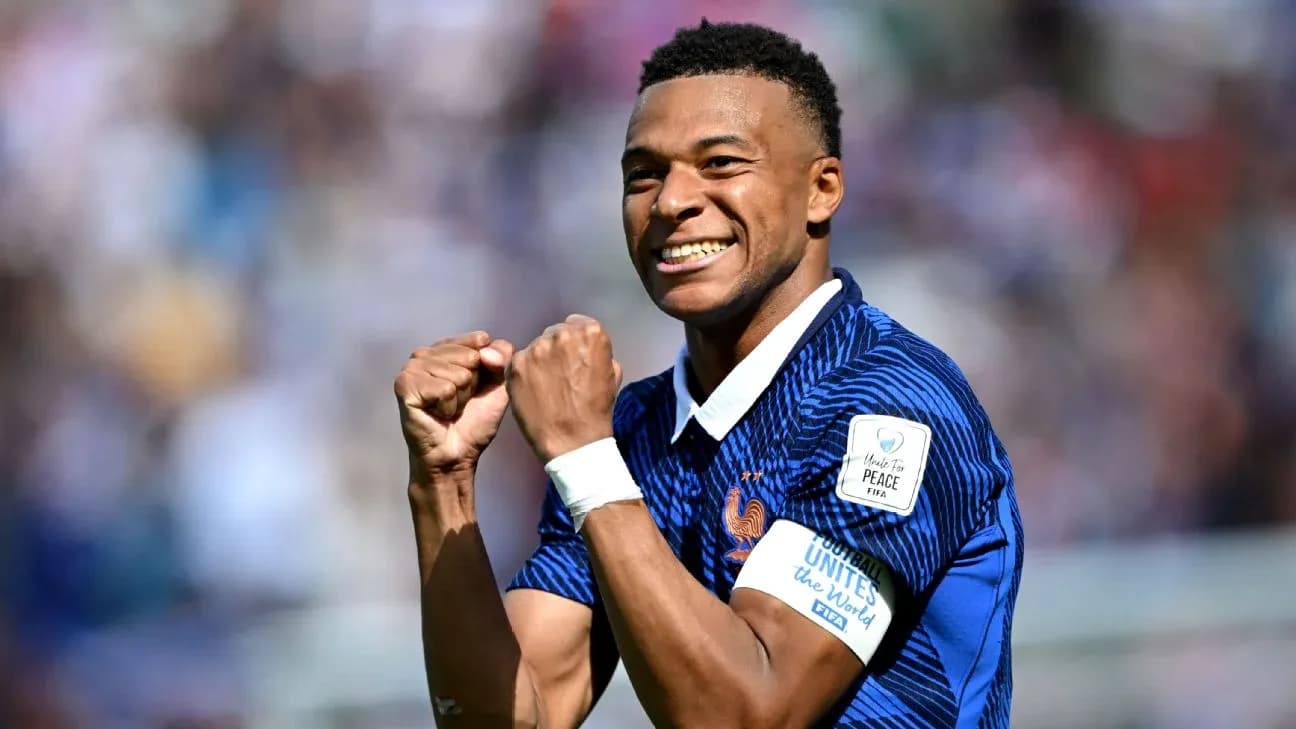
The breakthrough at 66' captured France’s attacking design. Mbappé’s first goal, assisted by Olise, came from France finally aligning their positional play: the double pivot secured rest-defense, the full-backs gave width, and the trio behind Mbappé occupied half-spaces and wide channels. Olise’s involvement as creator reflected his role as the primary link between midfield circulation and the final third, exploiting the pockets between Senegal’s midfield and defense.
Deschamps’ substitutions then added a new dimension. At 80', Bradley Barcola (IN) came on for Ousmane Dembélé (OUT), injecting fresh pace and directness on the flank. Just two minutes later, at 82', Barcola finished a move assisted by Rabiot, underlining how France’s structure allowed new entrants to immediately find advantageous positions. Rabiot’s assist was the product of his dual function: secure in the double pivot in buildup, but with license to step into the left half-space when France had stable possession, overloading Senegal’s right side.
On the opposite bench, Thiaw tried to tilt the game with a series of offensive substitutions: Ibrahim Mbaye (IN) for Ismaïla Sarr at 75', Habib Diarra (IN) for Lamine Camara at 76', then a double change at 83' with Ahmadou Bamba Dieng (IN) for Nicolas Jackson and Iliman Ndiaye (IN) for Pape Gueye. Later, Pathé Ismaël Ciss (IN) replaced Idrissa Gana Gueye at 88'. These moves collectively pointed to a shift towards more direct attacking profiles and fresh legs to press, but the underlying problem remained: Senegal struggled to progress cleanly into the final third against France’s rest-defense and were limited to 1 blocked shot and 4 attempts inside the box.
The late goals encapsulated the tactical narrative. Mbappé’s second at 90+6' — unassisted — came with France exploiting space against a stretched Senegal side chasing the game. With France still organized behind the ball and capable of transitioning quickly, Mbappé’s individual quality was amplified by the team’s compact spacing. Senegal’s consolation at 90+5', scored by Ibrahim Mbaye and assisted by Ndiaye, stemmed from the wave of attacking substitutions finally breaking France’s line once, but it arrived too late to alter the tactical balance.
Defensively, France’s risk management was effective. They conceded only 2 shots on goal and 1 blocked shot, with Mike Maignan (France) required to make just 2 saves. The negative goals prevented figure (-0.94) suggests that the single goal conceded slightly exceeded the expected outcome from the chances allowed, but over 90 minutes France largely kept Senegal at arm’s length. Their foul count of 5, compared to Senegal’s 9, also reflects a controlled defensive posture, relying more on positioning than on disruptive challenges.
From a statistical verdict, France’s 3 goals from 1.79 xG underline clinical finishing, especially from Mbappé, and the value of high-quality chance creation rather than volume alone. Senegal’s 1 goal from 0.53 xG mirrors their difficulty in generating sustained pressure. Corner counts (6 for France, 4 for Senegal) and the close passing numbers show that this was not a siege but a structurally won game: France’s superior occupation of zones, more dangerous shot map and better exploitation of wide and half-space channels made the difference in a match where both teams nominally shared similar shapes and possession.