Canada's World Cup Knockout Match Against South Africa
Canada’s World Cup road is finally real. No more permutations, no more “if this, then that.” On Sunday, in their first-ever World Cup knockout match, it runs straight through South Africa.
A Favourable Draw – On Paper Only
The numbers say Canada should advance. They arrived at this tournament ranked 31st in the world, a full 29 places ahead of South Africa at No. 60. ESPN’s pre-tournament model put Canada 25th out of 48, South Africa way down at 46.
But tournaments are built on performances, not spreadsheets.
South Africa staggered out of the gate with a 2-0 loss to Mexico that included two red cards and the sense their campaign might be over before it began. They refused to fold. A late Teboho Mokoena penalty salvaged a vital point against Czechia, and when they needed a result most, they delivered: Thapelo Maseko’s winner in a 1-0 victory over South Korea sealed second place in Group A, despite having just 31 per cent of the ball.
This is not a side that scares easily. Nor one that minds suffering without possession.
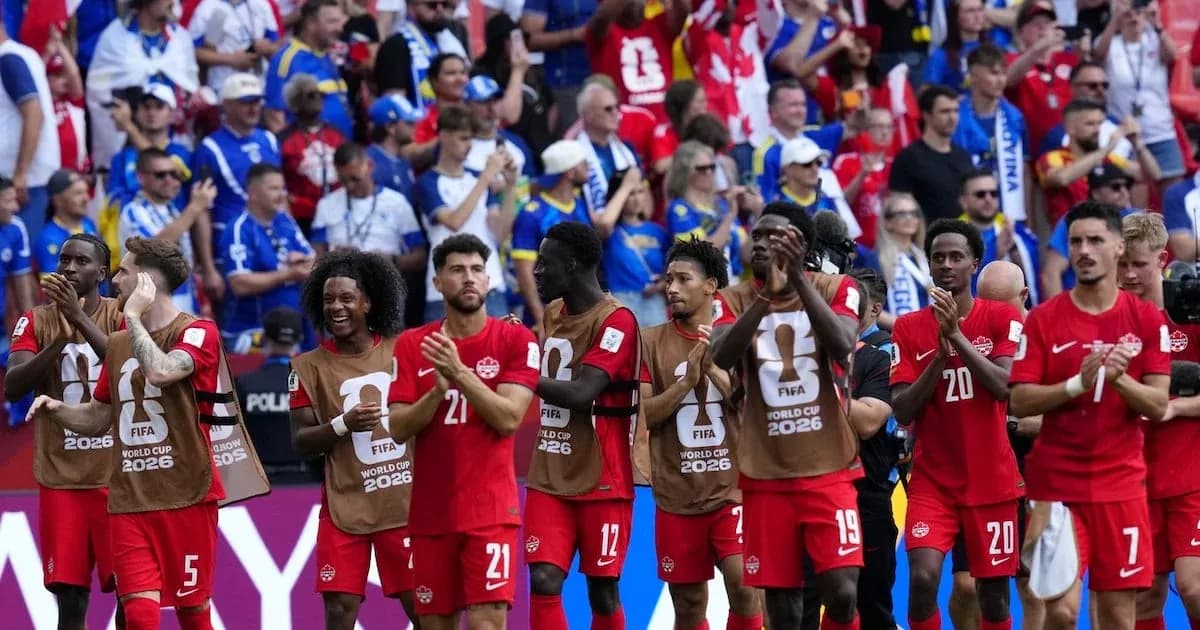
Canada, though, have earned their status as favourites. They reached the Round of 32 by grinding out a 1-1 draw with Bosnia and Herzegovina, dismantling a nine-man Qatar 6-0, and then pushing Switzerland to the edge in a 2-1 defeat that could easily have finished level.
They trailed 2-0 early in the second half against the Swiss and came roaring back, throwing bodies forward and turning stoppage time into a siege.
Jonathan David called those final minutes “kind of intense,” and the description barely does it justice.
“You try not to look at the clock, because the more you look at it, the quicker time goes. But it’s garbage time,” the striker said. “You have to just have to crash the box and get the crosses and make sure you make your chances happen, and put shots on target, and hopefully something falls. And we came really, really close.”
A draw would have handed Canada top spot in Group B and a different path entirely: a third-place opponent, a later kickoff in Vancouver, a slightly smoother road. Instead, they got a reminder of tournament reality. One lapse, one slow start, and the bracket changes beneath your feet.
The Alphonso Davies Question
Now comes the biggest unknown of all: Alphonso Davies.
Canada’s captain has yet to play a minute at this World Cup, kept out by a hamstring injury and wrapped in a layer of secrecy. Jesse Marsch admitted after the Switzerland match that Davies’ presence in the squad during the group stage was pure theatre.
“Alphonso wasn’t ready yet, but I wanted Switzerland to think about him and if you heard their press conference yesterday, they spoke about him a lot,” Marsch said. “He was never ready to play today, but I used him as a decoy.
“He will be ready for the next match, though. We didn’t want to be in a situation where he could be in danger, but he will be ready for the next match.”
Is that a promise or more gamesmanship? Canada stopped issuing injury updates before the win over Qatar, and very little has leaked out since. What is clear: even the hint of Davies changes how opponents prepare. South Africa now have to plan for the possibility of one of the game’s most explosive wide players returning fresh into a knockout tie.
Canada will also hope Stephen Eustáquio is fit enough to start after coming off the bench in the 58th minute against Switzerland. His control in midfield remains vital to how Marsch wants his side to play. At the back, Moise Bombito could be in line for a first start of the tournament if he’s deemed ready, another potential tweak in a team that has already shown it can adapt to different game states.
What Awaits Beyond South Africa
Beat South Africa on Sunday, and the picture sharpens quickly.
The winner earns six days’ rest before a Round of 16 clash on Saturday, July 4, against the survivor of a heavyweight tie: Group F winners Netherlands against Group C runners-up Morocco. Both arrive unbeaten at 2-0-1. Both came into the tournament ranked inside FIFA’s top eight.
Morocco, seventh in the world, are still riding the momentum of their historic run to the semifinals at Qatar 2022. Netherlands, ranked eighth, have been a World Cup constant for decades, and they still haven’t lost a match in regulation at this tournament since the 1-0 defeat to Spain in the 2010 final.
Morocco’s route through the group was efficient and controlled: a 1-1 draw with Brazil, a 1-0 win over Scotland, then a 4-2 victory over Haiti. They know how to manage tight games and how to spring forward with pace and purpose.
The Dutch leaned into their attacking power. A 2-2 draw with Japan, a 5-1 demolition of Sweden, and a 3-1 win over Tunisia showcased a front line that can overwhelm teams in waves.
Whoever emerges from that clash will not be intimidated by a Round of 16 stage. For Canada or South Africa, it would be something entirely new.
And the gauntlet only gets heavier in the quarter-finals. Waiting in that top section of the bracket are likely Germany or France. Germany have already locked up Group E. France, ranked third in the world, will secure Group I with a result against Norway on Friday. If they do, a colossal Round of 16 showdown between France and the 10th-ranked Germans looms, with the winner sliding into the path of Canada’s section.
This is the company Canada now keeps. Germany. France. Netherlands. Morocco. Nations that have shaped recent World Cup history.
History Made. What Now?
For Canada, the temptation is to stare too far ahead, to trace the line from Sunday’s kickoff to a possible date with European royalty. Marsch is trying to pull that focus back, one rung at a time.
“We’re going to focus on the response,” he said after the loss to Switzerland. “We’re exactly where we want to be.”
In a sense, he’s right. This team has already ripped up its own ceiling at this World Cup: first point, first win, first time out of the group. The anxiety that haunted previous generations has given way to something else entirely — expectation.
The question now is whether they can live inside that pressure.
South Africa will not care about Canada’s rankings, their new landmarks, or their potential quarter-final opponents. They’ve already survived red cards, late drama and a possession deficit that would break lesser teams. They arrive with nothing to lose and a clear idea of how to suffer and strike.
Canada arrive with a target on their back, a captain on the brink of returning, and a chance to turn a breakthrough tournament into something bigger.
A first knockout win at a World Cup is sitting there, 90 minutes away.
Are they ready to take it?