Brazil vs Morocco: Tactical Duel Ends in 1-1 Draw
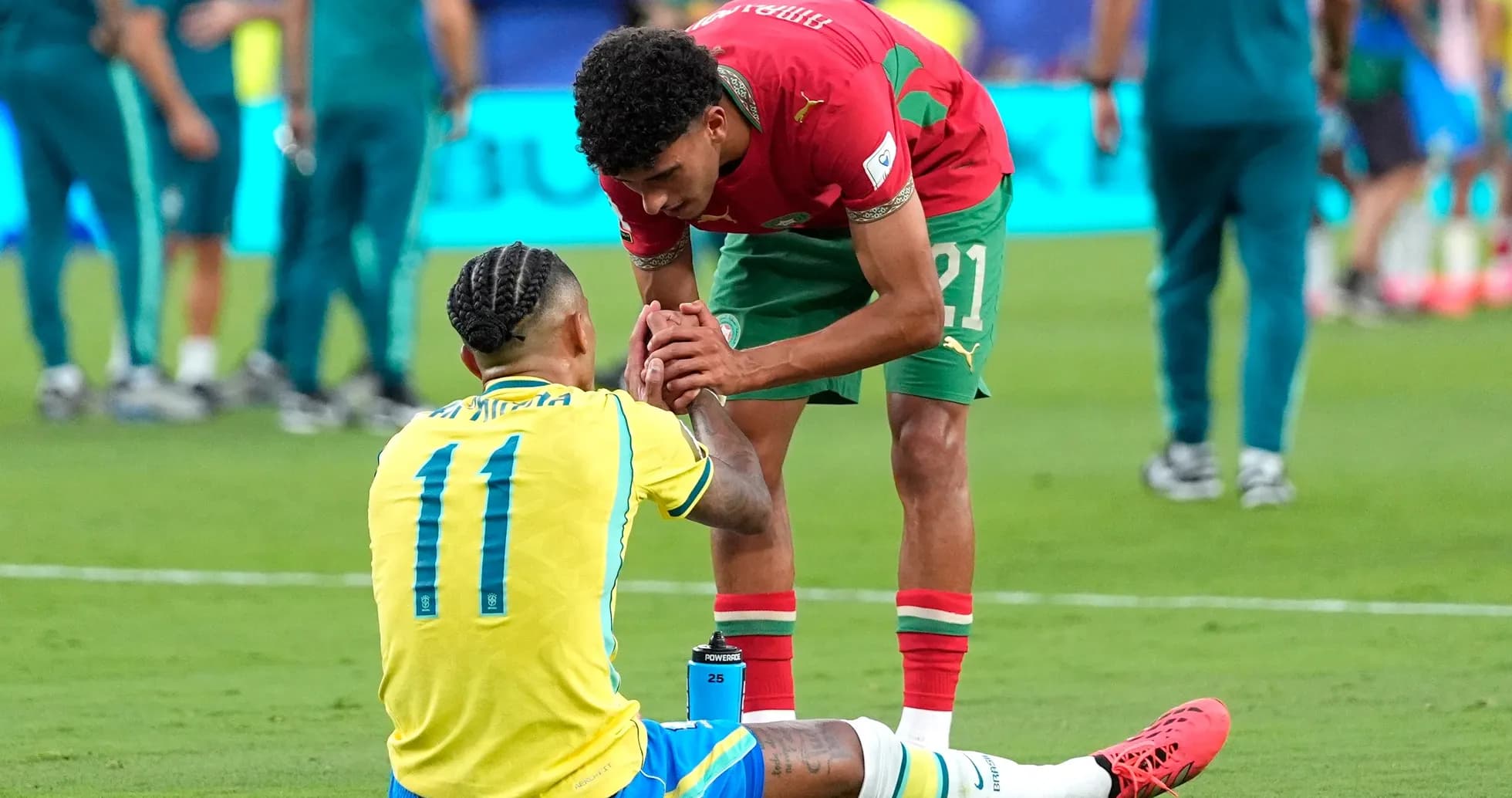
Brazil and Morocco shared a 1-1 draw at MetLife Stadium in their opening World Cup Group Stage match, a contest that quickly settled into a tactical duel between two 4-2-3-1 structures. Brazil, under Carlo Ancelotti, controlled slightly more of the ball and territory, but Mohamed Ouahbi’s Morocco were incisive in transition and structurally disciplined without it. The scoreline reflected the balance: Brazil’s more sustained possession and crossing game against Morocco’s compact block, vertical counters and intelligent use of their advanced midfield line.
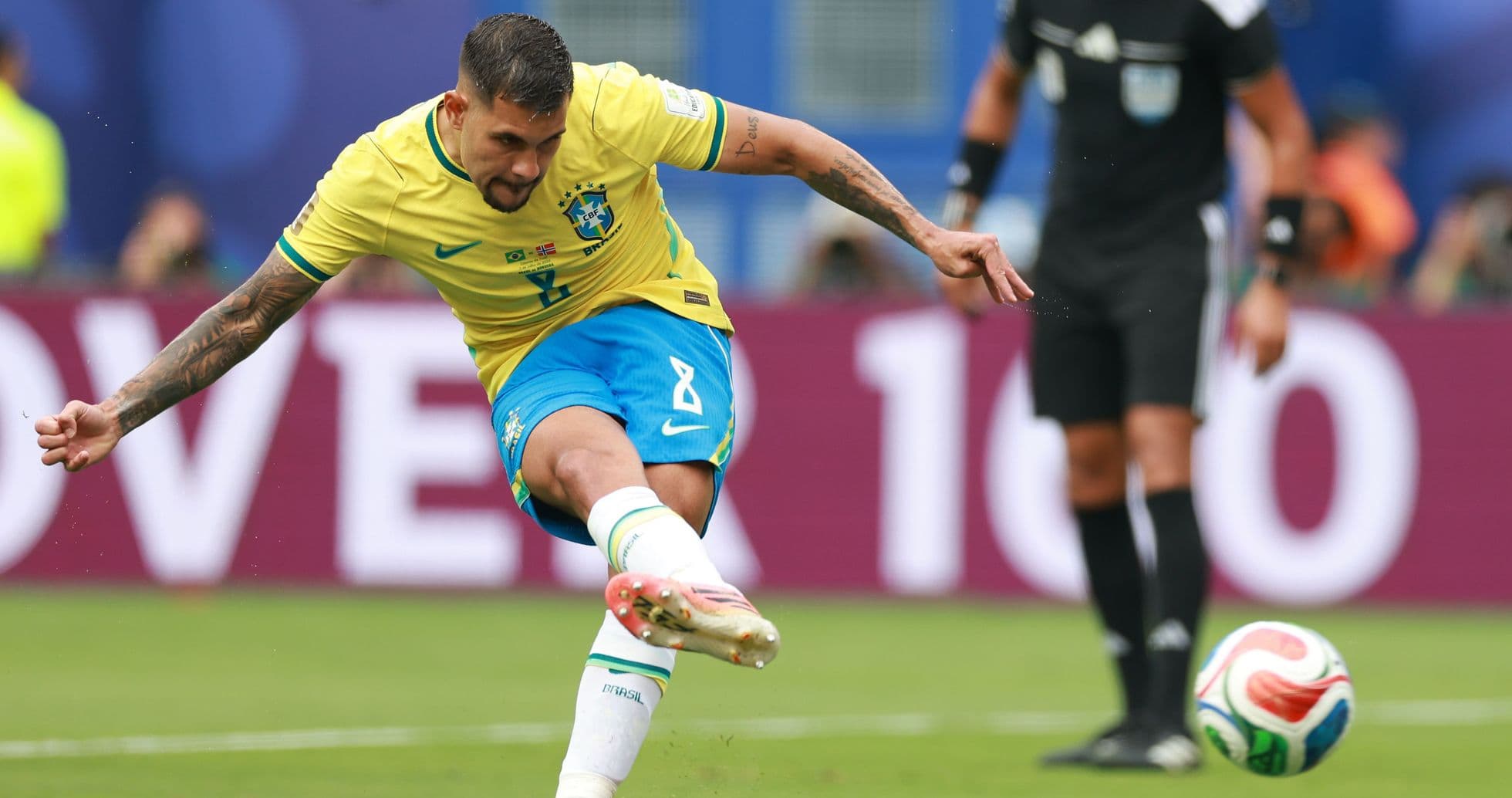
Ismael Saibari’s 21st-minute opener for Morocco, assisted by Brahim Díaz, came from exactly that transition threat, punishing Brazil before their rest defence had fully set. Brazil responded on 32 minutes when Vinícius Júnior equalised, fed by Bruno Guimarães, a move that showcased the home side’s capacity to find their winger between lines and isolate him in dangerous zones. From there, the match became a battle of adjustments: Brazil trying to tilt the pitch and increase their shot volume inside the box, Morocco managing distances and preserving central compactness.
Team Structures
Both teams lined up in a 4-2-3-1, but the interpretation of the shape differed. Brazil’s back four of Douglas Santos, Gabriel Magalhães, Marquinhos and Roger Ibañez played relatively high, with Casemiro and Bruno Guimarães as the double pivot. Bruno tended to drop to aid first-phase build-up, allowing Casemiro to hold the central lane and protect against counters. The three behind Igor Thiago — Vinícius Júnior left, Raphinha right, Lucas Paquetá central — often rotated, with Paquetá drifting into left half-spaces to combine with Vinícius.
Morocco mirrored the base shape but with a more conservative slant. Achraf Hakimi and Noussair Mazraoui were full-backs in name but prioritised line integrity over overlapping surges, particularly early on. Neil El Aynaoui and Ayyoub Bouaddi formed a hard-working double pivot, while the line of three — Bilal El Khannouss, Azzedine Ounahi and Brahim Díaz — played narrow, collapsing inside to congest Brazil’s preferred central channels. Saibari, nominally the centre-forward, often dropped to link and then spun in behind, which was key for the opening goal.
Possession and Shot Analysis
In possession, Brazil’s 54% share of the ball was used to probe patiently. The 501 passes with 441 accurate (88%) underline a controlled circulation rather than frantic chasing of the game. The ball was frequently recycled through Marquinhos and Gabriel Magalhães, with Douglas Santos stepping slightly higher on the left to create triangles with Paquetá and Vinícius. The emphasis was clearly on progressing into the box: 9 of Brazil’s 12 shots came from inside the area, indicating that the structure succeeded in generating penalty-box touches rather than speculative efforts.
However, Morocco’s compactness meant those box entries were often crowded. The visitors recorded 6 blocked shots to Brazil’s 4, a sign that Ouahbi’s side consistently had bodies between ball and goal. Their 4-2-3-1 without the ball often resembled a 4-4-1-1, with the wide attacking midfielders dropping to form a bank of four. This allowed them to concede certain wide spaces but protect the central lane in front of Bono. Brazil’s five corners reflected territorial pressure, but Morocco’s aerial organisation and first-contact dominance limited the danger from these set plays.
Transitions and Counterattacks
Transitions were Morocco’s main offensive weapon. Despite having only 46% possession and completing 432 passes (375 accurate, 87%), they matched Brazil’s total shot count at 12. The split of 6 shots inside the box and 6 from outside highlights a dual approach: quick vertical attacks that reached the area and opportunistic strikes from distance when Brazil’s block was set. The fact that Morocco generated 1.28 xG to Brazil’s 1.24, despite similar shot volumes, suggests their best chances were at least as clear as Brazil’s, if not marginally better.
Goalkeeping and Defensive Structures
Goalkeeper usage and defensive structures were notable. Alisson (Brazil) faced only 2 shots on goal and made 1 save, supported by a back line that generally controlled depth well after the early concession. The 0.46 goals prevented for Brazil’s side indicates that the goal they conceded was broadly in line with chance quality, with Alisson not required to perform extensive rescue work. Bono (Morocco), meanwhile, dealt with 4 shots on target and made 3 saves. Morocco’s identical 0.46 goals prevented figure underlines that Bono’s interventions, while solid, were framed by a defensive unit that kept most Brazilian efforts within manageable angles.
Discipline and Tactical Adjustments
Discipline and duels tilted slightly towards Brazil’s aggression. They committed 15 fouls to Morocco’s 14 and collected the only two yellow cards of the match: Casemiro and Roger Ibañez were both booked for “Foul” in the first half, reflecting Brazil’s need to break up transitions and protect against Morocco’s vertical runs. This pattern also explains Ancelotti’s double change at 46 minutes, with Danilo (IN) coming on for Roger Ibañez (OUT) and Fabinho (IN) for Casemiro (OUT), effectively refreshing the defensive spine and slightly adjusting the risk profile in midfield.
Substitutions further shaped the tactical narrative. Brazil’s introduction of Luiz Henrique (IN) for Igor Thiago (OUT) and Matheus Cunha (IN) for Lucas Paquetá (OUT) around the hour mark suggested a desire for more direct running and central penetration, moving away from Paquetá’s more combinational role. Later, Danilo Santos (IN) for Bruno Guimarães (OUT) at 80 minutes pointed to energy and legs in midfield to sustain the press and protect against late Moroccan counters.
Morocco’s changes were equally strategic. Samir El Mourabet (IN) for Azzedine Ounahi (OUT) and Chemsdine Talbi (IN) for Brahim Díaz (OUT) at 64 minutes refreshed the attacking midfield line, adding work rate and fresh pressing triggers. In the final phase, Ayoube Amaimouni Echghouyab (IN) for Bilal El Khannouss (OUT) and Anass Salah-Eddine (IN) for Noussair Mazraoui (OUT) at 80 minutes, followed by Soufiane Rahimi (IN) for Ismael Saibari (OUT) at 89 minutes, indicated a shift towards preserving the draw while keeping a counterpunch threat.
Statistical Overview
Statistically, the match was almost perfectly balanced. Both teams produced 12 total shots, with Brazil leading 4-2 in shots on goal but Morocco blocking more attempts. The xG figures — Brazil 1.24, Morocco 1.28 — reinforce the impression of a finely poised contest in which neither side clearly out-created the other. Brazil’s marginal edge in possession and passing accuracy translated into slightly more controlled territory, but Morocco’s structure and transition sharpness ensured they remained dangerous and efficient.
From a broader tactical lens, Brazil’s overall form metric in this match leans towards controlled but not ruthless: good ball circulation, significant box presence, but only one goal from four efforts on target. Morocco’s defensive index was strong: high block density, effective management of the half-spaces, and a goalkeeper who handled the workload reliably. In the end, a 1-1 draw at MetLife Stadium felt like a fair outcome between two sides whose tactical plans largely neutralised each other, setting up an intriguing remainder of the group campaign.