Bologna Tops Napoli 3-2 in Tactical Showdown at Stadio Diego Armando Maradona
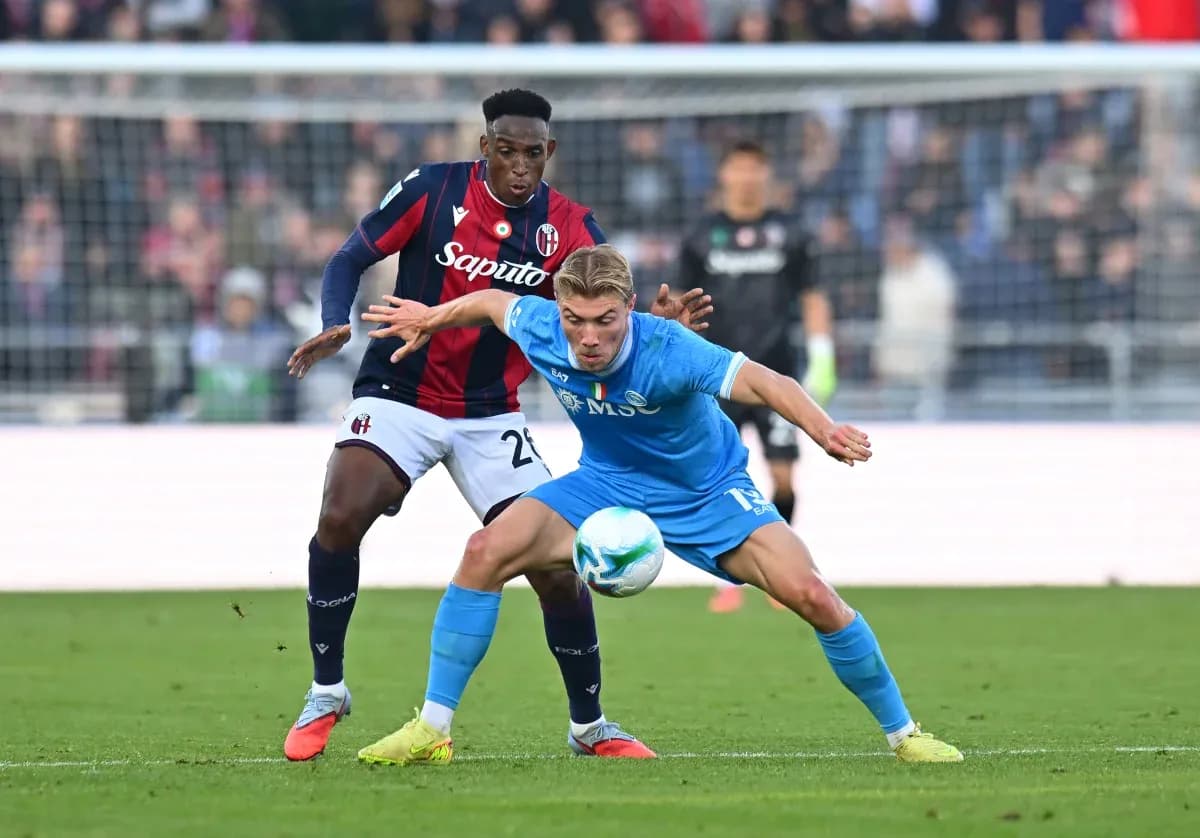
Napoli’s 3-2 home defeat to Bologna at Stadio Diego Armando Maradona unfolded as a structurally intriguing game: Antonio Conte’s 3-4-2-1 controlled slightly more of the ball (52% possession) and generated more volume (14 total shots to 10), but Vincenzo Italiano’s 4-3-3 was sharper in both boxes. Bologna leaned on vertical, high-value attacks and set-piece pressure, reflected in a higher xG (1.32 to Napoli’s 0.75), and converted those moments into three decisive goals that Napoli’s back three and single pivot never fully solved.
Bologna’s Early Dominance
Bologna’s early 4-3-3 structure set the tone. With R. Freuler as the holding midfielder and L. Ferguson and T. Pobega as interiors, they created a triangle that constantly targeted the half-spaces around S. Lobotka and S. McTominay. Full-backs Joao Mario and J. Miranda pushed high to pin Napoli’s wing-backs M. Politano and M. Gutierrez, forcing Napoli’s wide midfielders into deeper, reactive positions. The opening goal on 10 minutes, F. Bernardeschi finishing from a J. Miranda assist, encapsulated this: Bologna progressed down the left, Miranda overlapping from full-back into advanced space that Politano could not cover in time, exploiting the channel outside A. Buongiorno and A. Rrahmani.
Napoli’s Struggles
Napoli’s 3-4-2-1 in possession was built to create central overloads, with Giovane and Alisson Santos floating behind R. Hojlund. However, Bologna’s front three pressed asymmetrically: R. Orsolini and Bernardeschi tucked in to screen passes into Lobotka, while S. Castro worked to curve his runs onto the back three. This limited Napoli’s clean build-up, forcing more direct balls into Hojlund and wide deliveries rather than the kind of vertical combinations Conte’s shape usually seeks. Despite 484 total passes and 425 accurate (88%), much of Napoli’s circulation was in front of Bologna’s block, not through it.
Key Tactical Moments
The key tactical hinge came around the 33rd minute. Bologna’s willingness to attack the box and isolate Napoli’s defenders led to a penalty situation, confirmed by VAR at 33' (Penalty confirmed for Juan Miranda) and converted by R. Orsolini at 34'. That phase showed Bologna’s intent to drive into the area rather than settle for low-percentage shots: they finished with only 10 total shots but a superior xG, underlining the quality of their shot locations.
Napoli’s response before half-time was more about mentality than structural change. G. Di Lorenzo’s 45' goal, arriving from open play, reflected the advantage of having a nominal centre-back comfortable stepping into advanced positions in Conte’s back three. With Bologna slightly deeper protecting the 2-0, Di Lorenzo advanced aggressively on the right, taking advantage of Joao Mario’s earlier booking at 38' (Yellow Card — Foul) which made Bologna’s right-back more conservative in duels. The 2-1 score at half-time kept Napoli’s system alive despite underlying issues.
Second Half Dynamics
The restart showed Napoli’s best attacking phase. Within three minutes of the interval, Alisson Santos equalised at 48', assisted by Hojlund. Tactically, this came from Napoli finally managing to pin Bologna’s back four with better occupation of the last line: Hojlund’s movement across the centre-backs dragged J. Lucumi and E. Fauske Helland out of their ideal zones, creating a channel for Alisson Santos to attack. The move also highlighted Napoli’s strength when the front three receive service on the run rather than with their back to goal.
Yet Bologna’s defensive structure, despite four yellow cards, held firm. Joao Mario (38' — Foul), Federico Bernardeschi (47' — Foul), Eivind Helland (58' — Foul) and Jhon Lucumí (69' — Foul) were all booked, indicating a deliberate tactical choice to stop transitions early and accept disciplinary risk to protect central areas. Napoli, by contrast, received only one yellow card, Matteo Politano at 84' (Foul), underlining how often they were the team chasing and being disrupted rather than disrupting.
Substitutions and Late Game Tactics
The substitution pattern from Italiano was decisive in reasserting control after Napoli’s equaliser. At 64', N. Zortea (IN) came on for Joao Mario (OUT), refreshing the right flank defensively and athletically. Later, a triple midfield/forward refresh between 81' and 82' — N. Moro (IN) for T. Pobega (OUT), S. Sohm (IN) for L. Ferguson (OUT), and T. Heggem (IN) for E. Fauske Helland (OUT) — rebalanced Bologna’s central block. Crucially, the earlier change at 73' saw J. Rowe (IN) come on for F. Bernardeschi (OUT), adding direct pace and verticality against a tiring Napoli back line.
Conte’s own changes were more attacking but less structurally transformative. At 76', E. Elmas (IN) replaced Giovane (OUT) and B. Gilmour (IN) came on for S. Lobotka (OUT), shifting Napoli’s midfield profile towards more forward running and progressive passing but at the cost of Lobotka’s positional discipline in front of the back three. Later, L. Spinazzola (IN) for M. Politano (OUT) at 85' and P. Mazzocchi (IN) for M. Gutierrez (OUT) at 87' doubled down on wing thrust, but also exposed the flanks to counter-attacks as both wing-backs pushed extremely high.
Decisive Late Goal
That exposure was punished at 90', when J. Rowe struck the winner for Bologna. With Napoli’s structure stretched and their wing-backs advanced, Bologna’s refreshed legs in wide and central zones found space to attack the retreating back three. The goal aligned perfectly with the statistical story: Bologna, with fewer total shots, still created more dangerous situations and had the personnel freshness to exploit them late.
From a goalkeeping perspective, both sides underperformed relative to shot quality. Napoli’s goalkeeper V. Milinkovic-Savic made 1 save, with a goals prevented figure of -0.82, indicating that Bologna’s three goals slightly exceeded what an average keeper would be expected to concede from those shots. On the other side, M. Pessina recorded 3 saves and the same goals prevented value of -0.82, suggesting Napoli’s two goals came from relatively low xG chances, and Bologna’s keeper also allowed marginally more than the model’s expectation.
Statistical Summary
Statistically, the match underlines a key tactical contrast. Napoli’s overall form in this game was possession-dominant and pass-heavy — 484 passes to Bologna’s 458, with a higher completion rate (88% vs 84%) — but their attacking construction produced only 0.75 xG from 14 shots, a sign of sterile control and an inability to consistently access prime shooting zones. Bologna’s defensive index for the night, despite the card count, was strong: 4 shots on target conceded from 14 attempts, with aggressive, foul-heavy protection of the box and half-spaces.
Bologna’s own attacking profile — 10 shots, 4 on target, 1.32 xG — speaks to a game plan built on quality over quantity, vertical surges, and targeted exploitation of Napoli’s structural weaknesses when their wing-backs and advanced midfielders vacated space. The 3-2 scoreline, with Bologna’s four yellows to Napoli’s one (total cards: Napoli 1, Bologna 4, Total: 5), reflects a contest where Italiano’s side accepted defensive risk and disciplinary cost to impose their transition game, and were rewarded with the decisive late strike that Napoli’s more controlled but blunter approach could not match.