Australia's Strong Start at World Cup 2026 with 2-0 Win Over Türkiye
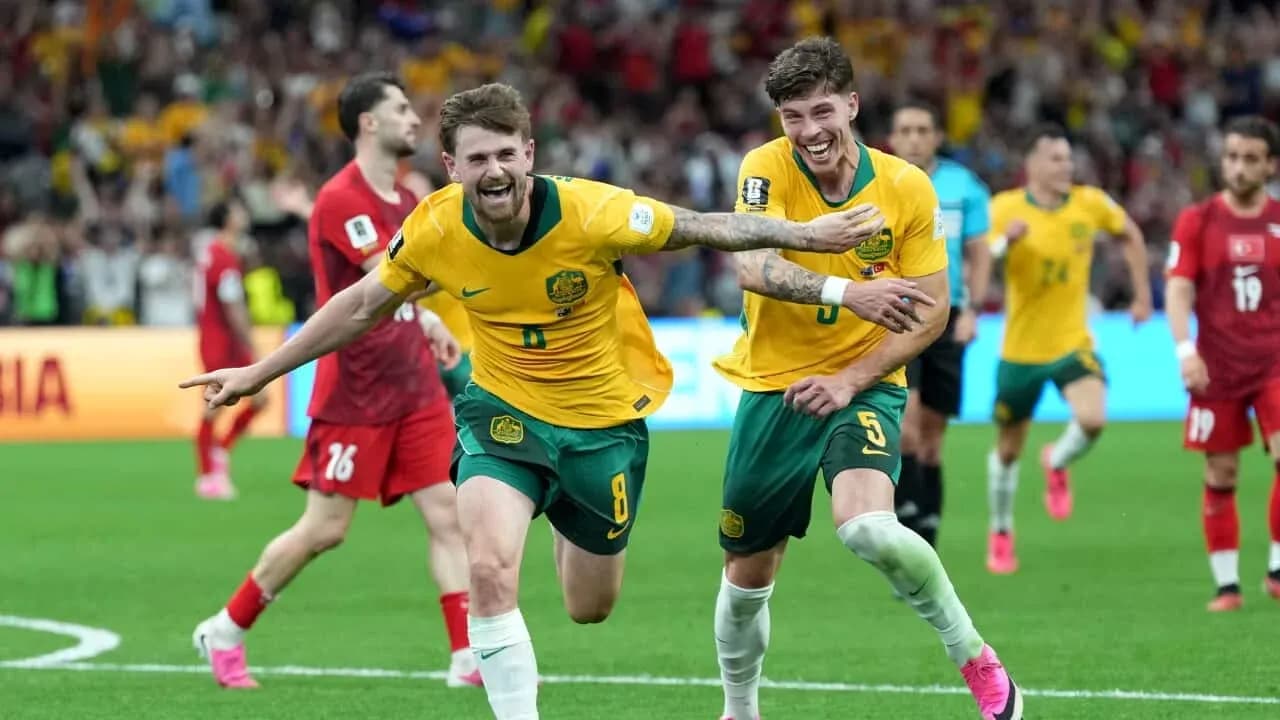
BC Place in Vancouver hosted a statement win as Australia opened their World Cup 2026 campaign with a 2-0 victory over Türkiye, a result that immediately reshaped the tone of Group D. Following this result, Australia sit 2nd in the group on 3 points with a goal difference of 2 (2 goals for, 0 against), while Türkiye are 3rd with 0 points and a goal difference of -2 (0 for, 2 against). It was a meeting of contrasting footballing identities: Australia’s compact, physically assertive 5-4-1 under Tony Popovic against Vincenzo Montella’s more intricate 4-2-3-1, built around technical flair and half-space creativity.
Popovic’s shape was the night’s defining structure. With Patrick Beach behind a back five of Jacob Italiano, Alessandro Circati, Harry Souttar, Cameron Burgess and Jordan Bos, Australia constructed a low, almost old-school World Cup block. The wing-backs, Italiano and Bos, were crucial: they had to be both full-backs and wingers, stepping out to confront Türkiye’s wide creators without leaving the three centre-backs exposed.
Ahead of them, the midfield quartet of Connor Metcalfe, Aiden O’Neill, Paul Okon-Engstler and Nestory Irankunda was built less like a traditional four and more like a sliding screen. O’Neill anchored the central channel, Metcalfe shuttled to close passing lanes into the No.10 zone, while Irankunda and Okon-Engstler alternated between tucking in and springing forward in transition. Mohamed Touré, the lone forward, was less a pure target man and more the trigger for pressing Demiral and Abdülkerim Bardakcı, forcing Türkiye to build wide rather than through the middle.
On the other side, Montella’s 4-2-3-1 had all the right names for control and incision: Hakan Çalhanoğlu and İsmail Yüksek as the double pivot, with Arda Güler, Orkun Kökçü and Barış Alper Yılmaz supporting Kerem Aktürkoğlu. On paper, that is a line of four capable of overwhelming most back fives between the lines. In practice, Australia’s density in central zones forced Türkiye to play in front of them, rarely through them.
The disciplinary and emotional narrative subtly tilted the match. Türkiye’s season card profile shows a pronounced late-game spike: 100.00% of their yellow cards so far have arrived in the 76-90 minute window. Yunus Akgün embodies that edge. Off the bench, he logged 35 minutes, took a yellow card, and still managed 21 passes at 90% accuracy with 2 key passes, plus 1 successful dribble from 1 attempt. He is both a spark and a risk: an attacker who can destabilise a block but whose aggression can boil over just as matches become stretched. There are no yellow or red card timings recorded yet for Australia, underlining how controlled and unflustered their defensive performance was in this opener.
In terms of individual arcs, two Australians have already written themselves into the early World Cup storylines. Nestory Irankunda, listed among the competition’s top scorers, delivered a quintessential wide-midfielder performance: 1 goal from 2 shots, both on target, in 61 minutes. He won 2 of 7 duels, completed his only dribble and absorbed contact on the outside, drawing 1 foul while committing 1. His role was the “Hunter” in the Hunter vs Shield dynamic: a vertical threat attacking the space behind Türkiye’s full-backs, particularly when Ferdi Kadıoğlu or Zeki Çelik advanced.
Behind him, Paul Okon-Engstler functioned as the understated “Engine Room” hub. Among the top assist providers in the tournament so far, he produced 1 assist, completed 32 passes at 81% accuracy and created 2 key passes. Out of possession he was even more impressive: 3 tackles, 3 interceptions, and he blocked 2 shots. That combination of progressive passing and defensive bite is exactly what Australia’s 5-4-1 needs to transition from survival mode into a proactive, counter-attacking system.
For Türkiye, the creative spine remains theoretically formidable. Çalhanoğlu and Kökçü are natural orchestrators, while Güler’s positioning between the lines is designed to test the seams of any back five. Yet heading into this tournament they have now played 1 match, scored 0 goals in total, and failed to score on their travels in that game. Their total goals against stands at 2, all conceded away, for a total average of 2.0 goals conceded per match on their travels. The Shield, at least for now, is fragile.
Tactically, the intersection is clear. Australia’s total attacking output so far is modest in volume but ruthless in efficiency: 2 goals in total from their only match, both at home, with a total average of 2.0 goals scored at home and 2.0 overall. They have yet to concede, registering 1 clean sheet at home and in total. That defensive platform allows them to lean into Irankunda’s directness and Touré’s running without overcommitting.
Türkiye, conversely, must solve two problems at once. First, how to protect their back line when their full-backs push high. The 2-0 away defeat is already their heaviest result of the campaign, and it came in the exact scenario Australia are built to exploit: a stretched pitch with space in the channels. Second, how to ensure that the creative quartet actually receives the ball in advantageous zones rather than constantly recycling in front of a low block.
From a statistical prognosis standpoint, Australia’s early numbers scream solidity: 1 win from 1, 0.0 goals conceded on average at home and in total, 1 clean sheet, and no penalties awarded or missed. Türkiye’s profile is inverted: 1 loss from 1, 0.0 goals scored in total, 2.0 goals conceded on their travels on average, and 1 match where they failed to score. There are no xG figures in the data, but the pattern is unmistakable: a side already comfortable in its defensive identity versus one still searching for balance between expression and control.
As the group stage unfolds, the blueprint from Vancouver is likely to persist. Australia will double down on their back five, trusting Okon-Engstler to connect phases and Irankunda to punish transitions. Türkiye must harness the talent of Güler, Çalhanoğlu and Kökçü while tightening the structure behind them. For now, the tale of Group D is that of a disciplined collective outmanoeuvring a more glamorous but less cohesive opponent, with the numbers and the narrative perfectly aligned.