Australia's Tactical Triumph Over Türkiye: A 2-0 Victory
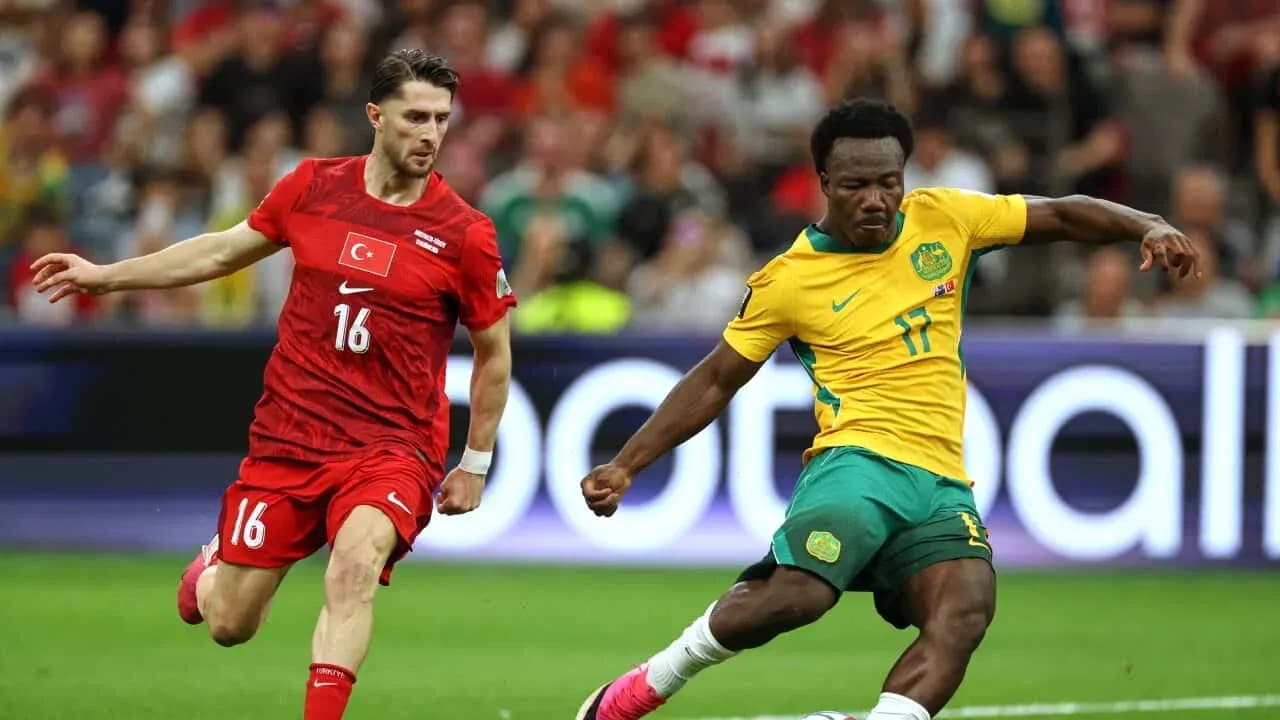
Australia’s 2-0 win over Türkiye at BC Place was a classic case of defensive control and ruthless transition from a low-possession side. In a World Cup group-stage opener where Türkiye had 72% of the ball and a 30-9 shot advantage, Tony Popovic’s Australia leaned fully into a 5-4-1 block, protected the box, and struck with precision through Nestory Irankunda and Connor Metcalfe to bank three points.
Executive Summary
Australia set up in a 5-4-1, ceding territory but compressing central spaces and defending their area with numbers. Türkiye’s 4-2-3-1, built around Hakan Çalhanoğlu and Arda Güler, produced volume but not clarity: many of their 30 attempts came from outside or through heavy traffic, repeatedly meeting a crowded defensive line and an outstanding Patrick Beach in goal. With xG at 0.77 vs 1.33 and possession 28% vs 72%, Australia won by executing a clear, low-margin plan better than Türkiye executed their expansive one.
Scoring Sequence & Disciplinary Log
The opener on 27' encapsulated Australia’s blueprint. Winning the ball and breaking quickly, Paul Okon-Engstler drove the transition from midfield and released Nestory Irankunda. Attacking from the right side of the Australian midfield line, Irankunda exploited the space behind Türkiye’s advanced full-backs and finished clinically: 27' N. Irankunda (Australia) — assisted by P. Okon-Engstler. That goal allowed Australia to sink even deeper into their 5-4-1, with the wide midfielders dropping to form a situational back six.
After the interval, Türkiye chased the game with more aggressive substitutions, but the decisive second goal again came from Australia’s ability to break the press. On 75', with Türkiye pushed high and both full-backs committed, Australia found Connor Metcalfe arriving from central midfield to finish a move that Türkiye’s rest defence could not stabilize: 75' C. Metcalfe (Australia) — (no assist). At that point, Australia led 2-0 and could fully prioritize box protection and time management.
Discipline remained relatively clean. The only card of the match came late: 86' Y. Akgun (Türkiye) — Roughing. That isolated yellow reflected Türkiye’s frustration rather than any sustained breakdown in control from Australia.
Tactical Breakdown & Personnel
Australia – Compact 5-4-1, vertical threat
Popovic’s 5-4-1 was built on three core principles: narrowness, depth, and rapid verticality. The back five of Jacob Italiano, Alessandro Circati, Harry Souttar, Cameron Burgess, and Jordan Bos stayed extremely compact horizontally, denying central lanes for Arda Güler and Orkun Kökçü. The wing-backs rarely overlapped; instead, they focused on holding the line and contesting crosses, which is reflected in Türkiye being forced into 16 shots from outside the box and 12 blocked shots overall.
In midfield, Connor Metcalfe, Aiden O’Neill, Paul Okon-Engstler, and Nestory Irankunda formed a flat four in the defensive phase, with Metcalfe and O’Neill screening Çalhanoğlu’s zone. Their job was not to dominate the ball (Australia completed 270 passes to Türkiye’s 707) but to protect the central corridor and spring forward at the first turnover. The first goal was a direct product of Okon-Engstler’s timing in transition and Irankunda’s aggressive starting positions on the right.
Mohamed Touré’s role as the lone forward was sacrificial: he pressed selectively to screen passes into Türkiye’s double pivot and offered a vertical outlet. Australia’s 9 total shots and 0.77 xG underline that they attacked in bursts rather than through sustained possession, but when they arrived in the box (6 shots inside), they did so with numbers and intent.
The defensive cornerstone was Patrick Beach (Australia). Facing 8 shots on goal, Beach made 8 saves, directly underpinning the clean sheet. The negative goals prevented figure (-0.95) suggests that, in pure xG-on-target terms, he conceded slightly better chances than expected, yet the raw saves volume in a 2-0 win confirms his importance: he dealt with repeated deliveries, mid-range efforts, and late Turkish pressure without error.
Substitutions from Australia were about refreshing energy in wide and midfield zones to maintain the block. Nishan Velupillay (IN) came on for Nestory Irankunda (OUT) at 61', preserving the right-sided transition threat. At 74', Tete Yengi (IN) came on for Mohamed Touré (OUT) to continue offering depth on the last line, while Jason Geria (IN) replaced Jacob Italiano (OUT) to keep the right flank defensively secure. In the final phase, Aziz Behich (IN) for Jordan Bos (OUT) and Jackson Irvine (IN) for Paul Okon-Engstler (OUT) at 84' added experience and aerial presence as Australia locked down the result.
Türkiye – Territorial dominance, structural inefficiency
Vincenzo Montella’s 4-2-3-1 delivered control but not incision. With 72% possession, 707 total passes (638 accurate, 90%), and 30 total shots, Türkiye dictated where the game was played but not how it was decided. The double pivot of İsmail Yüksek and Hakan Çalhanoğlu circulated the ball well, yet Australia’s narrow block forced much of the play into lateral recycling and speculative efforts from distance.
The front four of Arda Güler, Orkun Kökçü, Barış Alper Yılmaz, and Kerem Aktürkoğlu tried to overload half-spaces, but Australia’s back five plus two screening midfielders regularly outnumbered them centrally. Türkiye’s 14 shots inside the box show they did reach dangerous zones, but the combination of tight marking and last-ditch blocks (12 blocked shots) meant many of these attempts were rushed or from suboptimal body positions.
Uğurcan Çakır (Türkiye) had a quieter but more punishing day: he faced 4 shots on goal and made 2 saves, conceding twice. With Türkiye’s line high and full-backs advanced, transitions left him exposed, particularly on the first goal when the back line was stretched and the protection in front of him thin.
Montella’s substitutions were clearly aimed at adding attacking thrust. At 46', Kenan Yıldız (IN) came on for Barış Alper Yılmaz (OUT), adding a more direct, dribbling threat between the lines. On 62', Yunus Akgün (IN) replaced Orkun Kökçü (OUT), pushing Türkiye towards a more winger-heavy, cross-oriented approach. Later, Salih Özcan (IN) for İsmail Yüksek (OUT) at 81' was designed to maintain tempo and counter-pressing, while Mert Müldür (IN) for Zeki Çelik (OUT) at 81' and Deniz Gül (IN) for Kerem Aktürkoğlu (OUT) at 85' injected fresh legs in wide and attacking areas. Yet, despite these changes, Australia’s structure held, and Türkiye’s shot quality never truly matched its volume.
The Statistical Verdict
The raw numbers tell a story of dominance without reward for Türkiye and efficiency for Australia. Türkiye’s 30-9 shot edge, 8-4 shots on goal lead, and 72%-28% possession advantage would normally correlate with at least a draw. Their xG of 1.33 against Australia’s 0.77 reinforces that they generated more and slightly better chances overall.
However, the defensive index tilts sharply towards Australia. They conceded only 8 shots on goal from 30 attempts, blocked 12, and forced 16 efforts from outside the box. Patrick Beach (Australia) converting 8 saves into a clean sheet, combined with a disciplined foul profile (12 fouls but no cards), underlines the effectiveness of their deep block. Türkiye, by contrast, committed just 4 fouls and picked up 1 yellow card (Yunus Akgün for Roughing), suggesting they lacked the tactical fouling sometimes needed to kill transitions.
Passing figures highlight the stylistic contrast: Australia’s 270 passes, 202 accurate (75%), were functional and vertical, while Türkiye’s 707 passes, 638 accurate (90%), established territorial control but not enough penetration. The negative goals prevented values for both teams (-0.95 each) point to slightly underperforming goalkeeping in pure xG-on-target terms, yet context matters: Beach’s volume of work under pressure was decisive, whereas Çakır’s few but high-impact actions went against him.
Ultimately, this match was won not in the passing lanes but in the penalty areas. Australia maximized their limited attacking moments and defended their box with collective precision; Türkiye translated dominance into pressure but not into goals. In tournament football, that trade-off is often fatal, and at BC Place it delivered Australia a tactically mature 2-0 victory.