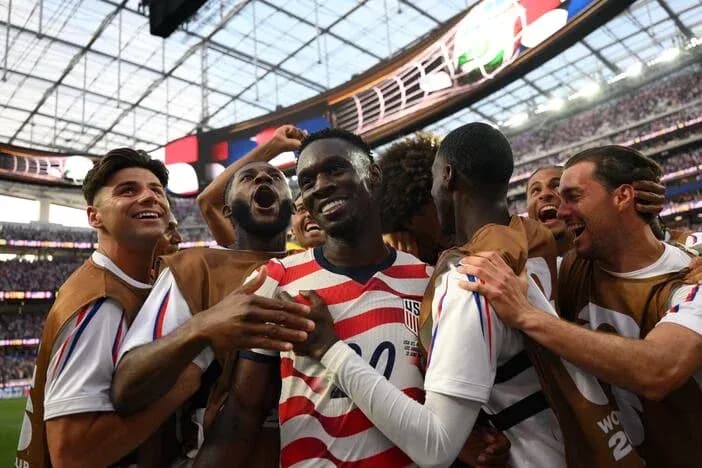
World Cup 2023: USA Shines in Opener, Scotland Surprises
LOS ANGELES — For months, the story of this World Cup lived outside the white lines: political crossfire, eye-watering ticket prices, immigration snags, questions about security and transit.
Then the whistle blew.
Once the ball started rolling across Mexico, Canada and the United States, the noise faded and the football took over. The opening days of this five-week tournament have already delivered upsets, statement wins and a few history-making moments.
A U.S. opener with real teeth
From a U.S. perspective, it’s hard to start anywhere but Los Angeles Stadium on Friday night, where the American men produced what will stand, for a long time, as one of the most complete World Cup performances in their history.
USA 4, Paraguay 1.
A scoreline that didn’t flatter them. It underlined them.
Four goals — the most the U.S. men have ever scored in a World Cup match. At the heart of it, Folarin Balogun, ruthless and sharp, became the first American since 1930 to hit a World Cup brace. Nearly a century of tournaments between those milestones. He picked his moments, finished with conviction, and turned an opener into a statement.
Behind him, Chris Richards quietly put together a masterclass. Back in the XI after missing both pre-tournament friendlies with injury, the defender treated the ball as if it were glued to his boots: 83 passes attempted, 83 completed. No player has hit that mark in a World Cup match since records began in 1966. It wasn’t just tidy recycling. It was control, rhythm, authority from the back.
Not everything went smoothly. Christian Pulisic, the face of this team and its cutting edge in transition, limped off at halftime with a calf issue. He walked gingerly to the bus afterward, his status still unclear. For a side that just announced itself so loudly, that’s the one note of anxiety humming underneath.
From back to front, though, the U.S. sparkled. They pressed, they combined, they took risks. It looked like a team that believes it belongs deep in this tournament.
But one game does not a World Cup run guarantee.
Australia crash the script in Group D
On Saturday, the Americans got a close look at what’s coming next in Group D: Turkey and Australia.
On paper, Turkey carry the star power. Arda Güler from Real Madrid. Kenan Yildiz from Juventus. A squad sprinkled across Europe’s biggest leagues, players used to Champions League nights and pressure.
Australia ripped that script up.
The underdogs punched Turkey in the mouth with a 2-0 win, a result that jolted the group and sharpened the stakes for Friday’s USA–Australia clash. Win that, and the U.S. don’t just top the group early; they seize control of their route to the knockout rounds. Lose it, and that Paraguay performance becomes a nice memory rather than a launchpad.
The group suddenly feels alive. One powerhouse flexing, another stumbling, and Australia refusing to play the supporting role.
Scotland back on the big stage — and on top
Elsewhere, another story has cut through the noise. Scotland, back at a World Cup for the first time in 28 years, didn’t just show up. They showed up and climbed straight to the top of Group C.
A win over Haiti put them in a position few would have predicted, especially in a pool that includes Brazil — five-time world champions — and a rising Morocco side that reached the semifinals in 2022. Those two heavyweights slugged out a 1-1 draw, a result that leaves Scotland looking down at royalty. For now, at least.
The assumption remains that Brazil and Morocco will find their stride and move on, but the early table tells a different, more romantic story. Scotland have waited nearly three decades for this stage. They’re not tiptoeing around it.
Firsts, shocks and a familiar German scoreline
The opening weekend also sprinkled in milestones and déjà vu.
Qatar, in just its second World Cup, finally has something tangible to show for the effort. A 1-1 draw with Switzerland on Saturday brought the nation its first-ever World Cup point. In 2022, as hosts, Qatar lost all three games. This time, they have a foothold.
Group F delivered a heavyweight draw of its own as the Netherlands and Japan traded blows in a 2-2 tie. Two well-drilled sides, both with ambitions that stretch far beyond the group stage, left with a point and a reminder that there will be no easy path out of this section.
Then came Curaçao. Population: 158,000. The smallest country ever to appear at a World Cup, walking out against Germany, one of the sport’s great tournament machines.
Germany struck early. Curaçao hit back, and for 17 minutes, the scoreboard read 1-1 and the impossible felt within reach. Then Germany did what Germany so often do on this stage. They turned the screw, found their rhythm and ran away 7-1 winners — a scoreline etched in World Cup history for them, now repeated against the tiniest of opponents.
For Curaçao, those 17 minutes will live long. For Germany, it looked ominously like business as usual.
Politics, pressure and Iran’s tightrope
The football hasn’t erased the politics entirely.
Iran’s opening match against New Zealand on Monday at Los Angeles Stadium arrives under a heavy shadow. After the U.S. and Israel attacked Iran in February, speculation swirled about whether the Iranian team would even participate in this World Cup.
They were originally set to base their camp in Tucson, Arizona. Instead, citing security concerns and the broader hostilities, they shifted to Tijuana, Mexico. Their movements into the U.S. are tightly controlled: the American government is allowing them to enter only the day before each of their three group matches.
So Iran will arrive late, play under scrutiny, and leave quickly. On the pitch, it’s still football. Off it, every step is political.
Mbappé, Messi and the giants join the party
The next wave of drama arrives on Tuesday, when two of the sport’s defining figures of this era walk into the tournament.
France, with Kylian Mbappé at the peak of his powers, open their Group I campaign against Senegal in one of the standout fixtures of the first round. Mbappé has carried France to a World Cup title and a final already; this time, he leads a squad expected not just to contend, but to dominate.
On the same day, the defending champions finally step onto the stage. Argentina and Lionel Messi begin their bid for back-to-back titles against Algeria in Group J. Only Italy (1938) and Brazil (1962) have ever successfully defended the World Cup. The history books are small here, the pressure enormous.
Messi’s chase for a second straight crown gives this tournament its central narrative thread. Argentina know exactly what it takes to climb the mountain. Doing it again, with every opponent desperate to be the one that knocks them off, is a different kind of test.
The noise before this World Cup was loud and messy. Now the games have started, the stories are being written in real time — on grass, under floodlights, with everything on the line.