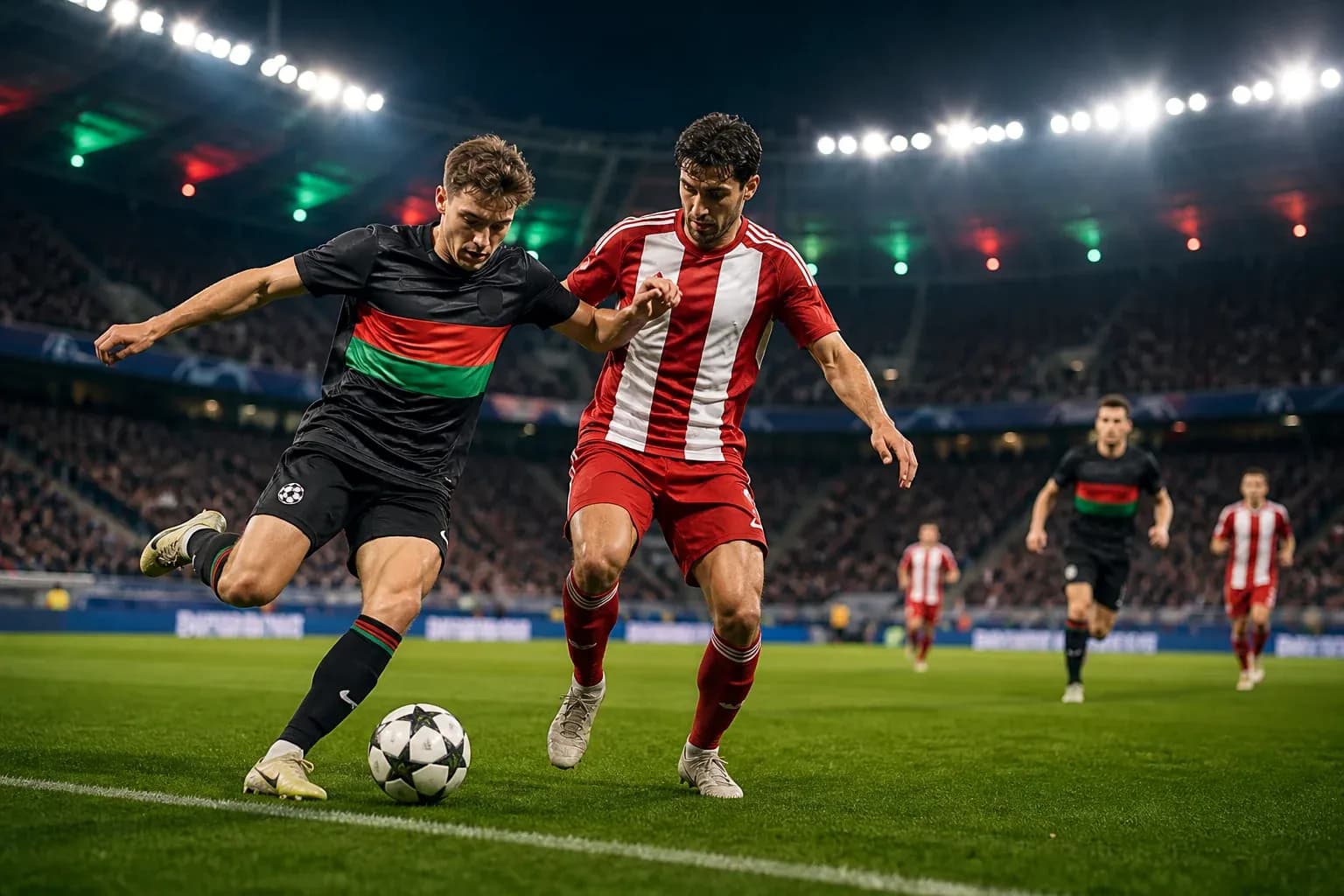
NEC Nijmegen's Tactical Mastery in 2-1 Win Over Olympiakos
NEC Nijmegen’s 2-1 extra-time win over Olympiakos Piraeus at Stadion de Goffert was built on structural bravery, tempo control and intelligent use of the extra man, rather than sheer volume of chances. Across 120 minutes in this UEFA Champions League 3rd Qualifying Round tie, NEC turned a 0-1 deficit into a controlled siege, leveraging a 3-1-4-2 to stretch and fatigue a 4-2-3-1 that became increasingly reactive after the red card.
NEC’s 3-1-4-2 gave them the central platform to dominate possession (54%) and passing volume (603 passes, 457 accurate at 76%). With three centre-backs and D. Nejasmic as the single pivot, they could build in a 3+1 structure against Olympiakos’s first pressing line of A. El Kaabi plus the three attacking midfielders. The back three – T. Storm, P. Sandler and D. Fonville – were rarely pressed simultaneously, allowing NEC to progress methodically and pin Olympiakos deeper as the game wore on.
The wing-oriented line of four midfielders was decisive. C. Bischoff and S. Ouaissa initially provided width and underlaps, while N. Lebreton and D. Tadic operated as interior playmakers. This shape consistently created 2v1s against the Olympiakos full-backs, especially once fatigue set in. NEC’s 11 shots inside the box (out of 16 total) show how often they managed to carry attacks into dangerous central zones after drawing the block wide.
Up front, the pairing of T. Chery and B. Linssen was more about occupation of centre-backs and link play than constant depth runs. Their movement between lines dragged P. Retsos and L. Pirola into uncomfortable positions, especially once NEC increased the tempo in the second half. Linssen’s equaliser, assisted by Tadic, was emblematic: NEC worked the ball into the half-spaces, then attacked the box with numbers, exploiting the structural superiority of two strikers against a tiring back four.
Olympiakos’s Approach
Olympiakos’s 4-2-3-1 started with a clear plan: compact mid-block, quick vertical transitions through G. Martins, G. Sa and Jota Silva into El Kaabi. With only 46% possession and 10 total shots, their approach hinged on efficiency and moments. El Kaabi’s goal at 46' was the clearest execution of that idea, capitalising on NEC’s high line at the start of the second half. However, as NEC increased their passing rhythm, the double pivot of D. Garcia and S. Hezze was forced progressively deeper, turning the 4-2-3-1 into a 4-4-1 and then, after the red card, into a survival 4-4-0/4-5-0 in many phases.
The discipline data underlines how stretched Olympiakos became: 19 fouls, four yellow cards and one red. The red card to Kostas Fortounis at 80' for “Foul”, following a VAR “Card upgrade” review at 79', fundamentally changed the tactical landscape. With ten men, Olympiakos could no longer contest central zones aggressively. Their block dropped closer to B. Popovic, and they sacrificed any consistent counter-attacking threat. From that point, their offensive structure largely collapsed into isolated clearances and sporadic transitions, reflected in only two shots on goal all match.
NEC’s Tactical Management
NEC’s bench management was tactically sharp. Early in the first half, Dick Schreuder adjusted his back line and right flank: S. Ouaissa (OUT) for E. Mor (IN) at 30' injected direct 1v1 threat, while P. Sandler (OUT) for B. Pereira (IN) at 34' refreshed the defensive line and later added overlapping energy. As the game progressed, attacking substitutions were layered on: K. Sierhuis (IN) for C. Bischoff at 88', J. Monteiro (IN) for B. Linssen and B. Nuytinck (IN) for N. Lebreton at 106', plus K. Kers (IN) at 106'. These changes tilted NEC into an even more aggressive, almost 3-3-4 look in possession during extra time, with multiple forwards and advanced midfielders attacking the last line.
The decisive extra-time goal by E. Mor at 95', assisted by K. Sierhuis, was the product of that cumulative pressure. NEC’s repeated entries into the box – 11 shots inside it, 7 on goal – eventually broke Olympiakos’s undermanned block. The disallowed potential goal by Sierhuis at 90+4', cancelled by VAR, also illustrated how NEC were overloading the penalty area with late runs from substitutes and second strikers.
Defensive Strategy
Defensively, NEC accepted a relatively high foul count (17) as the cost of aggressive counter-pressing. Their three centre-backs stepped into midfield when possession was lost, with Nejasmic screening El Kaabi. Olympiakos’s 6 shots off goal and 4 shots from outside the box show that NEC generally forced them into lower-quality attempts. The card for Brayann Pereira at 88' for “Foul” was part of that edge-of-acceptability approach to stopping transitions.
In goal, G. Crettaz (NEC Nijmegen) faced only 2 shots on goal and made 1 save, underlining NEC’s territorial control and the limited volume of clear Olympiakos chances. At the other end, B. Popovic (Olympiakos Piraeus) made 5 saves, a figure that aligns with NEC’s sustained attacking pressure, particularly after going 2-1 up in extra time.
Statistically, NEC’s superiority is clear: more possession, more passes (603 vs 505), better passing accuracy (76% vs 69%), more total shots (16 vs 10), more shots on goal (7 vs 2), and more blocked efforts (3 vs 2), reflecting Olympiakos’s last-ditch defending. The corner count (3 vs 4) is the one area where Olympiakos marginally edged NEC, but it never translated into sustained territorial dominance.
From a broader tactical lens, NEC played like a side built for control and volume rather than pure efficiency, while Olympiakos approached the tie as an away underdog seeking moments. Once reduced to ten men, Olympiakos’s game model could no longer support El Kaabi in transition, and NEC’s structural and numerical superiority in midfield and wide zones inevitably turned into scoreboard pressure. Over 120 minutes, the 2-1 scoreline and the underlying metrics both point to a deserved progression for NEC Nijmegen, earned through systematic occupation of space, assertive in-game adjustments, and relentless exploitation of the extra man.