Celje's Tactical Mastery in 2-0 Win Against Ararat-Armenia
Celje’s 2-0 win over Ararat-Armenia at Arena Z’dezele in the UEFA Champions League 3rd Qualifying Round was built on a clear structural idea: a 4-3-3 that gradually squeezed the visitors deeper until the final-quarter surge delivered the goals. With possession split exactly 50%-50%, the difference lay not in ball share but in how Celje used territory, width and their midfield three to pin Ararat-Armenia back and generate a much higher shot volume.
Vitor Campelos set Celje up in a 4-3-3 with Z. Leban in goal behind a back four of P. Sirvys, D. Hrka, Artemijus Tutyškinas and Leonardo Koutris. In front, the trio of M. Kvesic, Mark Zabukovnik and S. Seslar acted as the game’s stabilising structure: Kvesic as the deeper organiser, Zabukovnik and Seslar stepping higher to connect with the front line of M. Ivansek, A. Kucys and Milot Avdyli. Although A. Kucys is listed without a position, his grid placement in the front line underlines the intention to maintain three high reference points and stretch Ararat-Armenia’s back four laterally.
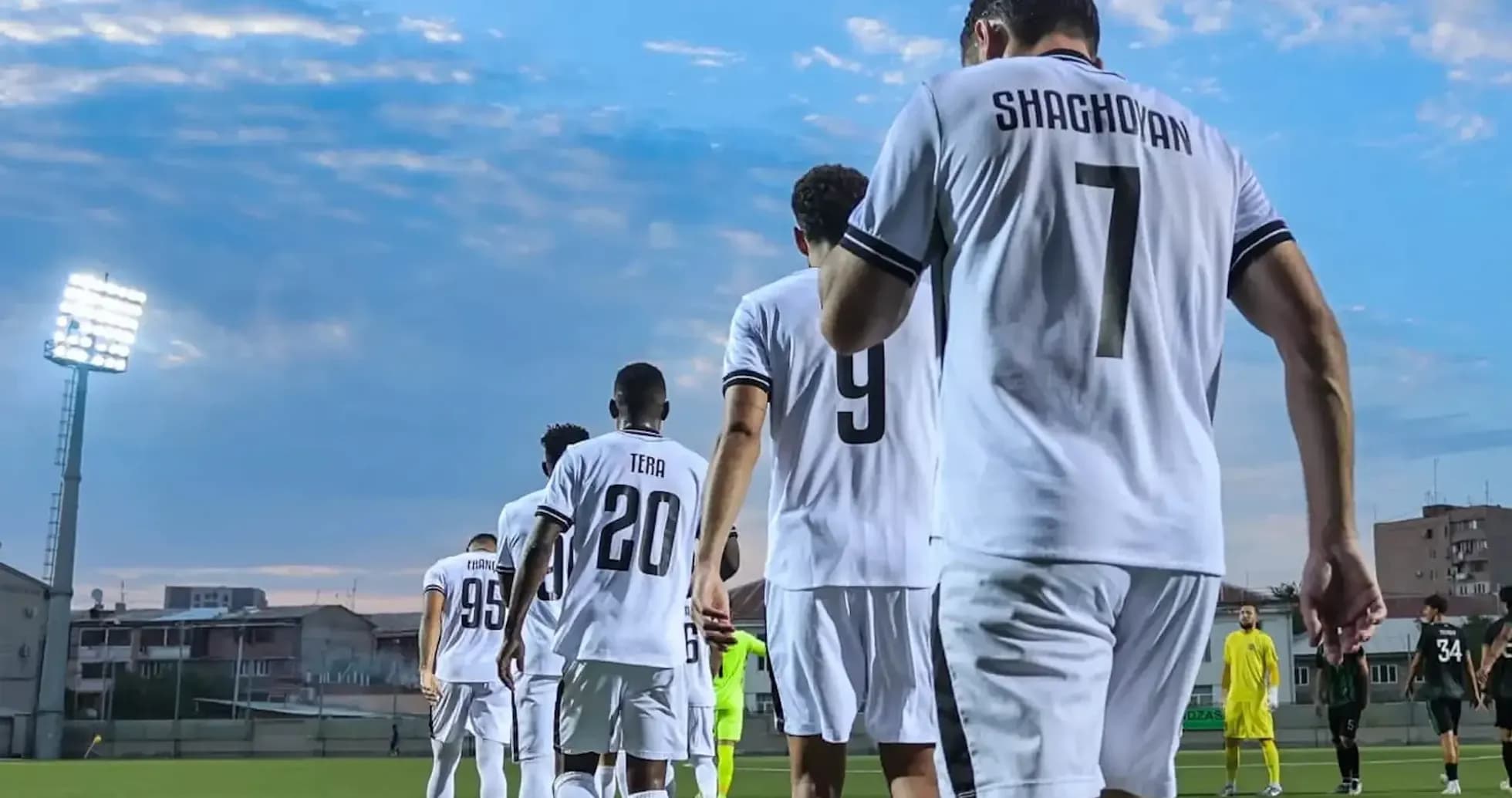
Ararat-Armenia mirrored the 4-3-3 on paper under Tulipa, but functionally played more like a 4-1-4-1 for long spells. Joao Bravim started in goal, with a defensive line of E. Grigoryan, A. Malis, B. R. Wilson Valdez and Junior Julio. In midfield, H. Oliveira and K. Muradyan flanked A. Tera, with A. Serobyan and Z. Banjaqui supporting central striker Sandro Lima. Yet the statistical pattern – only 3 shots on goal to Celje’s 8, and 4 blocked shots to Celje’s 7 – shows that Ararat-Armenia’s 4-3-3 was mostly reactive, absorbing pressure and relying on sporadic transitions.
Celje’s 12 corner kicks to Ararat-Armenia’s 9 tell part of the story: repeated territorial gains, especially down the flanks. Early on, Koutris and Sirvys pushed high, with Zabukovnik and Seslar rotating into the half-spaces to create 2v1s on the outside. This dynamic forced Ararat-Armenia’s wide midfielders, particularly Z. Banjaqui and A. Serobyan, to drop deeper than ideal, blunting their counter-attacking threat. The fouls count – 16 for Celje and 13 for Ararat-Armenia – reflects a physically intense contest, but the disciplinary timeline shows Celje increasingly using tactical fouls to prevent transitions as they committed more bodies forward.
The first-half stalemate at 0-0 was less about a lack of structure and more about execution in the final third. Celje already had the upper hand in shot volume, but Ararat-Armenia’s compact central block, anchored by A. Tera and K. Muradyan, narrowed the lanes into Sandro Lima’s feet and tried to spring quick counters. However, with only 3 shots on goal across the 90 minutes, Ararat-Armenia rarely managed to connect the first and second passes after regaining possession, a sign that Celje’s counter-press and rest defence were well calibrated.
Campelos’ in-game management sharpened Celje’s attacking edge. At 46', B. Verbic (IN) came on for L. Koutris (OUT), a substitution that had a double tactical effect. First, it introduced a more direct, vertical runner who could attack the left half-space and arrive in the box, rather than overlapping from deep. Second, it allowed Celje to tilt their shape asymmetrically, with Sirvys staying a bit deeper on the right while the left side became more aggressive. Later, at 69', Y. Dukuly (IN) for P. Sirvys (OUT) and M. Poplatnik (IN) for A. Kucys (OUT) further increased attacking density between the lines, with Dukuly offering dribbling and combination play and Poplatnik adding penalty-box presence.
Ararat-Armenia’s response was more conservative. Benny (IN) for A. Tera (OUT) at 55' and then M. Carlier (IN) for H. Oliveira (OUT) plus Franca Carlos (IN) for A. Serobyan (OUT) at 73' were aimed at refreshing legs in midfield rather than changing the structural picture. The late change of A. Ndour (IN) for Z. Banjaqui (OUT) at 89' came when Celje were already 2-0 up and in control. The fact that Ararat-Armenia never significantly altered the front structure around Sandro Lima contributed to their predictability; Celje’s centre-backs could step out aggressively, knowing the support runs behind Lima were limited.
The decisive phase between 80' and 90' highlighted how Celje’s sustained pressure finally broke the visitors. By then, the home side had accumulated 8 shots on goal and 7 blocked shots, underlining both volume and persistence. The first goal at 83' came from Y. Dukuly, assisted by M. Avdyli, a direct payoff from Campelos’ attacking substitutions: fresh legs in advanced midfield zones exploiting tired defenders and second-phase disorganisation. Just two minutes later, at 85', B. Verbic struck to make it 2-0, confirming the value of his half-time introduction as a more goal-oriented wide presence.
Discipline also had a subtle tactical impact. Ararat-Armenia’s early bookings – Alwyn Tera for "Foul" and Hugo Oliveira for "Unsporting behaviour", both at 19' – reduced their margin for aggression in central areas. As Celje increased their tempo after the break, the visitors’ midfielders had to defend with more caution, which opened pockets for Seslar, Zabukovnik and later Dukuly to receive on the turn. Celje’s own yellow cards – Leonardo Koutris (32', "Foul"), Artemijus Tutyškinas (64', "Foul"), Milot Avdyli (66', "Foul"), Mark Zabukovnik (79', "Foul") and Benjamin Verbič (86', "Unsporting behaviour") – reflect a side willing to foul to sustain pressure and counter-press, particularly once they had numerical superiority in attacking zones.
Without recorded goalkeeper saves or passing metrics, the clearest statistical lens is shot quality and territorial indicators. Celje’s 8 shots on goal versus Ararat-Armenia’s 3, combined with a 12-9 corner advantage and identical 50% possession, depict a match where the home side transformed equal ball share into far more dangerous field positions. The 2-0 final scoreline aligns with this pattern: a structurally dominant Celje side that, through intelligent use of the 4-3-3, aggressive full-back and midfield rotations, and well-timed attacking substitutions, converted territorial control into a deserved two-goal cushion while restricting Ararat-Armenia to sporadic, low-volume threat.