Bodo/Glimt's Tactical Mastery in Extra-Time Victory Over Union St. Gilloise
Bodo/Glimt’s 3-2 extra-time win over Union St. Gilloise at Aspmyra Stadion was a tactical siege decided by patience, width and superior control of space, set against an opponent built for vertical transitions and last-ditch resistance.
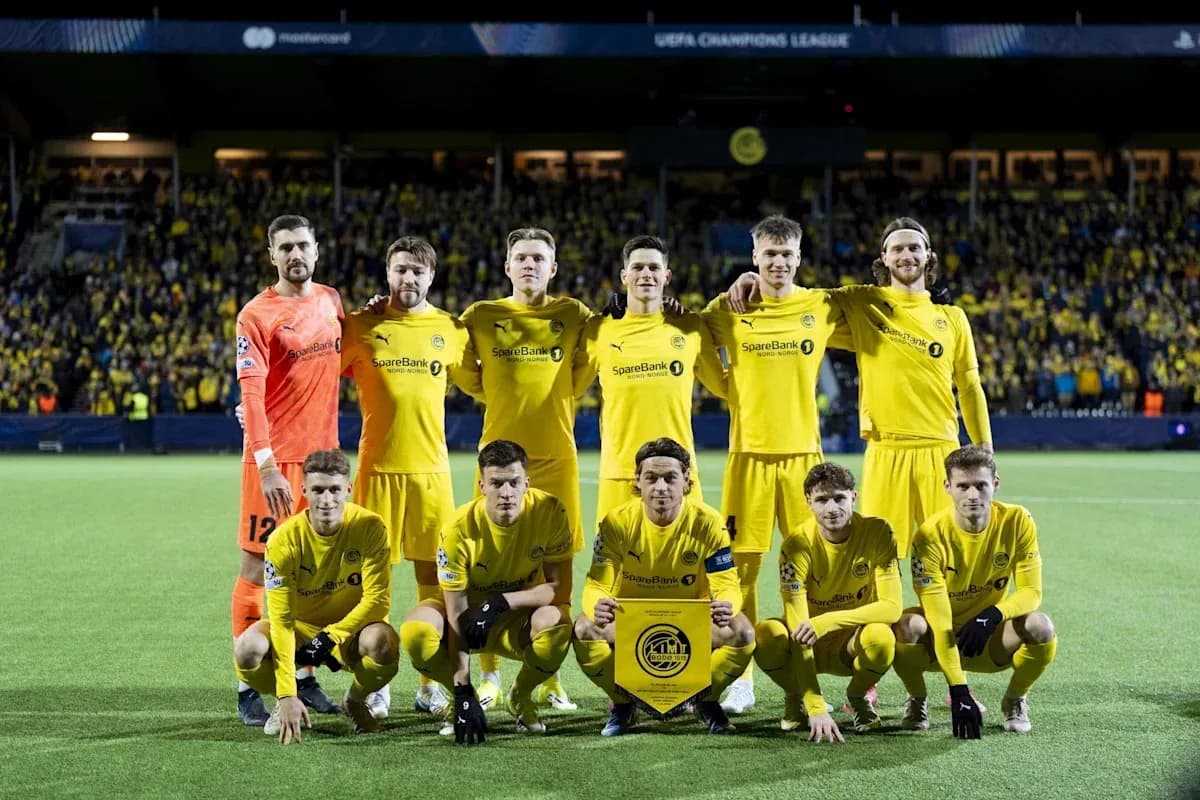
Structurally, Kjetil Knutsen kept Bodo/Glimt in a clear 4-3-3. The back four of F. Bjorkan, J. Gundersen, O. L. Bjortuft and F. Sjovold set an aggressively high line, supported by a midfield trio of Sondre Auklend, P. Berg and S. Fet that constantly stepped into Union’s half. With 70% possession and an enormous 999 passes (889 accurate, 89%), the home side’s plan was to suffocate the visitors with circulation and positional rotations, particularly between the interiors and wide forwards.
The front three of O. Blomberg, O. Brynhildsen and J. Hauge provided the width and depth that underpinned the entire attacking scheme. Bodo/Glimt generated 23 total shots, 17 from inside the box, and 9 on target; that shot map profile reflects a team consistently arriving in advanced zones through structured pressure rather than chaotic breaks. Hauge’s role was pivotal: he drifted inside from the left, combining with Berg between the lines, while Bjorkan overlapped to pin back Union’s right side. On the opposite flank, Sjovold’s more conservative positioning allowed Blomberg to attack the half-space and arrive in finishing zones, as seen in his opening goal.
Union St. Gilloise, in contrast, set up in a 3-5-2 under David Hubert, clearly designed for compactness and counter-attacking. The back three of N. Havenaar, M. Sylla and Kevin Mac Allister sat relatively deep, with wing-backs L. Patris and Guilherme Smith tasked with covering huge vertical distances. Central midfielders B. Zeneli, K. Van De Perre and A. Zorgane (later replaced by R. Schoofs) tried to stay narrow, protecting the central lane and forcing Bodo/Glimt wide. With only 30% possession and 427 passes (335 accurate, 78%), Union accepted long spells without the ball, aiming to spring forward quickly once it was regained.
Despite the territorial imbalance, Union still produced 19 shots, 15 inside the box and 5 on target, underlining that their threat was concentrated in fewer but often dangerous moments. Their attacking pattern leaned heavily on quick vertical passes into the forwards P. David and D. Olaru, with Smith and Patris surging ahead to create overloads in transition. The goals by Smith and later M. Fuseini came from precisely these moments when Bodo/Glimt’s high line and advanced full-backs left space to attack behind.
Goalkeeper usage reflected the tactical story. N. Haikin (Bodo/Glimt) was largely a sweeper-keeper behind a dominant side, needing to make only 3 saves across 120 minutes, most of his work being about positioning and rest-defence support rather than shot-stopping volume. V. Chambaere (Union St. Gilloise), by contrast, was under siege: he made 5 saves and was repeatedly exposed as Bodo/Glimt attacked with numbers. The disparity in shots on goal (9 for Bodo/Glimt, 5 for Union) and corners (10-1) shows how often Union were pushed back into their own box, relying on blocks (4) and emergency defending rather than proactive control.
In-game management from Knutsen was decisive. The 41' change, with H. Aleesami (IN) coming on for J. Gundersen (OUT), allowed Bodo/Glimt to maintain high full-back energy and continue pinning Union’s wide players. At 70', the double switch — J. Kitolano (IN) for S. Auklend (OUT) and A. Helmersen (IN) for O. Brynhildsen (OUT) — refreshed the midfield legs and added a more direct presence up front. Helmersen’s later impact, scoring the 117' winner, was the clearest tactical dividend: a fresh striker attacking a tiring, numerically reduced back line.
Union’s substitutions were primarily reactive. Bringing on M. Fuseini (IN) for P. David (OUT) at 61' added pace in behind, and he rewarded that move with the 88' equaliser. Later introductions of R. Schoofs, M. Biondic, R. Mofokeng, R. Florucz and O. Niang were attempts to restore energy and maintain a counter-attacking threat despite going down to ten men. However, the structural problem remained: with so little of the ball and so much ground to cover, their 3-5-2 increasingly became a 5-3-1 block, inviting the pressure that eventually broke them in extra time.
Discipline and fatigue intersected with tactics in the decisive phase. Union committed 10 fouls to Bodo/Glimt’s 11, but crucially accumulated 4 yellow cards and 1 red, compared to Bodo/Glimt’s 2 yellows. The sending off of Kamiel Van de Perre at 90+6' fundamentally altered the geometry of the match: Union lost an important central presence just as the game moved into extra time. That forced deeper lines and narrower spacing, which Bodo/Glimt exploited by continuing to circulate the ball and switching play, stretching a short-handed opponent side-to-side.
By extra time, Bodo/Glimt’s passing volume and accuracy became a strategic weapon rather than a mere statistic. With 10 corner kicks to Union’s 1 and sustained pressure, they kept Union pinned and repeatedly forced defensive resets. The late substitutions — I. Maatta (IN) for F. Bjorkan (OUT) at 103', U. Saltnes (IN) for S. Fet (OUT) at 104', and finally V. Nielsen (IN) for J. Hauge (OUT) at 120+1' — were about preserving intensity and securing the advantage, balancing attacking thrust with defensive stability for the closing moments.
Overall, the tactical balance was clear: Bodo/Glimt’s structured 4-3-3, ball dominance and rotation of attacking profiles eventually overcame Union St. Gilloise’s compact 3-5-2 and transition threat. The numbers — heavy possession, high passing accuracy, more shots and corners — all align with what unfolded on the pitch: a home side methodically wearing down a resilient, occasionally dangerous underdog, and finally breaking them once space and numbers tilted decisively in their favour.