Hapoel Beer Sheva Dominates FK Crvena Zvezda in UEFA Champions League
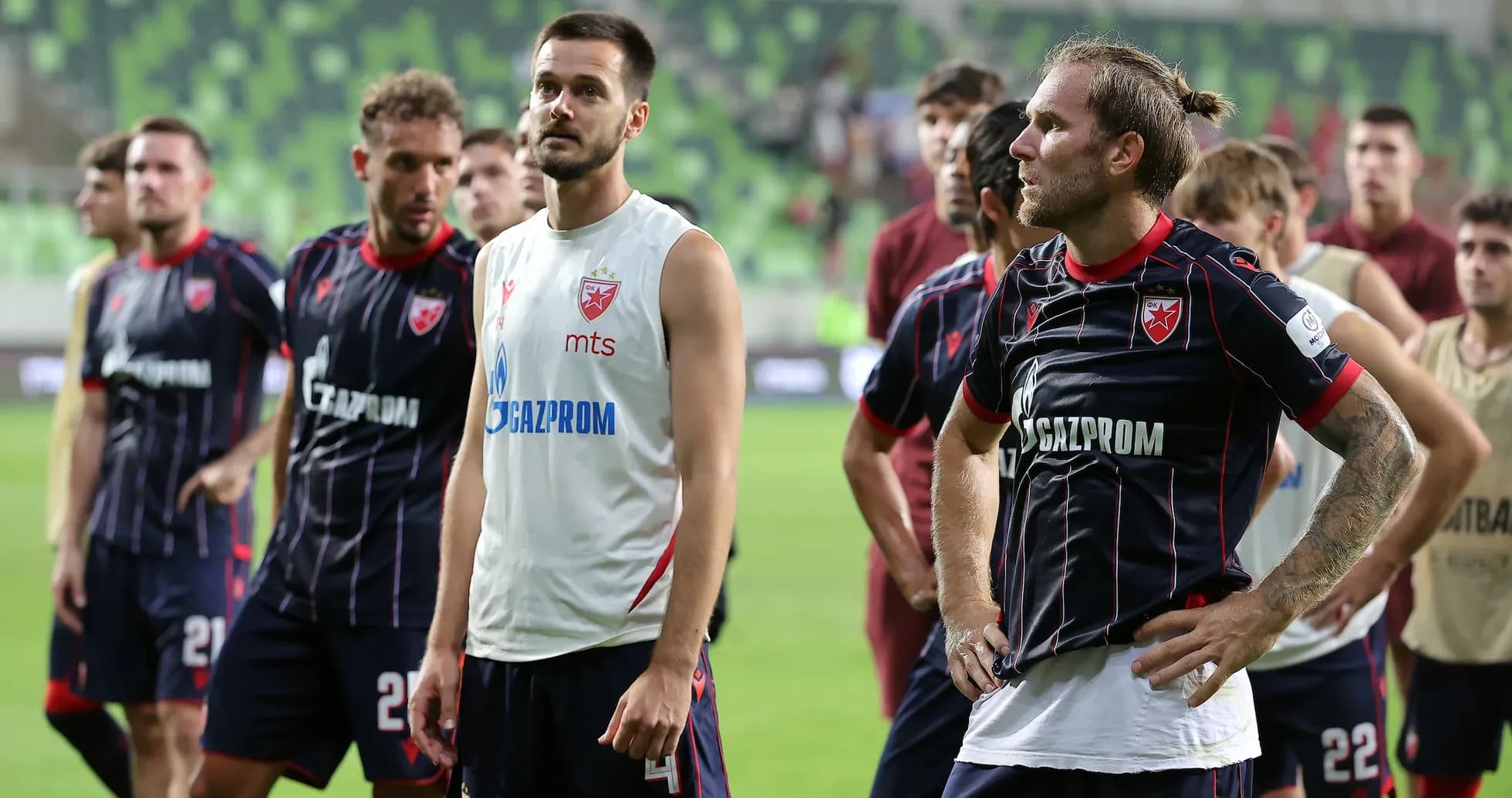
FK Crvena Zvezda’s 0-2 home defeat to Hapoel Beer Sheva at Stadium Rajko Mitić in the UEFA Champions League 3rd Qualifying Round was defined by an extraordinary territorial imbalance and a dramatic collapse in discipline. With Hapoel Beer Sheva recording 96% of ball possession against Zvezda’s 4%, the match quickly turned into a siege, and once the hosts went down to ten and then nine men, the Israeli side’s 4-3-3 structure methodically converted dominance into a decisive two-goal cushion.
Match Overview
Hapoel Beer Sheva lined up in a 4-3-3 that functioned as a positional play machine against a permanently deep opponent. The back four of G. Mizrahi, Miguel Vitor, I. Rotman and P. Amador were rarely pressured, effectively acting as a circulating platform on the halfway line. With 96% possession and only 5 fouls committed, they were able to progress the ball with minimal risk, using Lucas Ventura as a central pivot to connect defence and midfield.
The three-man midfield was crucial to the territorial lock. Lucas Ventura, booked for “Roughing” on 63’, still dictated the central lanes, supported by E. Peretz and N. Yehoshua. Peretz’s role was particularly important between the lines: his positioning in the right half-space allowed him to receive unopposed and either feed the front three or recycle play. His assist for J. East’s 79’ goal was a direct expression of this: a late-arriving, untracked movement from midfield into a creative pocket to slip East through.
Up front, J. East and I. Zlatanovic were the main reference points. Zlatanovic’s 61’ opener, assisted by East, came after Zvezda had already lost Dejan Stankovic to a red card on 57’, and illustrated Hapoel Beer Sheva’s patient exploitation of the extra man. With Zvezda forced into an even deeper 4-4-1 block, East could receive between the lines, draw out a centre-back and then release Zlatanovic into the exposed channel. The second goal on 79’ reversed the combination: Peretz found East, who finished to make it 0-2 against a Zvezda side now emotionally and structurally unraveling.
Because the visiting goalkeeper O. Marciano (Hapoel Beer Sheva) faced only 2 shots on goal and Zvezda managed just 3 corners, the away defensive structure was rarely stressed. The 4-3-3 became a 2-3-5 in possession, with both full-backs stepping high and the three midfielders forming a stable rest-defence. The extremely low foul count (5) underlined how little emergency defending they had to perform; most regains came through counter-pressing immediately after losses rather than through last-ditch interventions.
Crvena Zvezda's Tactics
FK Crvena Zvezda’s 4-2-3-1 under Dejan Stankovic never got close to its intended attacking shape. On paper, the double pivot of T. Elsnik and R. Krunic should have provided a platform for O. Bukari, V. Kostov and Bruno Duarte to support J. Enem. In reality, with only 4% possession and 10 fouls, Zvezda were locked into a low block from the opening minutes, unable to build through any phase. The centre-backs D. Luckassen and S. Erakovic, along with full-backs Seol Young-Woo and N. Tiknizyan, were pinned deep by the constant presence of East, Zlatanovic and Z. Ahmed, forcing long clearances rather than structured buildup.
The substitutions at half-time — M. Arnautovic (IN) came on for J. Enem (OUT), and M. Abu Fani (IN) came on for T. Elsnik (OUT) — were an attempt to inject more vertical threat and control. Arnautovic offered a different profile up front, but with Zvezda still starved of the ball, his impact was minimal. Abu Fani’s introduction was aimed at stabilising midfield circulation; instead, his night ended with a red card for “Roughing” at 90+2’, reducing Zvezda to nine and symbolising the breakdown in composure.
Disciplinary Events
The disciplinary events were tactically decisive. The first-half yellow to I. Rotman for “Holding” on 22’ did little to alter Hapoel Beer Sheva’s approach, but the red card shown to D. Stankovic (FK Crvena Zvezda) on 57’ fundamentally changed the match state. Already under extreme territorial pressure, Zvezda’s 4-2-3-1 morphed into a 4-4-1, with lines compressed almost onto their own box. From that point, every Zvezda possession became purely transitional, and with no passing structure (no recorded total passes or passing accuracy data), they could not exit their half.
Subsequent changes — M. Ivanic (IN) for V. Kostov (OUT) on 62’, M. Cham (IN) for O. Bukari (OUT) on 73’, and A. Katai (IN) for N. Tiknizyan (OUT) on 80’ — were reactive attempts to find a creative spark and fresh legs in wide areas. But with Hapoel Beer Sheva’s possession share remaining overwhelming, these players were largely forced into defensive running rather than influencing the game with the ball.
Statistical Overview
Statistically, the match paints a picture of almost total control by Hapoel Beer Sheva. They outshot Zvezda 6-2 on goal and 2-7 off goal, with 1 blocked shot to Zvezda’s 2. The shot profile reinforces the territorial story: Hapoel Beer Sheva converted sustained possession into a steady stream of efforts, while Zvezda’s rare attacks were low-volume and low-quality, never sufficient to shift momentum. Both sides finished with 3 corner kicks, but for Zvezda those corners were isolated moments rather than part of a sustained attacking pattern.
Discipline further underlined the tactical divide. Hapoel Beer Sheva collected 2 yellow cards (Rotman for “Holding”, Lucas Ventura for “Roughing”) but kept eleven men on the pitch, maintaining their positional structure to the end. FK Crvena Zvezda, by contrast, had 1 red card recorded in the statistics and suffered two separate red-card incidents in the event log — D. Stankovic on 57’ and M. Abu Fani on 90+2’ — which destroyed any chance of late pressure. With no recorded goalkeeper saves or xG values for either side, the clearest indicators of superiority are possession, shots on goal, and the ability to stay structurally intact under minimal defensive stress. Hapoel Beer Sheva dominated all three, and the 0-2 scoreline at Stadium Rajko Mitić was a logical tactical outcome.