Mexico vs England: Tactical Analysis of a World Cup Defeat
Mexico’s 3-2 defeat to England at Estadio Azteca was a study in territorial dominance versus ruthless efficiency. In a World Cup Round of 16 tie that finished 2-3 despite Mexico owning 67% of the ball and a 20–6 shot advantage, the tactical story was less about chance creation and more about how England’s compact 4-2-3-1, even with ten men, repeatedly survived Mexico’s pressure and struck with precision.
Mexico lined up in a 4-3-3 under Javier Aguirre, with Raúl Rangel in goal behind a back four of Jorge Sánchez, César Montes, Johan Vásquez and Jesús Gallardo. The midfield triangle of Gilberto Mora, Erik Lira and Luis Romo was tasked with controlling rhythm and feeding a front three of Roberto Alvarado, Raúl Jiménez and Julián Quiñones. The structure delivered exactly what it promised: control of possession, territory and volume of attacks. Mexico completed 455 passes, 420 of them accurate (92%), reflecting long, patient spells in England’s half and a clear intent to progress through central midfield before switching to wide combinations.
England, coached by Thomas Tuchel, set up in a 4-2-3-1 with Jordan Pickford in goal and a back four of Jarell Quansah, Ezri Konsa, Marc Guéhi and Nico O’Reilly. Declan Rice and Elliot Anderson sat as the double pivot behind an advanced line of Bukayo Saka, Jude Bellingham and Anthony Gordon, supporting Harry Kane as the lone striker. With only 244 passes (195 accurate, 80%) and 33% possession, England accepted a reactive role, focusing on verticality and high-value transitions rather than extended build-up.
The early pattern underlined the tactical contrast. Mexico tried to build from the back, using Lira as the primary outlet to connect defence and midfield, while Romo and Mora alternated between dropping to receive and making third-man runs. The full-backs, Sánchez and Gallardo, pushed high to pin England’s wide midfielders, creating a 2-3-5 shape in possession. This produced a steady stream of attacks: 12 shots inside the box and 7 blocked efforts show how often Mexico worked the ball into crowded central zones.
England’s response was to compress the middle and attack quickly once they recovered the ball. Rice, booked for “Roughing” after just 1’, set an aggressive tone in screening the back line. In possession, England rarely circulated for long; instead, they looked to find Bellingham early between Mexico’s midfield and defence. That plan was rewarded twice in quick succession: Bellingham’s double at 36’ and 38’, assisted first by Saka and then by Kane, came from precisely those vertical patterns where Mexico’s high full-backs and advanced eights left space to be exploited on turnover.
Despite trailing 2-0, Mexico did not abandon their structure. Quiñones’ goal at 42’ was the payoff for sustained pressure and numbers in the final third, emblematic of how the 4-3-3 could overload England’s box. Yet the halftime scoreline of 1-2 underlined the central tactical problem: Mexico’s dominance in phases was not matched by defensive stability in transition.
Second Half Adjustments
The second half opened with Aguirre adjusting personnel rather than shape: at 46’, Edson Álvarez (IN) came on for César Montes (OUT), a move that hinted at a desire for more mobility and ball progression from deep. Paradoxically, the major tactical turning point came for England: Jarell Quansah’s straight red card for “Serious foul” at 54’ forced Tuchel to reconfigure his side with ten men.
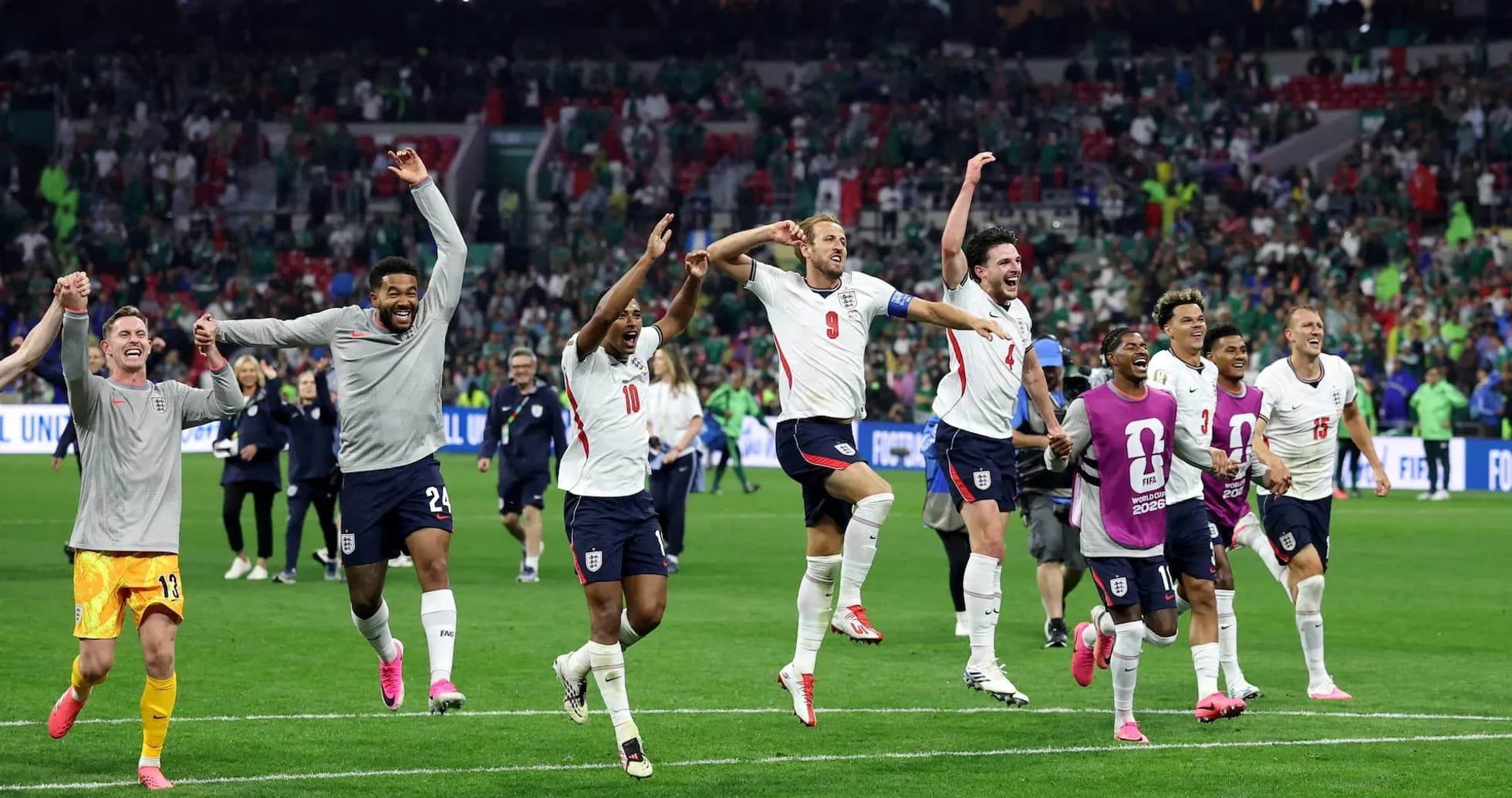
England’s reaction to the dismissal was instructive. At 57’, John Stones (IN) came on for Bukayo Saka (OUT), effectively shifting England into a deeper, more conservative block with additional central defensive presence. The front line narrowed, and England focused almost exclusively on protecting the box and breaking only when the opportunity was clear. Remarkably, they still managed to extend their lead: at 60’, Kane converted a penalty to make it 3-1, a reward for England’s ability to create high-impact moments despite minimal volume (only 6 total shots, 5 on goal).
From 61’ onward, the match became a siege. Aguirre doubled down on attacking changes: Santiago Giménez (IN) for Gilberto Mora (OUT) and Brian Gutiérrez (IN) for Luis Romo (OUT) at 61’ transformed Mexico’s midfield into a more attacking unit, with Álvarez anchoring and extra forwards flooding the last line. Later, Álvaro Fidalgo (IN) for Jorge Sánchez (OUT) at 79’ and Guillermo Martínez (IN) for Julián Quiñones (OUT) at 81’ further tilted the structure towards an almost 3-3-4/2-4-4 in possession, with wide players and forwards constantly occupying England’s back line.
Mexico’s attacking profile in this period is captured by the numbers: 20 shots to England’s 6, 5 on target, 7 blocked, and 12 from inside the box. Their xG of 1.87 versus England’s 1.55 shows that, over 90 minutes, they produced slightly better chances in aggregate. Yet the key was conversion and defensive balance. While Raúl Jiménez’s penalty at 69’ narrowed the gap to 2-3 and justified the sustained pressure, Mexico could not turn their territorial dominance into an equaliser.
England’s ten-man block, with Stones and Konsa central and Guéhi and O’Reilly narrowing inside, protected the most dangerous zones. The low number of England fouls (7 to Mexico’s 14) despite constant defending highlights how they relied on compactness and positioning rather than repeated last-ditch challenges. Their 2 corner kicks versus Mexico’s 12 underline how rarely they spent time in the attacking third, but when they did, they were clinical.
In goal, Raúl Rangel (Mexico) faced 5 shots on target and made 2 saves, with a goals prevented value of -0.15, suggesting England slightly outperformed the quality of their chances against him. Jordan Pickford (England) faced 5 shots on target as well and made 3 saves, also with goals prevented at -0.15, indicating that Mexico, too, could have scored marginally more given their shot quality. The near symmetry in xG and goals prevented, contrasted with Mexico’s overwhelming volume of possession and shots, crystallises the tactical verdict: this was a game decided not by who controlled the ball, but by who controlled the key spaces and moments.
Ultimately, Mexico’s 4-3-3 delivered control but left them vulnerable to England’s vertical 4-2-3-1 transitions and, later, to a resilient ten-man low block. England’s efficiency—3 goals from 6 shots—and their ability to reorganise defensively after the red card carried them through, despite ceding territory and enduring long periods without the ball.