Brazil vs Norway: Clash of Football Archetypes in World Cup Knockouts
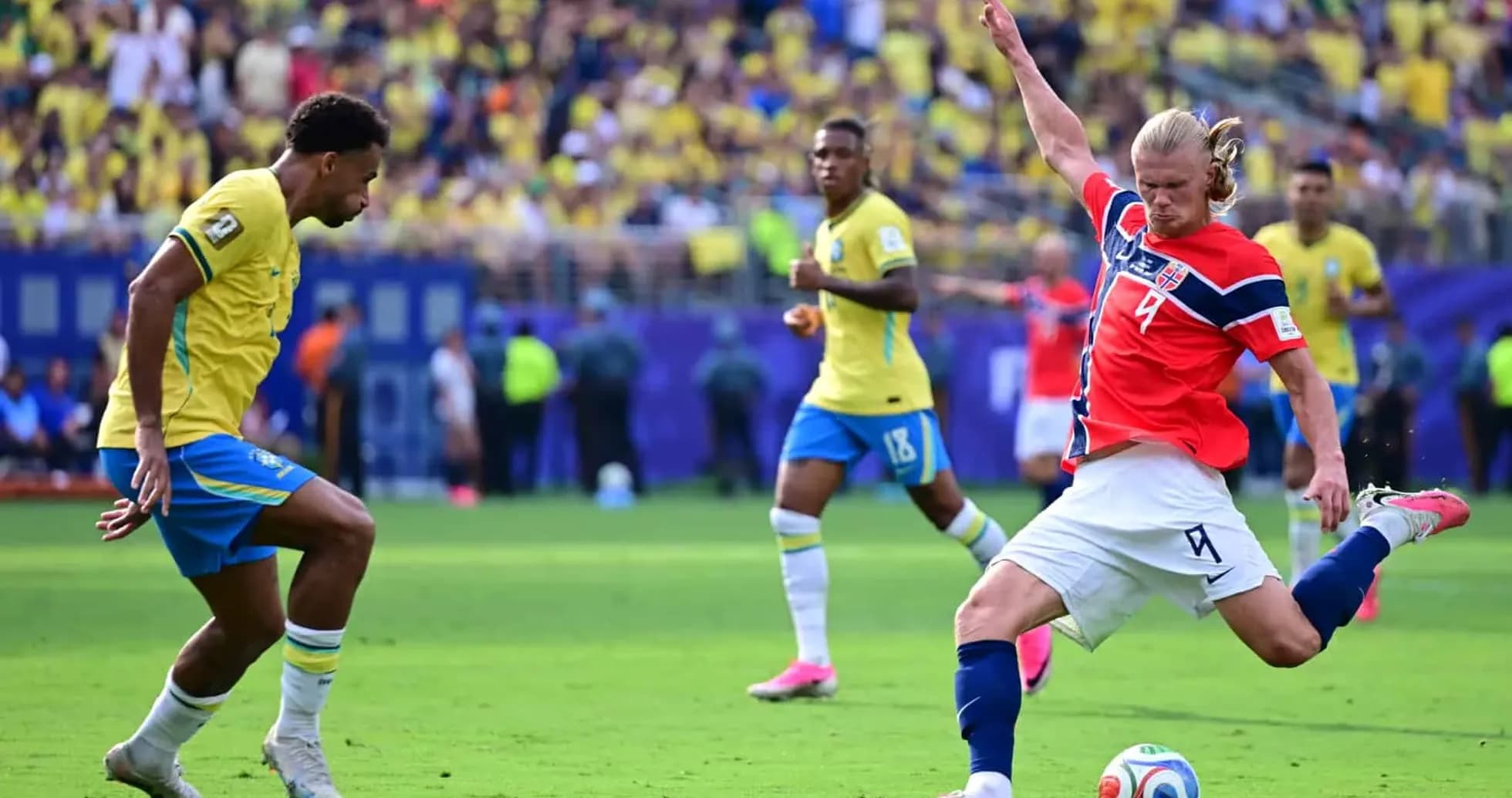
MetLife Stadium framed this Round of 16 clash as a meeting of football archetypes: Brazil, group winners from Group C with a total goal difference of 6 after scoring 7 and conceding 1, against Norway, the rising force from Group I, who reached the knockouts with a total goal difference of 1 from 8 goals for and 7 against. On neutral soil, with no true “home” or “away” form to lean on, it was about whose identity would hold under pressure.
Brazil’s seasonal profile heading into this game was that of a controlled heavyweight. Across the campaign they had played 5 fixtures in total, winning 3, drawing 1 and losing 1, with 10 goals scored and 4 conceded overall. At home they had averaged 1.8 goals for and 1.0 against, while on their travels they were far more explosive: 3.0 goals for and 0.0 against away, underscoring how dangerous they become when space opens up. Norway arrived as a more volatile proposition: 5 fixtures in total, 4 wins and 1 defeat, with 12 goals scored and 9 conceded overall. At home they had averaged 2.0 goals for but 3.0 against, while away they were more balanced at 2.7 for and 1.0 against, suggesting a side that embraces chaos but is learning to manage it better on their travels.
Carlo Ancelotti’s selection of a 4-4-2 for Brazil represented a deliberate departure from the 4-3-3 that had been their most-used structure this tournament. Alisson anchored a back four of Danilo, Marquinhos, Gabriel and Douglas Santos. Ahead of them, a flat-looking but functionally fluid midfield of Rayan, Bruno Guimarães, Casemiro and G. Martinelli supported the front pair of M. Cunha and Vinicius Junior.
The absences mattered. Brazil were without Raphinha and Lucas Paquetá, both ruled out by hamstring injuries. Without Paquetá’s ability to drift between the lines, creative responsibility tilted heavily toward Bruno Guimarães and the wide players. Without Raphinha’s direct right‑flank threat, Danilo’s overlapping and Rayan’s movements on that side became the main route to stretch Norway horizontally.
Norway’s Stale Solbakken kept faith with their core identity: a 4-3-3 that has underpinned 4 wins from 5 this campaign. O. Nyland started in goal behind a back line of J. Ryerson, K. Ajer, T. Heggem and D. Wolfe. The midfield triangle of P. Berg at the base with S. Berge and M. Ødegaard ahead offered both steel and subtlety, while the front three of A. Nusa, E. Haaland and A. Sorloth promised direct power and verticality.
The disciplinary backdrop subtly shaped the tactical temperature. Brazil’s season card map shows a wide spread of yellow cards, with a notable late-game surge: 25.00% of their yellows arriving between 31-45 minutes and another 25.00% between 61-75, plus a further 12.50% in the 76-90 window. Casemiro and Danilo both entered this tie as repeat offenders, each having collected 2 yellow cards in the tournament. Norway’s yellows were more concentrated early and just after the break, with 50.00% between 0-15 minutes and 50.00% between 46-60, hinting at an aggressive start to each half that Brazil’s dribblers could exploit if they drew contact intelligently.
In the “Hunter vs Shield” duel, the numbers painted a fascinating contrast. For Norway, Erling Haaland arrived as the competition’s most terrifying finisher: 7 goals from 15 shots in total, 12 of those on target, across 360 minutes. His total rating of 8.3 underlined a striker not just scoring, but dominating duels and occupying entire back lines. Brazil’s “shield” was collective rather than individual: across the campaign they had conceded only 4 goals in total from 5 fixtures, averaging 0.8 against overall and 0.0 away. Marquinhos and Gabriel, protected by Casemiro, formed a compact triangle specifically designed to deny Haaland the central spaces he thrives in.
At the other end, Brazil’s own hunters were in prime form. Vinicius Junior had 4 goals and 1 assist in total, with 14 shots and 11 on target, plus 36 dribbles attempted and 16 successful. His rating of 8.02 reflected a player who bends entire defensive structures around his presence. M. Cunha complemented him with 3 goals in total from 10 shots, and a work rate that extended to 6 tackles and 3 interceptions, making him both finisher and first presser.
Norway’s shield, by contrast, was more porous. They had conceded 9 goals in total across 5 matches, an average of 1.8 per game overall, with 3.0 against at home and 1.0 away. K. Ajer’s reading of the game and aerial presence, supported by T. Heggem, would be tested not only by Brazil’s front two but by G. Martinelli’s diagonal surges from the left and Rayan’s underlaps on the right. Brazil’s season numbers show they have failed to score in 0 fixtures overall; there is always a goal in this side.
The “Engine Room” confrontation between Bruno Guimarães and Norway’s double pivot of S. Berge and P. Berg, with Ødegaard floating ahead, was always going to decide the rhythm. Bruno entered this tie with 4 assists in total, 191 passes at an 86% accuracy, and 10 key passes, plus 11 tackles and 2 interceptions. He is both metronome and disruptor. Ødegaard, for his part, had 3 assists in total, 263 passes at 90% accuracy and 4 key passes, operating as Norway’s conductor between lines. If Bruno could press Ødegaard’s first touch and cut off the passing lanes into Haaland and Sorloth, Brazil would tilt the field. If Ødegaard found time to turn, Norway’s 12 goals in total this campaign suggested they could hurt even a disciplined Brazilian block.
Set against this was the psychological and statistical weight of penalties. Brazil had been awarded 2 penalties in total, scoring 1 and missing 1, a 50.00% conversion rate that lingers in the mind of both taker and goalkeeper. Norway’s record was even more fraught: 1 penalty in total, missed, for a 0% conversion rate. In a knockout tie where marginal decisions in the box can swing momentum, neither side could claim to be entirely comfortable from the spot.
From a statistical prognosis, the clash felt like a collision between Brazil’s defensive solidity and Norway’s attacking ferocity. Brazil’s average of 2.0 goals for and 0.8 against overall suggested control and balance; Norway’s 2.4 for and 1.8 against overall hinted at high‑event football. Tactically, Brazil’s 4-4-2 offered more direct presence against Norway’s centre-backs, while Norway’s 4-3-3, with Nusa and Sorloth flanking Haaland, threatened Brazil’s full-backs in transition.
In the end, the numbers implied a narrow edge for Brazil in territorial and chance control, but Norway’s cutting edge in the final third meant that any lapse in the Brazilian block could be punished ruthlessly. This was a tie set up not just as Brazil’s heritage versus Norway’s emergence, but as a live test of whether structure or chaos would rule the World Cup’s 1/8 final stage.