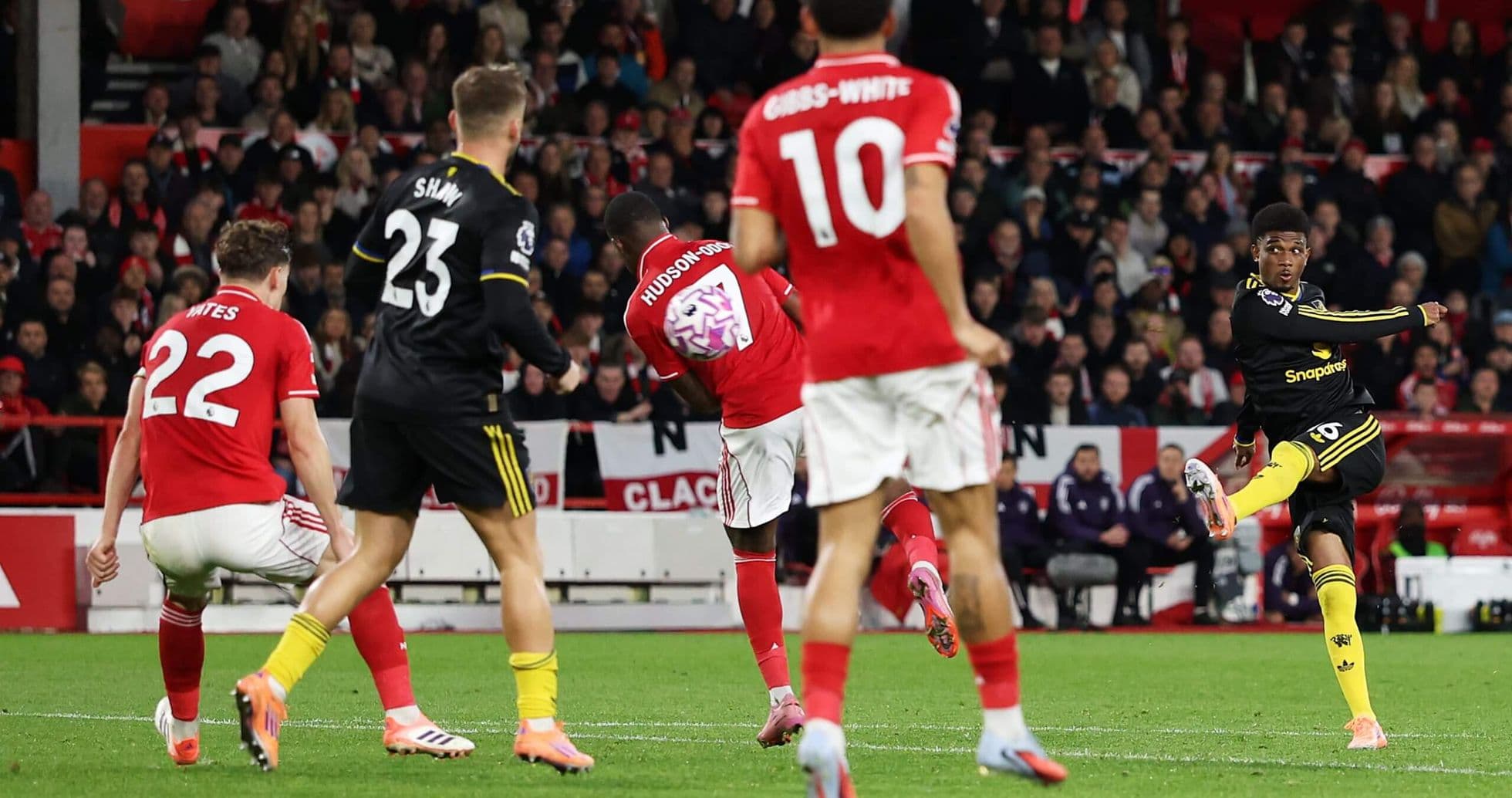
Manchester United Edges Nottingham Forest in Thrilling 3–2 Match
Old Trafford staged a five-goal thriller as Manchester United edged Nottingham Forest 3–2, a result that crystallised the contrasting trajectories of two clubs heading into the final bend of the Premier League season.
I. The Big Picture
This was Round 37 of the Premier League, a late-season fixture with very different stakes. Manchester United, already shaping as a Champions League side, came in ranked 3rd with 68 points and a goal difference of 16, built on 66 goals for and 50 against overall. At home they had been formidable: 19 matches played, 13 wins, 3 draws, 3 defeats, with 39 goals scored and 24 conceded. Their seasonal DNA is clear – front-foot, high-risk football, averaging 2.1 goals for and 1.3 against at Old Trafford.
Forest arrived as survivors-in-progress. Ranked 16th with 43 points and a goal difference of -3 (47 scored, 50 conceded overall), they have been better on their travels than at the City Ground. Away, they had played 19, winning 7 and losing 9, scoring 28 and conceding 28, an away average of 1.5 goals for and 1.5 against. That balance – dangerous but porous – framed this as a test of whether their improved away punch could withstand United’s home storm.
The scoreline – 3–2 to United after a 1–0 half-time lead – reflected the season-long pattern: Carrick’s side are rarely dull, often open, and almost always capable of finding one more goal.
II. Tactical Voids
Both managers were forced to redraw their plans by key absences.
For Manchester United, the most glaring void was up front. B. Šeško, with 11 league goals in total, missed out through a leg injury, removing a direct, penalty-box focal point. M. de Ligt’s back injury also deprived United of an aerially dominant centre-back option. Carrick’s response was to double down on mobility and ball-playing from the back and between the lines: H. Maguire and L. Martinez anchored a 4-2-3-1, shielded by Casemiro and K. Mainoo, with Matheus Cunha, Bruno Fernandes, A. Diallo and B. Mbeumo forming a fluid attacking quartet.
Forest’s absences were just as structurally significant. O. Aina, W. Boly, Murillo and N. Savona were all unavailable, stripping Vitor Pereira of depth and experience in his defensive line. The loss of Murillo, in particular, meant Forest lacked a natural progressive centre-back to step out under pressure. C. Hudson-Odoi’s injury removed a 1v1 outlet on the flank, further nudging Pereira toward a more compact, collective 4-4-2 built on work rate rather than individual incision.
Disciplinary trends also coloured the tactical risk calculus. United’s season card profile shows a pronounced late-game edge: 20.63% of their yellows have arrived between 46–60 minutes and another 20.63% between 76–90, with 17.46% in added time (91–105). Red cards have clustered in the second half too, with 66.67% between 46–60 and 33.33% between 76–90. Forest, meanwhile, see 25.42% of their yellows between 46–60 and 22.03% between 61–75, with their only league red in the 31–45 window – a reminder that N. Williams, for all his drive, walks a disciplinary tightrope.
III. Key Matchups
Hunter vs Shield
On one side, United’s multi-headed attack; on the other, a Forest defence patched together without key lieutenants. Even with Šeško absent, Carrick could lean on three high-end threats.
Matheus Cunha, with 10 goals and 2 assists in total, is United’s chaos agent. Across 33 appearances he has fired 58 shots, 35 on target, and attempted 91 dribbles with 44 successes. His duel volume (353 total, 164 won) underlines how often he engages defenders frontally. Against a Forest back line missing Boly and Murillo, Cunha’s tendency to drop off the front and drive at the inside channels between full-back and centre-back was always likely to stretch the 4-4-2 into uncomfortable shapes.
Bryan Mbeumo added another 10 goals and 3 assists overall, with 58 shots (31 on target) and 52 dribble attempts, 17 successful. Operating as the nominal striker here, his movement into wide pockets threatened to drag N. Milenkovic and Morato away from their zones, particularly with Bruno Fernandes threading passes from the half-spaces.
Forest’s primary offensive “hunter” was M. Gibbs-White. With 14 goals and 4 assists in total, plus 47 key passes and 59 dribble attempts (28 successful), he is both scorer and creator. His 57 shots (31 on target) and 315 duels (127 won) tell the story of a midfielder who lives on the half-turn between the lines. Against United’s double pivot, the duel with Casemiro and Mainoo was central: if Gibbs-White could receive between the lines and connect with Igor Jesus and C. Wood, Forest’s 1.5 away goals-per-game average had a chance to hold.
Engine Room
The midfield confrontation was defined by contrast. Casemiro, with 90 tackles, 27 blocked shots and 32 interceptions overall, remains United’s enforcer. His 10 yellow cards and one yellow-red underline the edge he plays with, but his 1,600 passes at 81% accuracy show he is also the platform. Alongside him, K. Mainoo offered the press-resistance and circulation to help United sustain attacks and recycle possession around Forest’s compact 4-4-2 shell.
Bruno Fernandes, the league’s leading creator with 20 assists and 8 goals, was the conductor. His 1,940 passes with 133 key passes and 54 shots (23 on target) make him the primary reference point between lines. He has also been imperfect from the spot, scoring 4 penalties but missing 2, a detail that reinforces both his centrality and his fallibility in high-leverage moments.
Forest’s answer in the engine room came from N. Dominguez and E. Anderson, tasked with compressing space around Bruno while also protecting the half-spaces that Gibbs-White vacated when he roamed. Their ability to screen passes into Mbeumo’s feet and track Cunha’s drifting was always going to dictate how exposed Milenkovic and Morato became.
On the flanks, N. Williams carried a dual burden. Offensively, his 2 goals, 3 assists, 37 key passes and 69 dribble attempts (30 successful) show a full-back who can drive Forest upfield. Defensively, his 94 tackles, 17 blocks and 45 interceptions overall made him Forest’s most active ball-winner. But with 6 yellows and 1 red, he also represented a potential pressure point for United’s wingers to provoke.
IV. Statistical Prognosis
Following this result, the numbers broadly aligned with expectation. United’s home profile – 39 goals for and 24 against across 19 matches, averaging 2.1 scored and 1.3 conceded – pointed to a high-scoring home win rather than a procession. Forest’s away record – 28 scored and 28 conceded in 19, with 1.5 both for and against – suggested they would not be overawed at Old Trafford, but that they would struggle to keep the door shut for 90 minutes.
In xG terms, United’s layered attack, volume shooters (Cunha, Mbeumo, Bruno) and home dominance implied a higher cumulative chance creation than Forest, whose threat is more concentrated through Gibbs-White and transition moments. Defensively, United’s overall concession of 1.4 goals per game and Forest’s identical 1.4 underline that neither unit is watertight; the difference lies in United’s superior firepower and ability to sustain pressure.
The 3–2 scoreline, then, felt like the logical expression of these underlying dynamics: Forest dangerous enough to land punches, United powerful enough to outscore them, and a contest shaped by the very traits that have defined their seasons.