West Ham's Sharp Performance vs Leeds Despite Relegation
The London Stadium closed its Premier League season with a paradox: West Ham produced one of their sharpest performances in a campaign that still ended in relegation. A 3–0 dismantling of Leeds underlined the latent quality in Nuno Espirito Santo’s squad, yet the table is unforgiving. Following this result, West Ham finished 18th on 39 points, their goal difference of -19 a stark summary of a year in which they scored 46 and conceded 65. Leeds, beaten but safe, closed in 14th with 47 points and a goal difference of -7 from 49 goals for and 56 against.
I. The Big Picture – Shapes, stakes and late-season identities
Nuno doubled down on the structure that has defined West Ham’s better spells: a 4-2-3-1 with M. Hermansen behind a back four of K. Walker-Peters, K. Mavropanos, A. Disasi and M. Diouf. T. Soucek and M. Fernandes formed the double pivot, with an aggressive, line-breaking trio of J. Bowen, Pablo and C. Summerville supporting T. Castellanos.
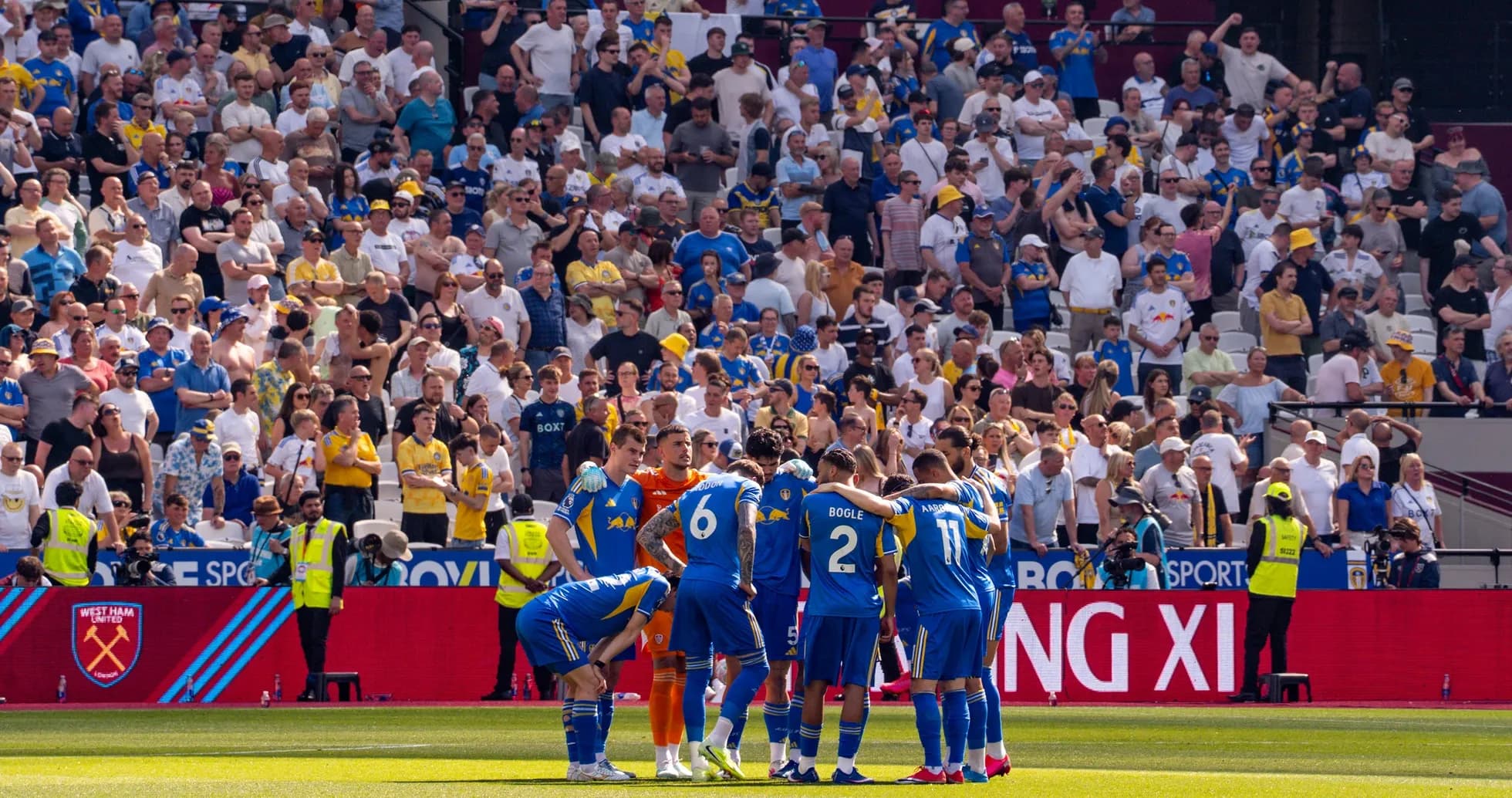
Leeds, by contrast, arrived with Daniel Farke’s 3-5-2, a shape that has been one of two pillars of their season alongside the 4-3-3. J. Rodon, J. Bijol and P. Struijk formed the back three in front of K. Darlow, with J. Bogle and J. Justin as wing-backs. The central lane belonged to E. Ampadu, A. Tanaka and B. Aaronson, feeding a front two of D. Calvert-Lewin and L. Nmecha.
The season-long data framed this as a clash of flawed but dangerous sides. Heading into this game, West Ham’s attack at home averaged 1.4 goals per match, while they conceded 1.6 at London Stadium. Leeds, on their travels, averaged 1.1 goals for but allowed 1.8, a profile of a team that can punch but often leaves its chin exposed.
II. Tactical Voids – Absences and discipline shaping the contest
Both squads walked into the finale with key gaps. For West Ham, L. Fabianski’s back injury removed an experienced voice from the spine, placing full trust in Hermansen. A. Traore’s muscle injury deprived Nuno of a direct, transitional outlet from the bench.
Leeds’ absentees were more structurally significant. I. Gruev (knee), G. Gudmundsson (hamstring), S. Longstaff (hernia), N. Okafor (calf) and A. Stach (ankle) stripped depth from the midfield and forward rotations. Without Stach and Longstaff, Farke’s options for a more destructive, second-ball-oriented midfield were limited, forcing heavy minutes again onto Ampadu and Tanaka.
Discipline across the season hinted at an edge to this fixture. West Ham’s yellow card distribution is heavily front-loaded around the end of the first half and late stages: 23.19% of their bookings came between 31-45 minutes and 21.74% in 91-105, with further spikes at 61-75 and 76-90. Leeds showed a similar late-game aggression, with 21.88% of yellows between 61-75 and 17.19% from 76-90. With both teams often fraying as matches stretched, the expectation was for a tense, card-strewn finale, particularly if the relegation picture tightened.
Red-card history added another layer. West Ham carried two notable offenders: J. Todibo and Soucek each saw red this season. Leeds had one dismissal in the 46-60 minute window. That history forced both coaches to manage emotional temperature in the middle third of the game, where this Leeds side has previously lost control.
III. Key Matchups – Hunter vs Shield, and the engine room battle
The “Hunter vs Shield” duel centred on D. Calvert-Lewin against a West Ham defence that has leaked too often. Overall, West Ham conceded 1.7 goals per match, with 30 goals allowed at home and 35 away. Calvert-Lewin arrived as Leeds’ leading scorer with 14 league goals, a classic penalty-box striker whose season numbers tell a story of persistence: 66 shots, 34 on target, and a willingness to battle, with 465 duels contested and 184 won.
Yet the shield around Hermansen was more robust than the raw goals-against column suggests. A. Disasi and K. Mavropanos are comfortable defending the box, and Todibo’s season profile – 13 blocked shots – showed what West Ham’s centre-backs are asked to do: absorb pressure deep and protect the six-yard line. Against a Leeds side that scores in waves – with 22.45% of their goals between 31-45 minutes and 20.41% from 76-90 – West Ham’s task was to survive those surges without collapsing.
In midfield, the “Engine Room” battle was clear: J. Bowen and Pablo as creators against E. Ampadu as the enforcer. Bowen’s season has been quietly elite: 9 goals, 11 assists, 793 passes with 45 key passes, and 119 dribble attempts with 53 successes. He is West Ham’s primary conduit between transition and final-third incision.
Ampadu, meanwhile, has been Leeds’ metronome and shield. Across 35 appearances he completed 1,729 passes at 85% accuracy, with 81 tackles, 18 successful blocks and 50 interceptions. He also sits atop the yellow-card charts with 10 bookings, a sign of how often he operates on the edge to break play. His duels mirror Bowen’s competitive streak: 295 contested, 184 won. Every time Bowen drifted inside from the right or slid between the lines, it was Ampadu’s responsibility to close the door without drawing yet another caution.
Around them, Soucek’s presence added a different threat. With 5 goals from midfield and 15 successful blocks, he offers late-box runs and aerial menace while still contributing to West Ham’s defensive wall. His own red card earlier in the season underlined the fine line he walks between aggression and overstep.
IV. Statistical Prognosis – A late-game script and xG undertones
The season’s minute-by-minute trends almost storyboarded this match. West Ham’s goals are heavily weighted towards the final quarter-hour: 29.79% of their strikes came between 76-90 minutes, their single biggest window. Leeds’ defensive vulnerability peaks at exactly the same time, with 28.57% of their goals conceded arriving in that 76-90 band. It is the critical intersection of this matchup: a home side that grows bolder late, against visitors whose structure loosens as legs tire.
Earlier phases pointed to volatility too. West Ham’s second-worst defensive window is 61-75 minutes (21.88% of goals conceded), while Leeds often build pressure there with 16.33% of their goals scored between 61-75. The middle of the second half, then, was always likely to be the storm zone: Calvert-Lewin and Nmecha testing a back line that has shown fragility, with Hermansen called to justify his selection ahead of the injured Fabianski.
From an Expected Goals perspective – even without raw xG values – the patterns are clear. West Ham’s home average of 1.4 goals for and 1.6 against suggests a team whose matches tilt towards narrow margins but regular scoring. Leeds’ away profile of 1.1 for and 1.8 against hints at open, chaotic games in which their attack creates enough to threaten, but their back three and wing-backs concede quality chances, especially late.
Following this result, the 3–0 scoreline felt like the upper bound of West Ham’s attacking potential rather than an outlier. It aligned with their biggest home win of 4-0 and their tendency to surge late, while also exposing Leeds’ familiar away flaw: a structure that cannot hold once the game breaks into transitions and penalty-box scrambles.
In the end, West Ham’s relegation and Leeds’ mid-table safety disguise how evenly poised this fixture was on paper. The squads, shaped by absences and discipline, delivered a match that mirrored their statistical identities: West Ham as late finishers with a fragile core, Leeds as brave but porous travellers. On this final afternoon, the numbers converged into a narrative that belonged, for once, to the home crowd.