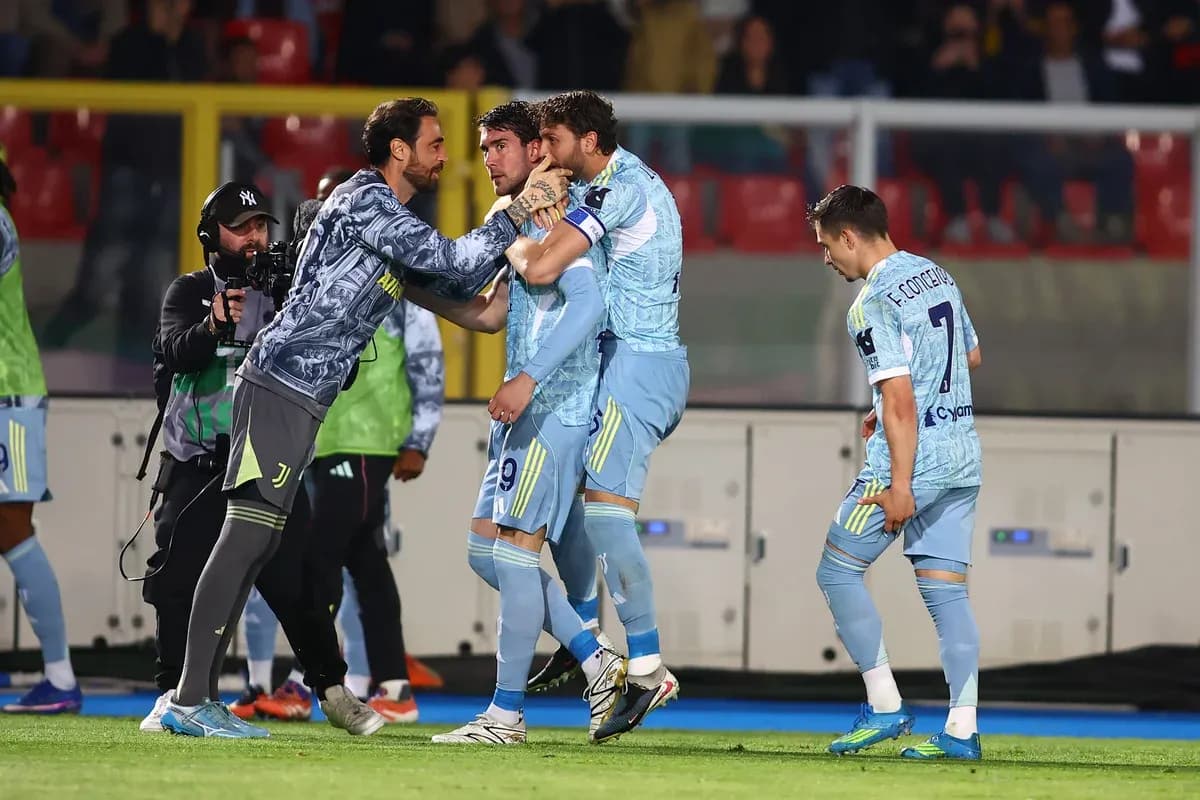
Juventus Secures Victory Over Lecce in Serie A Clash
Lecce 0–1 Juventus at Stadio Ettore Giardiniero – Via del Mare was a study in territorial control and early ruthlessness. In this Serie A Regular Season - 36 fixture, Luciano Spalletti’s Juventus scored in the 1st minute and then leaned on structure, pressing and possession to suffocate Eusebio Di Francesco’s Lecce. Juventus’ 65% of the ball, 15 shots and 2.16 xG contrasted sharply with Lecce’s more sporadic threat (8 shots, 0.88 xG), yet the game remained within one goal thanks to Lecce’s compact 4-2-3-1 block and a strong goalkeeping display.
The decisive moment arrived almost immediately. At 1', D. Vlahovic finished a move created down the left, converting a pass from overlapping full-back A. Cambiaso. That goal stood as the only change to the scoreline despite further Juventus pressure and two second-half incidents where the visitors thought they had doubled their lead. At 50' and again at 61', Juventus had goals cancelled after VAR interventions, first involving Dušan Vlahović and later Pierre Kalulu; both were chalked off, preserving the 0–1 scoreline and forcing Juventus to manage a precarious lead.
From a disciplinary standpoint, the match was relatively controlled but reflected Juventus’ greater defensive aggression. Total cards: Lecce 1, Juventus 1, overall 2. The bookings were:
- 80' Francisco Conceição (Juventus) — Foul
- 82' Gaby Jean (Lecce) — Argument
Francisco Conceição’s yellow on 80' came as Juventus tried to halt a Lecce transition, while Gaby Jean’s card two minutes later, explicitly for “Argument”, underlined rising frustration as Lecce pushed for an equaliser without finding a clear route through.
Both sides lined up in a 4-2-3-1, but their interpretations were very different. Di Francesco’s Lecce used W. Falcone behind a back four of A. Gallo, Tiago Gabriel, J. Siebert and D. Veiga. In front, the double pivot of Y. Ramadani and O. Ngom tried to screen central spaces, with S. Pierotti, L. Coulibaly and L. Banda supporting lone striker W. Cheddira. The plan was clear: compact central zones, then spring L. Banda and W. Cheddira into space once possession was recovered.
Spalletti mirrored the shape but not the intent. M. Di Gregorio was protected by a high, proactive line of A. Cambiaso, L. Kelly, Bremer and P. Kalulu. The double pivot of M. Locatelli and T. Koopmeiners dictated tempo, with a fluid three of F. Conceicao, W. McKennie and K. Yildiz rotating behind D. Vlahovic. Juventus’ 501 passes at 86% accuracy versus Lecce’s 267 at 73% show how consistently the visitors recycled possession, using Locatelli as the primary outlet to switch play and pull Lecce’s 4-2-3-1 out of shape.
The early goal allowed Juventus to lean even more into their positional dominance. With 14 of their 15 shots coming from inside the box, they repeatedly accessed the half-spaces, especially via Yildiz and McKennie, then attacked the area with late runs and overlaps. Lecce’s centre-backs, Tiago Gabriel and J. Siebert, were forced into a deep block, which limited space behind but conceded territory and corners (7 for Juventus, just 1 for Lecce).
Lecce’s offensive plan relied heavily on transitions. Their 35% possession and just 1 corner underline how rarely they sustained pressure in the final third. Yet they did carve out some quality looks: 3 shots on target from 8 total and 0.88 xG suggest that when they broke through Juventus’ press, they reached reasonably dangerous positions. W. Cheddira’s runs into the channels and L. Banda’s direct dribbling were the main outlets, but they were often isolated.
Falcone’s performance was central to keeping Lecce in the game. His 5 saves, compared to Di Gregorio’s 3, reflect not only Juventus’ higher shot volume but also the quality of chances conceded. Juventus generated 2.16 xG yet scored only once, meaning Falcone and his defensive unit effectively “overperformed” against expectation, limiting the damage and giving Lecce a platform to chase a point.
The substitution pattern from Di Francesco underlined a shift from containment to risk. At 62', O. Ngom (OUT) made way for G. Jean (IN), adding more directness and physicality from deeper areas. On 70', D. Veiga (OUT) was replaced by T. J. Helgason (IN), a more progressive profile at full-back, to support overlapping and crossing. The double change at 76' — W. Cheddira (OUT) for F. Camarda (IN) and L. Banda (OUT) for K. Ndri (IN) — refreshed the front line, chasing vertical runs and fresh legs against a Juventus defence that had spent most of the match on the front foot.
Spalletti’s changes were about game management and energy conservation. At 77', D. Vlahovic (OUT) for E. Holm (IN) rebalanced the side, with Holm offering defensive work on the flank and allowing a more conservative structure. Then came a triple wave on 83': A. Cambiaso (OUT) for J. David (IN), K. Yildiz (OUT) for J. Boga (IN), and F. Conceicao (OUT) for E. Zhegrova (IN). These moves injected fresh attacking profiles but also allowed Juventus to keep the ball higher up the pitch and defend by possession. Finally, at 86', W. McKennie (OUT) for F. Gatti (IN) signalled a clear shift to protect the lead, adding another defensive-minded presence to close central lanes and defend set pieces.
Statistically, Juventus’ superiority is evident. They led in possession (65% to 35%), total shots (15 to 8), shots on target (6 to 3), corners (7 to 1) and xG (2.16 to 0.88). They also committed more fouls (18 to 7), consistent with a side aggressively counter-pressing after turnovers and breaking up Lecce’s counters early. Both teams recorded 1 yellow card and no reds, with reasons explicitly “Foul” for Francisco Conceição and “Argument” for Gaby Jean.
From a season-trend perspective, Juventus’ high pass volume and efficiency align with a possession-dominant side whose Overall Form is built on controlling territory and shot quality rather than high-scoring chaos. Their Defensive Index in this match was strong: allowing only 8 shots and 0.88 xG away from home is the profile of a top defensive unit. Lecce, conversely, showed the typical profile of a lower-possession, reactive team: fewer passes, lower accuracy, but a compact block and a goalkeeper capable of exceeding expected concession.
In synthesis, Juventus combined an immediate attacking punch with 90 minutes of structural control. Lecce defended bravely and received high-level goalkeeping from Falcone, but their limited possession game and low-volume chance creation meant the early 1' goal from D. Vlahovic, assisted by A. Cambiaso, was always likely to be decisive.