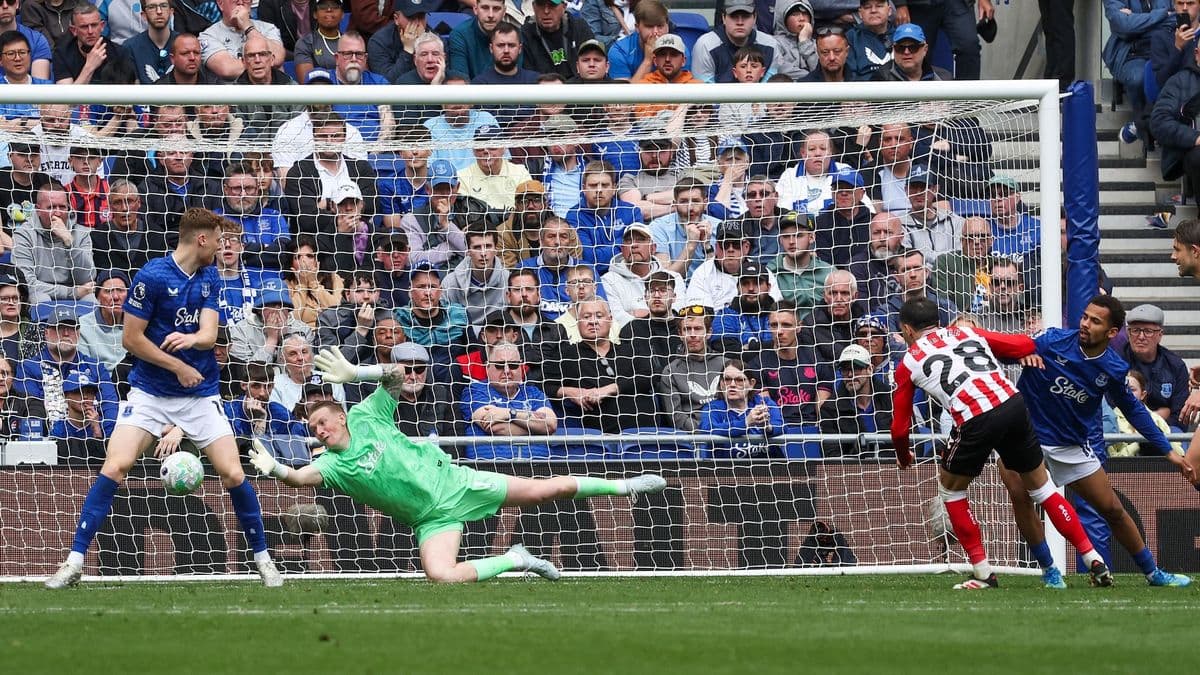
Everton vs Sunderland: Tactical Analysis of Premier League Clash
On a grey afternoon at Hill Dickinson Stadium, a season’s worth of tension condensed into 90 unforgiving minutes. Everton, 12th in the Premier League heading into this game with 49 points and a goal difference of -2 (47 scored, 49 conceded in total), saw a 1-0 half-time lead unravel into a 3-1 home defeat to Sunderland, who arrived in Liverpool sitting 9th with 51 points and a goal difference of -7 (40 for, 47 against in total).
The fixture, part of the Premier League’s Regular Season – 37, felt like a referendum on both clubs’ identities: Everton’s rugged, attritional 4-2-3-1 against Sunderland’s more elastic version of the same shape under Regis Le Bris.
I. The Big Picture – Systems, Context, Trajectory
Leighton Baines doubled down on Everton’s season-long template. This was their 37th league match, and they had already used 4-2-3-1 in 36 of them. At home this campaign, they averaged 1.4 goals scored and 1.4 conceded, a mirror that explained their mid-table drift: competitive, but rarely in control. Six clean sheets at home and four matches without scoring underlined a side oscillating between solidity and sterility.
Sunderland, meanwhile, came in with a more complex tactical CV. They had deployed 4-2-3-1 in 20 league matches, but also flirted with 4-3-3, 5-4-1, 4-4-2 and 4-1-4-1. On their travels they had been fragile – 17 away goals for and 28 against, an away average of just 0.9 scored and 1.5 conceded – yet their overall record of 13 wins and 12 draws suggested a team that knew how to survive, bend shape, and strike late.
The lineups mirrored each other on paper. For Everton: J. Pickford behind a back four of J. O’Brien, J. Tarkowski, M. Keane and V. Mykolenko; a double pivot of J. Garner and T. Iroegbunam; a three of M. Rohl, K. Dewsbury-Hall and I. Ndiaye behind Beto. Sunderland answered with R. Roefs in goal; L. Geertruida, N. Mukiele, O. Alderete and R. Mandava across the back; G. Xhaka and N. Sadiki screening; T. Hume, E. Le Fée and N. Angulo supporting B. Brobbey.
II. Tactical Voids – Absences and Discipline
The absentees shaped the tone before a ball was kicked. Everton were without J. Branthwaite (hamstring), J. Grealish (foot injury) and I. Gueye (injury) – three very different profiles whose absence narrowed Baines’ options.
Without Branthwaite, Everton lost a left-footed presence and aerial security in the back line, increasing the burden on Tarkowski and Keane to defend big spaces against Brobbey’s runs. The missing Grealish removed a key ball-carrier and chance creator; in 20 league appearances he had produced 2 goals and 6 assists, plus 40 key passes and 57 dribble attempts. His ability to draw 58 fouls and relieve pressure would have been invaluable against Sunderland’s aggressive mid-block.
I. Gueye’s absence stripped away a natural ball-winner in front of the defence. That left Garner and Iroegbunam to cover enormous defensive ground, particularly in transition.
Sunderland’s problems were of a different flavour. D. Ballard missed out through suspension (red card), S. Moore was sidelined with a wrist injury, and R. Mundle and B. Traore were also unavailable. Ballard’s absence was especially stark: in 29 appearances he had made 24 successful blocks and 20 interceptions, anchoring their box defence. Without him, Mukiele and Alderete had to manage Everton’s direct play and Beto’s physicality without their usual enforcer.
Discipline was always going to be a subplot. Heading into this game, Everton’s yellow cards peaked in the 46-60 and 76-90 minute windows, both at 20.83% of their total bookings – a sign of a side that often has to foul to reset the game either just after half-time or in late scrambles. Sunderland’s yellows also spiked after the interval, with 23.38% between 46-60 minutes and 18.18% from 61-75, underlining how both midfields are drawn into attritional battles as legs tire and spaces open.
III. Key Matchups – Hunter vs Shield, Engine Room
The narrative duel was clear: Everton’s home attack, averaging 1.4 goals per game, against Sunderland’s away defence conceding 1.5 per match. Beto’s role as the focal “hunter” was to pin Mukiele and Alderete, attack crosses and create second balls for the trio behind him. For a while, it worked. The 1-0 half-time score reflected Everton’s ability to exploit Sunderland’s uncertainty without Ballard, pulling the centre-backs wide and asking questions of Roefs’ command of his box.
But Sunderland’s “shield” stiffened as the match wore on. Mukiele’s athleticism in recovery and Alderete’s positioning began to choke off direct routes into Beto. Mandava, who has already shown his edge this season with 35 tackles, 14 blocked shots and one red card, tightened his duels with Ndiaye, turning Everton’s left flank from a launchpad into a contested trench.
In midfield, the engine room battle was engrossing. J. Garner, one of the league’s standout two-way players this season with 2 goals, 7 assists, 52 key passes, 116 tackles and 9 blocked shots, was Everton’s metronome and firefighter rolled into one. His duel with G. Xhaka – 1753 passes at 83% accuracy, 50 tackles, 20 blocked shots and 29 interceptions this campaign – was a clash of control and confrontation.
Xhaka’s presence allowed Sunderland to step higher in the second half, compressing the pitch and enabling E. Le Fée to influence the game between the lines. Le Fée, with 5 goals and 6 assists this season and 49 key passes, repeatedly found pockets around Garner and Iroegbunam. Once Sunderland tilted the game into those half-spaces, Everton’s double pivot began to look stretched, and the visitors’ front four started to rotate with growing menace.
T. Hume added another layer of edge. With 64 tackles, 12 blocks and 9 yellow cards in 37 appearances, he plays on the line, and his aggression down Sunderland’s right both pinned Mykolenko back and contributed to the territorial shift that underpinned the comeback.
IV. Statistical Prognosis and What the Scoreline Tells Us
Following this result, the numbers tell a story of structural fragility for Everton and adaptive resilience for Sunderland. Everton’s overall record of 47 goals for and 49 against across 37 matches, with identical home averages of 1.4 scored and conceded, describes a side that lives on fine margins. Once they lost control of the midfield and their pressing intensity dipped, there was little statistical foundation to suggest they could shut the game down.
Sunderland, by contrast, defied their away profile. On their travels they had only 17 goals in 19 matches heading into this fixture, yet they found three at Hill Dickinson Stadium. That speaks to a tactical plan that matured as the game went on: absorb the early Everton surge, then let the quality of Xhaka and Le Fée tilt the xG balance.
Everton’s season-long discipline patterns – with a heavy cluster of yellow and even red cards in the final quarter of matches – hinted at late-game stress, and the second-half collapse here fit that template. Sunderland’s capacity to sustain intensity beyond the hour mark, reflected in their own card spikes between 46-75 minutes, is the flip side: they are willing to foul to keep their structure, then trust their attacking unit to make the decisive moments count.
In narrative terms, this 3-1 away win is more than a comeback; it is a crystallisation of each side’s seasonal DNA. Everton, short of key lieutenants like Branthwaite, Grealish and Gueye, could not maintain control once the game became chaotic. Sunderland, even without Ballard, leaned into their tactical versatility and midfield quality to turn an away weakness into a statement victory.