England’s World Cup Journey: From Celebrations to Sobering Realities
In the grey half-light of a Durham rush hour, with commuters inching towards the city centre and the afterglow of England’s 4-2 World Cup win over Croatia still hanging in the air, police officers stepped into the flow.
Cars were waved to the kerb. Windows came down. Drivers blew into roadside breathalysers, some still in their work shirts, some in England jerseys from the night before. The message was blunt: last night’s celebrations can kill this morning.
Durham Constabulary launched the operation on the back of England’s opener in Dallas, armed with a stark statistic – collisions rise by around 20% on England match days. With this World Cup being staged in North America and kick-off times pushed deeper into the UK evening, the concern is obvious: fans drink later, sleep shorter, and climb back behind the wheel with alcohol still in their system.
None of the motorists stopped while the Press Association watched failed the test, but one driver discovered he was uncomfortably close to the limit. A warning, not a charge – this time.
Sergeant Sarah Manser did not sugar-coat it.
“We come out this morning to give that message that alcohol still might be in your system the next morning,” she said. “We’ve had a couple this morning already who haven’t blown over the limit, but they have had alcohol in the system. Please just don’t and drink-and-drive, it’s just as simple as that.”
For some, the checks were an inconvenience. For others, a necessary line in the sand.
Driver Louis Renwick, who blew clear, backed the clampdown. “There’s too many deaths on the roads through drink-driving,” he said, watching other cars pull in behind him.
A World Cup night that didn’t sleep
If Durham’s roads told one side of the story, a pub 4,700 miles away showed the other.
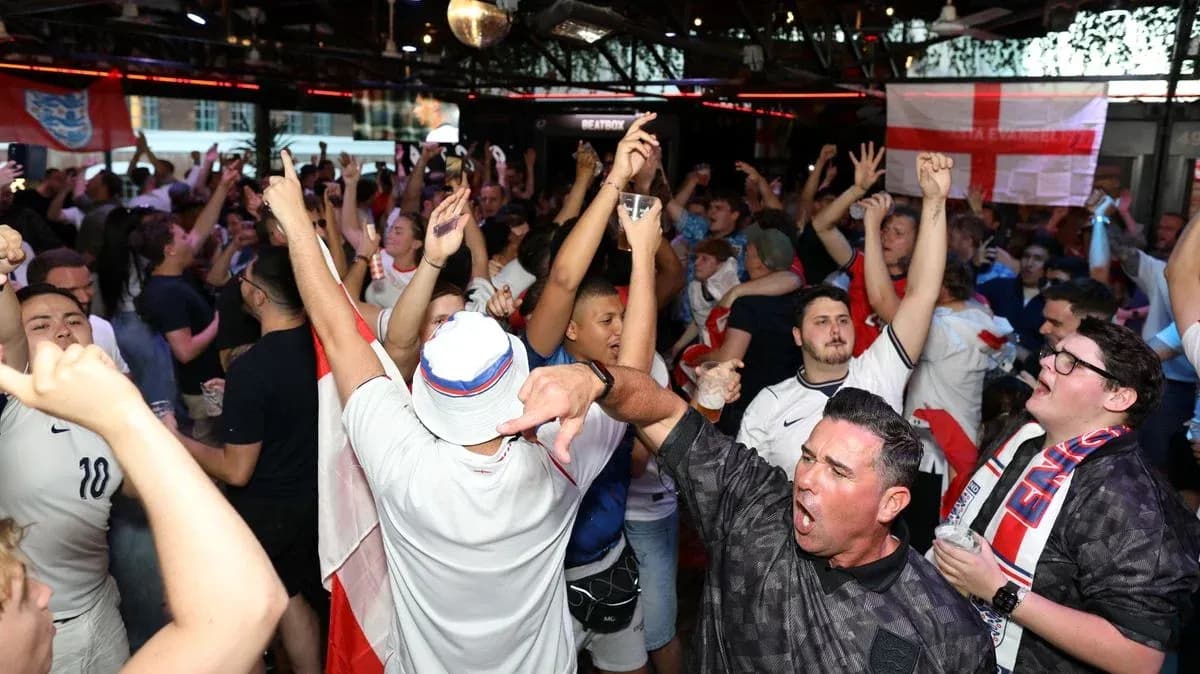
The Londoner Pub in Dallas, the self-styled “Palace in Dallas” for England’s travelling army and expats, became the epicentre of a wild opening night. Hundreds of England fans flooded through the doors, lured by an extended closing time and the promise of a home-from-home in Texas.
They drank it dry in footballing terms. The venue shifted 2,352 bottles of beer and more than 5,000 beers in total, raking in over £30,000 in a single evening. A staggering take, and a snapshot of the scale of England’s travelling support and the thirst that comes with it.
The scenes were raucous enough for police to intervene. With the pub at maximum capacity and only two security guards on duty, officers moved in at the start of the match. Videos showed fans being ordered out even as they belted out the national anthem. The fire marshal later ordered the venue to close early amid what the pub described as “mayhem”.
In a statement the following day, The Londoner stressed that the eye-catching sales figures did not reflect the “destruction of our property and landscaping” and reminded supporters that the bar sits within a complex that also includes residential properties.
England’s World Cup campaign had barely begun, yet the collateral – financial, emotional, logistical – was already spilling far beyond the pitch.
Kane’s hunger, Tuchel’s edge
On the field in Dallas, England produced the kind of chaotic, compelling opener that sends a nation scrambling for superlatives and bookmakers slashing odds.
Harry Kane, now the spearhead of Thomas Tuchel’s England, matched Gary Lineker’s record of 10 World Cup goals with a first-half brace. Jude Bellingham and substitute Marcus Rashford then finished the job in a second-half surge that turned a jittery 2-2 interval scoreline into a 4-2 statement.
Tuchel, who has long admired Kane, called his captain the “full package” and pointed not to the goals but to a moment in extra time when the striker hurled himself in front of a set-piece shot.
“If you see the commitment of our captain, of our number nine, in the extra time to block a crucial shot after a set piece with all his body and his commitment to buy into a defensive action like this, then you know everything about his performance today,” Tuchel said. “Complete performance, absolute leader and he is all in – he's all in physically, he’s all in mentally, and he's all in.”
Kane, chasing history, has more than England’s hopes on his shoulders. He is also locked in a personal duel with the game’s other great modern finishers.
Twenty-four hours before his double, Kylian Mbappé and Erling Haaland had both struck braces in their opening games. Lionel Messi went one better, hitting a hat-trick for Argentina against Algeria. Kane admitted that the exploits of his rivals fuel his own.
“Obviously I saw the guys scoring their goals,” he said. “I don't like to concentrate on other people, but it is natural as a sportsman and athlete to want to reach the highest level. Those guys started in a great way.
“As a striker myself, I just want to get on the scoresheet as quickly as possible. In the back of my mind that competition helps me to push my levels. That is what the World Cup is for, to push myself at the highest level, so it is nice to get a couple.”
“Take the shackles off”
If the first half in Dallas felt like a wild FA Cup tie transplanted into a Super Bowl setting, the second half was controlled fury. England, twice pegged back, came out after the break with a different posture and a different tempo.
Jude Bellingham struck just two minutes into the second period. Rashford killed the contest on 85 minutes. Between those moments, England suffocated Croatia, then sliced through them on the counter.
Kane lifted the lid on Tuchel’s half-time message.
“He told us to take the shackles off, calm down and let's go,” the captain revealed. “He said what's the worst that can happen? Show the world who we can be.
“We came out in the second half full gas and they couldn't live with it, and that's the level we have to set in every game. The way we controlled the game once we went ahead, we never really looked like we were in danger and then scored on the counterattack.”
Kyle Walker, writing in The Sun, drew a sharp line between Tuchel and former England manager Gareth Southgate. For the defender, the German’s in-game interventions made the difference.
“When I look back at the tournaments I played under Gareth Southgate, there is a difference compared to how Thomas Tuchel operates,” Walker wrote. He pointed to the timing and impact of substitutions – Bukayo Saka, Morgan Rogers and Rashford arriving with around 20 minutes left – as a key factor.
“Gareth tended to stick with the XI he trusted in and only made a few changes here and there,” Walker added. “I was part of that XI so it benefited me, but sometimes when you’re on the field, you’re thinking ‘go on, make a change, do something’ and Thomas got that right. If you’ve got Saka, Rogers and Rashford coming on when they did with about 20 minutes left, it would scare any team in the world.”
Bellingham’s edge, critics in reverse
No player embodies this new England quite like Bellingham. No player divides opinion quite like him either.
At 22, the Real Madrid midfielder is playing in his fourth international tournament. His swagger and authority have seen him branded arrogant by some, including during his time at Borussia Dortmund, where aspects of his behaviour grated with observers such as former Germany international Dietmar Hamann.
Hamann, covering the Croatia game for RTE, admitted he has had to revisit that stance.
“I saw him for Dortmund for a couple of seasons, and some of the things he did I didn't like at all,” he said. But he pointed to Bellingham’s instant impact at Madrid, capped by a Champions League title in his first season, and his display in Dallas as proof of his evolution.
“I wasn't sure about him going to Madrid, but I have got to say the way he made the transition to Madrid and winning the Champions League in his first year, there is huge pressure to perform, and tonight he looked like a team player. When he does play for the team, when he does work for his team-mates, we know he's an excellent player.”
Tuchel, who had publicly questioned Bellingham’s ability to buy into his “brotherhood” after a difficult international window last summer, kept the midfielder’s place in the starting XI under scrutiny heading into the opener. Morgan Rogers pressed hard for the same role. Bellingham responded with the third goal and a performance that fused bite with control.
“A very good player, he deserved to start, and that's what he needs to do to fight for his place,” Tuchel said.
Bellingham himself spoke of channelling the noise.
“For me personally, it was nice to put some of the noise aside and just show my country and my team-mates how committed I am to help us try to win football matches,” he told BBC Sport. “Second half, we got things right, first half we got the intensity right, but not quite with the ball and second half we put it all together nicely.
“To contribute, to help my team and help my country is one of the biggest honours and regardless of the noise outside, that honour doesn't change for me at all.
“It has been a tough season for me but I am feeling fresh and sharp and stronger. I have got a little bit of a chip on my shoulder. That helps me a lot to find that focus early in the game and to find that intensity.
“I know that it's part of being a footballer and I don't hold a grudge against anyone who says bad things about me because sometimes I do deserve it. Today, it was nice to try to show people and remind people what I'm about.”
Odds tumble, belief surges
The bookmakers reacted as quickly as England did in that second half.
Betway cut England’s price to win the World Cup from 8/1 to 13/2 after the Croatia victory. “After a shaky end to the first half, England were excellent in the second 45, and that was a real statement win from Thomas Tuchel's men,” said Betway spokesperson Lewis Knowles.
“They undoubtedly answered a lot of critics last night, and although there hadn't been much confidence in them in the market at 8/1 going into the game, the Three Lions are now 13/2 to go all the way, and there seems to be a real belief that football might actually come home this summer.”
Inside the “Palace in Dallas”, that belief sounded like a karaoke night turned fever dream. Beatles anthem “Hey Jude” rolled into Oasis’s “Wonderwall”, then “Sweet Caroline”. When Rashford struck late, the entire stadium erupted into “Football’s Coming Home”.
For American fan Jessica Long, who approached a reporter in the stands to talk about the World Cup arriving in her home city, the whole day felt like a glimpse of the future. A former London Marathon runner, she had once pounded the streets past that same reporter’s flat. Now she stood in Dallas, swept up in a different kind of endurance event.
“This is brilliant what an amazing day,” she said. “The World Cup is fantastic – look at everyone coming together.”
Elsewhere, a drone and a legend under scrutiny
While England basked, the tournament kept spinning.
In Mexico, the military brought down an “unregistered” drone flying near South Korea’s training camp before their Group A meeting with the hosts. The South Korean coach, Hong Myung-bo, called the incident “unfortunate”, though he stressed it came just before his side began working on tactical drills and did not affect preparations.
“During our training, there was a drone in the sky that we came to know about the fact,” he said. “But fortunately, it was right before we practised our tactics, so it did not impact us.
“But while we were preparing for the match, that was the most important timing, so what happened was unfortunate.”
In another corner of the competition, Cristiano Ronaldo began his sixth World Cup with a whimper rather than a roar. The 39-year-old was largely anonymous as Portugal were held by the Democratic Republic of Congo, Yoane Wissa scoring the equaliser. Ronaldo had two half-chances from pull-backs but failed to convert.
On BBC Radio 5 Live, Chris Sutton accused Portugal coach Roberto Martínez of lacking the courage to substitute his star.
“That is embarrassing,” Sutton said. “That is embarrassing for Roberto Martinez. Are we all watching a different game to Martinez? He is scared to take him off.
“He is not the manager. He might score the winner, but the game has passed him by. He is a brilliant player. He was once the playmaker, but now he is the poacher. He is not only the poacher, but he runs the estate.”
The contrast with England’s willingness to refresh, to rotate, to unleash Saka, Rogers and Rashford from the bench, could hardly be sharper.
The road ahead
Day seven of this sprawling World Cup is done. Day eight brings the next wave: Czech Republic against South Africa at 5pm UK time, both already on the brink after opening defeats; Switzerland versus Bosnia-Herzegovina at 8pm; Canada against Qatar at 11pm in a Group B so tight all four teams sit on a point.
Then, deep into the early hours, Mexico meet South Korea in a Group A clash that could propel one of them into the knockout rounds.
By then, some England fans will be heading home from late-night screenings, others waking up from the previous evening’s excess. Some will be pulled over on cold British roads and asked to blow into a tube, the echoes of “Football’s Coming Home” still rattling in their heads.
The football is intoxicating. The stakes, on and off the pitch, are higher than ever. The question now is whether England can keep their balance – in the bars, in the dressing room and in those breathless, brutal minutes when a World Cup campaign can tilt one way or the other.