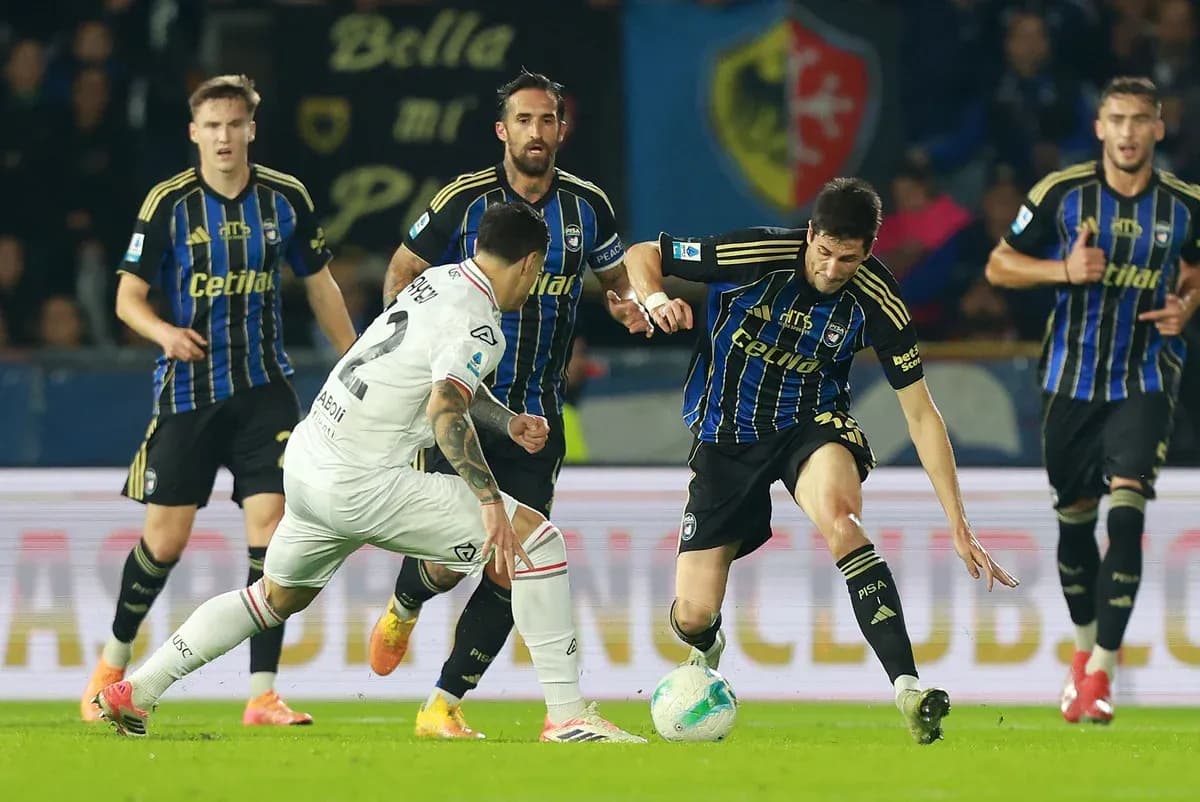
Cremonese Dominates Pisa 3-0 in Tactical Masterclass
Cremonese’s 3-0 win over Pisa at Stadio Giovanni Zini was a tactical strangling more than a simple scoreline victory. In a Serie A Round 36 fixture, Marco Giampaolo’s 4-4-2 dominated territory, the ball and the duels, while Oscar Hiljemark’s 3-5-2 unraveled under constant pressure and severe disciplinary damage. With Pisa reduced to nine men and failing to register a single shot, Cremonese converted structural superiority into a controlled, low-risk rout, leading 1-0 at half-time and never loosening their grip on the game’s rhythm.
Disciplinary Log
Disciplinary log (chronological, with exact reasons):
- 16' Rosen Bozhinov (Pisa) — Foul
- 23' Rosen Bozhinov (Pisa) — Foul
- 23' Rosen Bozhinov (Pisa) — Foul (Red Card)
- 49' Arturo Calabresi (Pisa) — Foul
- 57' Felipe Loyola (Pisa) — Foul (Red Card)
- 89' Malthe Højlholt (Pisa) — Foul
Cremonese received no cards. Pisa finished with 4 yellow cards and 2 red cards, all explicitly for “Foul”. There were no VAR interventions.
Scoring Sequence
Scoring sequence followed the same clear arc of control. At 31', J. Vardy put Cremonese 1-0 up with a Normal Goal, capitalizing on sustained pressure against a Pisa side already down to ten after Rosen Bozhinov’s dismissal at 23'. Early in the second half, at 51', F. Bonazzoli doubled the lead to 2-0, finishing a move created by J. Vandeputte’s assist from midfield. Pisa’s resistance collapsed further at 57' when Felipe Loyola’s red card for “Foul” left them with nine players. With numerical and territorial dominance, Cremonese added a third at 86': substitute D. Okereke finished clinically from an A. Zerbin assist to seal a 3-0 full-time score (Cremonese 3-0 Pisa).
The disciplinary cascade was decisive in shaping the tactical picture. Bozhinov’s first yellow at 16' for “Foul” was already a warning sign for Pisa’s back three. His second yellow and consequent red at 23', again for “Foul”, forced Hiljemark to abandon any proactive intentions. Pisa’s 3-5-2 flattened into a 5-3-1 low block, with the wing-backs dropping deep and the midfield line compressed in front of the box. Cremonese, already intent on building through a structured 4-4-2, now faced minimal pressure on the ball.
Giampaolo’s side used the back four as a stable platform. S. Luperto and M. Bianchetti could hold a high line, with full-backs G. Pezzella and F. Terracciano stepping aggressively into Pisa’s wide lanes. The double pivot of A. Grassi and Y. Maleh (later M. Thorsby) ensured Cremonese always had a free man in the first build-up line, while wide midfielders T. Barbieri and J. Vandeputte stretched Pisa’s remaining defenders horizontally. Up front, the partnership of J. Vardy and F. Bonazzoli alternated: one dropping between the lines, the other pinning the last defender.
The first goal at 31' was the logical outcome of this structure. With Pisa already a man down, Cremonese circulated at will, using their 77% possession to move Pisa’s compact block side-to-side until a channel opened for Vardy. The English forward’s movement into the right half-space exploited the gap between Pisa’s outside centre-back and wing-back, a zone that had become fragile once the back line had to constantly adjust for the missing defender.
Pisa’s attempt to react came via substitutions rather than a genuine tactical shift. At 37', S. Moreo (OUT) left for A. Calabresi (IN), and M. Leris (OUT) for S. Angori (IN), signaling a move to reinforce the back line and wide areas. However, the statistical reality—0 Total Shots, 0 Shots on Goal, 1 corner, and only 218 passes—shows they never translated those changes into attacking presence. Their 23% possession was almost entirely spent in their own third.
The second half opened with Pisa trying to hold a compact 5-3-1, but the pressure and fatigue told. At 49', Arturo Calabresi’s yellow for “Foul” reflected a back line constantly arriving late into duels. Two minutes later, at 51', Cremonese’s second goal came through a classic wide overload: Vandeputte’s assist from midfield into Bonazzoli’s run inside the box, exploiting Pisa’s inability to step out and engage due to their numerical inferiority.
Felipe Loyola’s straight red at 57' for “Foul” ended any remaining tactical contest. Pisa were now effectively in a 5-3-0 or 4-3-1 emergency shape, focused solely on protecting the central corridor. Giampaolo responded pragmatically, rotating energy and profiles rather than altering the fundamental structure. At 59', Y. Maleh (OUT) made way for M. Thorsby (IN), adding physicality and aerial presence in midfield, while G. Pezzella (OUT) for A. Zerbin (IN) pushed Cremonese into a more aggressive left side, with Zerbin operating high as a winger/full-forward hybrid.
Hiljemark’s triple response—at 65', I. Vural (OUT) for M. Hojholt (IN) and F. Stojilkovic (OUT) for H. Meister (IN), followed at 72' by E. Akinsanmiro (OUT) for G. Piccinini (IN)—was about fresh legs in central areas to survive waves of pressure. Yet Cremonese’s dominance in passes—735 total, 684 accurate (93%)—meant Pisa’s midfielders were chasing rather than dictating. Pisa’s 218 passes, 161 accurate (74%), underline how rarely they could string phases together.
Giampaolo continued to manage resources with the game state in mind. At 72', J. Vardy (OUT) was replaced by A. Sanabria (IN), and J. Vandeputte (OUT) by D. Okereke (IN), maintaining a front two but with fresher, more vertical runners against a tiring, undermanned defense. At 85', S. Luperto (OUT) for F. Folino (IN) allowed the coach to protect his starting centre-back and give minutes to the bench without compromising the high defensive line, as Pisa still posed no threat—confirmed by their 0 Shots on Goal and 0 Total Shots.
The third goal at 86' encapsulated the tactical pattern: Cremonese patiently circulating against a deep block, then injecting pace and directness through substitutes. Zerbin, introduced at 59', provided the assist; Okereke, brought on at 72', supplied the finish. It was the product of accumulated territorial pressure rather than a single transition moment.
From a statistical verdict perspective, Cremonese’s 1.15 xG against Pisa’s 0 xG reflects a controlled, low-risk offensive performance. The home side did not create an avalanche of high-quality chances but systematically denied Pisa any platform to attack. Notably, Cremonese’s goalkeeper E. Audero recorded 0 saves, a direct consequence of Pisa’s inability to generate shots. At the other end, A. Semper made 2 saves for Pisa, but his side’s “goals prevented” value of -1.18 underscores that the defensive unit, decimated by cards, underperformed relative to the quality of chances conceded.
Overall form and defensive index both favor Cremonese: a 3-0 win, 77% possession, 10 Total Shots (6 on Goal), 7 corners, and no cards, against a Pisa side that finished with 12 Fouls, 4 yellow cards, 2 red cards, and no shots. The match was less a contest of ideas and more a demonstration of how structural superiority, discipline, and ball retention can suffocate an opponent once numerical advantage is secured.