Chelsea's Tactical Masterclass in 2-1 Victory Over Tottenham
Chelsea’s 2-1 win over Tottenham at Stamford Bridge was a classic case of out-performing the numbers through structure, compactness and efficiency in key moments. Despite trailing in possession (44% to 56%) and xG (0.63 to 1.72), Chelsea controlled the game’s most valuable spaces better for long stretches, then survived a late territorial tilt as Tottenham chased an equaliser.
Both sides lined up in a 4-2-3-1, but the interpretations were markedly different. Calum McFarlane’s Chelsea used Moisés Caicedo and Andrey Santos as a double pivot primarily to protect the back four and spring quick central-to-wide transitions, while Roberto De Zerbi’s Tottenham tried to dominate the ball with João Palhinha anchoring and Rodrigo Bentancur stepping higher to connect with the three behind Richarlison.
Chelsea’s pressing scheme was selective rather than constant. Liam Delap led a curved press onto the centre-backs, screening Palhinha, while Cole Palmer and Enzo Fernandez narrowed in off the flanks to form a compact 4-4-2 block without the ball. That shape forced Tottenham to circulate horizontally, contributing to Spurs’ higher pass volume (538 passes, 473 accurate, 88%) but with a lot of their possession in front of Chelsea’s midfield line. Chelsea’s 425 passes (355 accurate, 84%) reflect a more vertical, risk-tolerant approach once they regained the ball.
Opening Goal
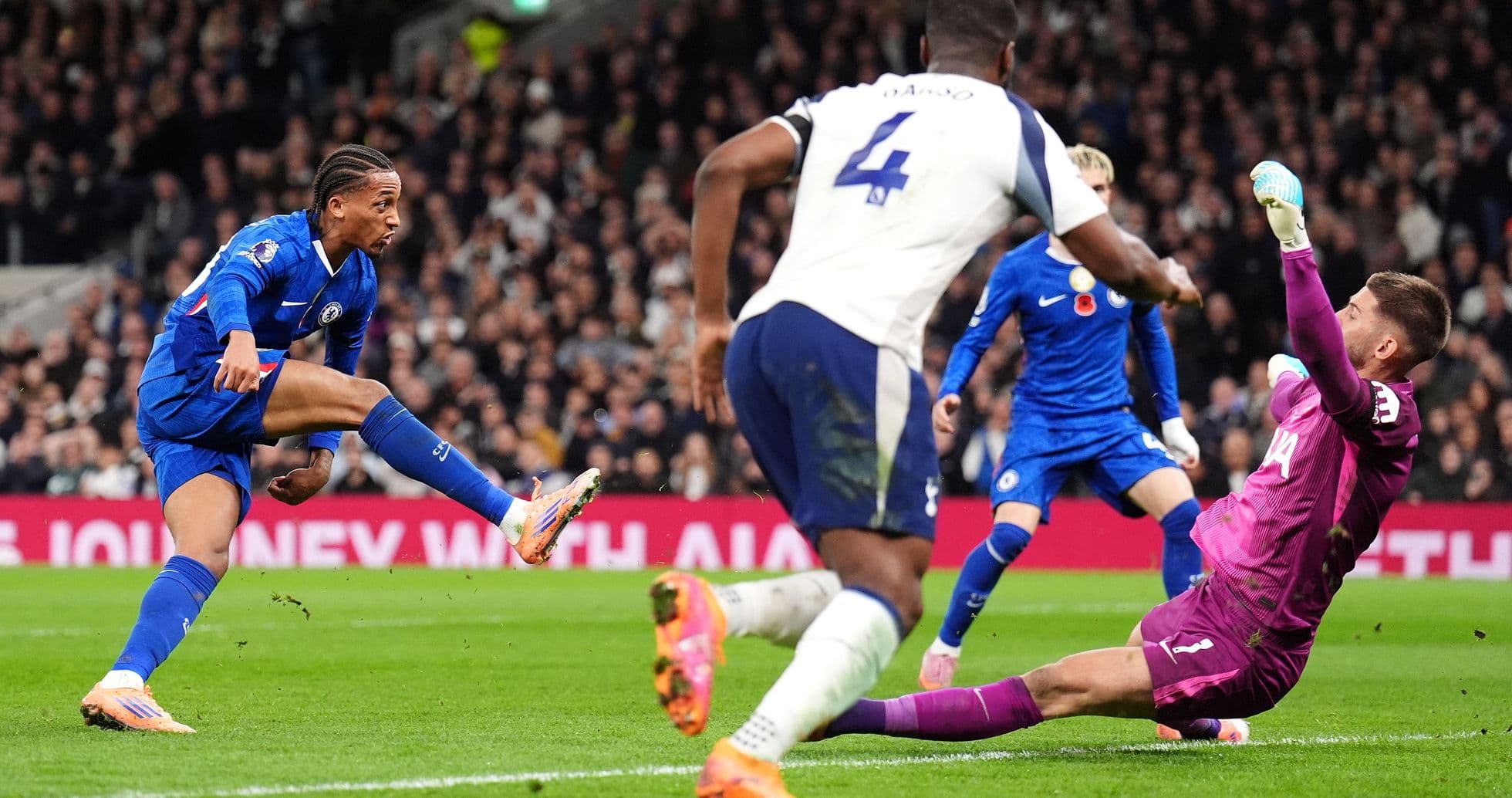
The opening goal on 18 minutes encapsulated Chelsea’s plan. Winning second balls in midfield, they quickly connected through the pivot into the half-spaces, with Pedro Neto finding Enzo Fernandez between the lines. Enzo’s advanced positioning from nominal “left 8/10” allowed him to arrive at the edge of the box and finish, one of only four Chelsea shots on target all night. With just nine total shots and modest xG, Chelsea relied on the timing and quality of their runs rather than volume.
Out of possession, the back four of Jorrel Hato, Wesley Fofana, J. Acheampong and Marc Cucurella (before the defensive reshuffle) stayed relatively narrow, inviting crosses rather than through-balls. Tottenham ended with eight shots inside the box but only three on target, a sign that Chelsea’s last-ditch pressure and blocking (two blocked shots) often forced rushed or off-balance attempts. Richarlison’s goal at 74 minutes, assisted by P. M. Sarr, came after De Zerbi’s triple change on 69 minutes, which injected more vertical running and second-line support around the striker.
Goalkeeping Performance
In goal, R. Sanchez (Chelsea) made two saves, mirroring A. Kinsky (Tottenham), who also registered two saves. The raw save counts are low, but they underline how much of Tottenham’s threat was either off target or smothered before it reached the goalkeeper. The negative goals prevented figure for Chelsea’s keeper (-1.08) indicates that, relative to shot quality faced, he conceded slightly more than expected, while Tottenham’s identical negative value reflects Kinsky being beaten twice from relatively modest xG.
Second Chelsea Goal
The second Chelsea goal on 67 minutes was structurally significant. Andrey Santos, usually sitting deeper alongside Caicedo, timed a late run into the box as Enzo Fernandez drifted into a playmaking pocket. That movement inverted the usual roles of the double pivot, catching Tottenham’s midfield line flat and exposing the space between centre-backs and holding midfielder. At 2-0, Chelsea dropped even deeper, turning their 4-2-3-1 into a 4-5-1 without the ball, with Neto and Palmer tracking full-backs to limit overlaps from Pedro Porro and Destiny Udogie.
Tactical Changes
De Zerbi’s reaction on 69 minutes — R. Kolo Muani (OUT) for J. Maddison (IN), Udogie (OUT) for Djed Spence (IN), and Palhinha (OUT) for P. M. Sarr (IN) — shifted Tottenham towards a more aggressive, front-loaded 4-2-3-1. Maddison operated between the lines, Sarr provided more box-to-box energy than Palhinha, and Spence offered direct running on the flank. The immediate payoff was Richarlison’s goal, but the structural cost was a slightly looser rest-defence, which Chelsea tried to exploit with counter-attacks, even if they did not add further goals.
Substitutions and Game Management
Chelsea’s substitutions were clearly aimed at game management. J. Acheampong (OUT) for T. Chalobah (IN) at 74 minutes added defensive security on the flank. Later, Fofana (OUT) for Malang Sarr (IN) at 81 minutes further reinforced aerial presence and box defending. In the final minute of normal time, Neto (OUT) for A. Garnacho (IN), Palmer (OUT) for Dário Essugo (IN), and Delap (OUT) for S. Mheuka (IN) refreshed the front line’s pressing legs and gave Chelsea more energy to contest clearances and second balls in stoppage time.
Discipline and Game Rhythm
Discipline also shaped the game’s rhythm. Tottenham’s three yellow cards — Pedro Porro, Micky van de Ven and Destiny Udogie all for “Foul” — reflected the strain their back line was under when defending Chelsea’s transitions and late midfield runs. Chelsea’s four bookings were more about game-state management: Hato for “Time wasting” at 79 minutes, Cucurella for “Argument” at 85, Delap for “Foul” at 87, and Essugo for “Foul” at 90+2. As Chelsea protected their lead, they increasingly disrupted Tottenham’s tempo, accepting fouls and arguments as the cost of breaking Spurs’ rhythm.
Statistical Analysis
Statistically, Tottenham’s profile — more possession, more passes, higher xG, more shots inside the box — usually correlates with at least a draw. But Chelsea’s compact mid-block, disciplined full-back positioning and efficient use of their four shots on target tilted the contest. The negative goals prevented figures on both sides underline that finishing, rather than goalkeeping heroics, decided the match.
In the context of the Premier League run-in, this 2-1 at Stamford Bridge looks like a tactical victory built on clarity: Chelsea accepted territorial inferiority, trusted their structure and transitions, and then used substitutions and controlled fouling to drag the game into a phase where Tottenham’s possession no longer translated into clear chances.