Brighton vs Manchester United: Tactical Analysis of the 0-3 Defeat
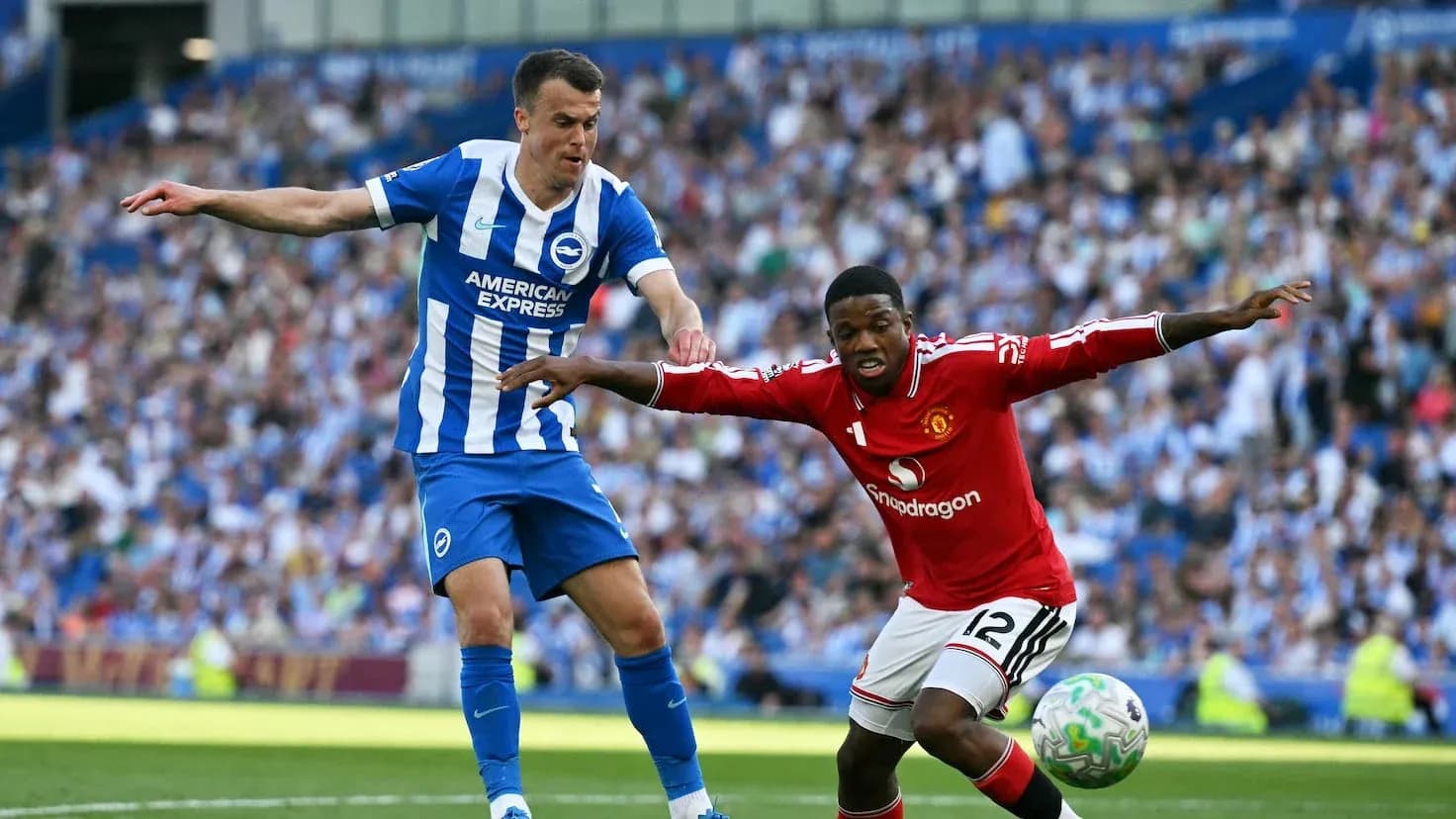
Brighton’s 0-3 defeat to Manchester United at Amex Stadium was defined less by possession or volume of shots and more by structure, verticality and penalty-box quality. Both sides lined up in a 4-2-3-1, but Manchester United’s version was far more ruthless, translating 11 total shots and 1.82 xG into three goals, while Brighton’s 13 attempts and 0.81 xG yielded nothing despite having 51% of the ball.
Brighton’s build-up under Fabian Hurzeler was clear: a back four of M. Wieffer, J. P. van Hecke, L. Dunk and F. Kadioglu, with P. Gross and J. Milner as the double pivot, looked to progress methodically through short passing. Their 463 passes, 397 accurate (86%), and majority possession reflect a team intent on controlling tempo. However, the structure often became sterile. With D. Welbeck as the lone forward and a line of three in D. Gomez, J. Hinshelwood and M. De Cuyper behind him, Brighton generated nine shots inside the box but too many were under pressure or from suboptimal angles, as the modest 0.81 xG underlines.
Manchester United’s pressing shape disrupted Brighton’s rhythm at key moments. From the 4-2-3-1 base, K. Mainoo and M. Mount sat as a double pivot, with A. Diallo and P. Dorgu wide and B. Fernandes central behind B. Mbeumo. Rather than pressing constantly, United chose their moments, allowing Brighton to circulate at the back but springing aggressively when passes entered the pivot zone. This forced Brighton into rushed decisions in the middle third, contributing to five of their shots being blocked and preventing clean final-third combinations.
In possession, United were far more direct and purposeful. Their 447 passes, 369 accurate (83%), came with slightly less of the ball (49%) but a clearer vertical intent. The front four constantly rotated: B. Fernandes drifted into half-spaces, A. Diallo moved inside from the right, and P. Dorgu advanced high from the left. The first goal on 33 minutes, P. Dorgu finishing from a B. Fernandes assist, epitomised this: Fernandes found a seam between Brighton’s lines, and Dorgu attacked the blind side of the full-back. The second, on 44 minutes, saw B. Mbeumo finish from an A. Diallo assist, again exploiting transitional space as Brighton’s structure stretched trying to chase the game before half-time.
The third goal, early in the second half at 48 minutes, underlined United’s control of central zones. B. Fernandes scored from a P. Dorgu assist, with the move later confirmed by VAR at 50 minutes. Here, United’s double pivot held their positions, allowing the attacking four to overload Brighton’s back line. Brighton’s 4-2-3-1 struggled to track these dynamic movements: the pivots were pinned, the full-backs were torn between stepping out and holding the line, and the centre-backs were repeatedly exposed to runners arriving from deeper positions.
Out of possession, United’s back four of N. Mazraoui, H. Maguire, L. Martinez and L. Shaw remained compact, rarely overcommitting in wide areas. That compactness, combined with the midfield screen, explains why Brighton’s shot count (13) did not translate into high-quality chances. Many of the nine shots inside the box were crowded out, reflected in Brighton having five blocked efforts to United’s one.
In goal, B. Verbruggen (Brighton) made 5 saves and, according to the data, prevented 0.32 goals, which suggests that without him the scoreline could have been even heavier. His shot-stopping kept Brighton marginally competitive despite the defensive disorganisation ahead of him. At the other end, S. Lammens (Manchester United) faced only two shots on target, making 2 saves. Protected by a disciplined block and aided by United’s control of the most dangerous spaces, he was rarely stretched, but remained clean in his handling when called upon.
Michael Carrick’s game management further tilted the tactical balance. With the score already 0-3, his substitutions around the 74th minute — J. Zirkzee for B. Mbeumo, L. Yoro for N. Mazraoui, and T. Fletcher for M. Mount — plus T. Malacia replacing L. Shaw on 82 minutes, allowed United to refresh energy without sacrificing structure. The shape stayed recognisably 4-2-3-1, with fresh legs maintaining pressing intensity and defensive concentration.
Hurzeler’s changes were more reactive than transformative. At 46 minutes, Y. Minteh (IN) came on for M. De Cuyper (OUT), aiming to inject directness on the flank. A triple change on 59 minutes — S. March (IN) for D. Gomez (OUT), C. Baleba (IN) for J. Milner (OUT), and C. Kostoulas (IN) for D. Welbeck (OUT) — attempted to add energy and more vertical running. Later, G. Rutter (IN) replaced J. Hinshelwood (OUT) at 74 minutes, pushing Brighton into a more aggressive attacking posture. Yet the underlying issue remained: Brighton could circulate the ball but struggled to disorganise United’s compact block or create clear central overloads.
Discipline and control also told a story. Brighton committed 11 fouls to United’s 8 but received no cards, while Kobbie Mainoo’s 45+3' yellow card for “Foul” was United’s only booking. That single card underlines how rarely United were forced into desperate, last-ditch defending; their fouls tended to be tactical and controlled, breaking up play without spiralling into chaos.
Statistically, the match confirms the tactical picture. United’s 7 shots on goal from 11 attempts, with 7 inside the box and 1.82 xG, show a side that created fewer but far better chances. Brighton, despite more total shots and a slight possession edge, produced only 2 shots on goal and 0.81 xG, a sign of low shot quality and United’s effective shot suppression. Corner disparity — Brighton 0, United 3 — further reflects how United reached the byline and final third in more threatening patterns.
Overall, Manchester United’s 4-2-3-1 was the more coherent system: compact without the ball, vertical and incisive with it, and supported by efficient game management. Brighton’s similar nominal shape lacked the same clarity between phases, leaving them with sterile control and a heavy final-day defeat.