Bournemouth vs Manchester City: A Tactical Analysis of the 1-1 Draw
The Vitality Stadium under floodlights has become one of the Premier League’s more awkward assignments, and this 1-1 draw between Bournemouth and Manchester City felt like a meeting of two fully formed identities rather than a simple underdog tale. Following this result, the league table underlines that: Bournemouth sit 6th with 56 points, City 2nd with 78. One is punching upward toward Europe, the other straining for a title. The scoreline, and the way it was earned, told us plenty about both squads.
Bournemouth came in with the seasonal profile of a stubborn disruptor. Overall this campaign they have scored 57 and conceded 53, a goal difference of 4 that reflects a side comfortable in chaos but no longer reckless. At home they have played 19 league matches, winning 7, drawing 10 and losing just 2, with 29 goals for and 20 against. The Vitality has become a place where visitors are rarely allowed a clean narrative.
Andoni Iraola doubled down on that identity with his trusted 4-2-3-1. D. Petrovic in goal set the tone with his distribution, inviting City’s press and daring them to overcommit. Ahead of him, the back four of A. Truffert, M. Senesi, J. Hill and A. Smith was built for aggression rather than retreat. Senesi and Hill are natural front‑foot defenders, happy to step in behind a midfield screen, while Truffert and Smith were tasked with the exhausting dual role of pinning City’s wide men and providing Bournemouth’s width in transition.
The double pivot of T. Adams and A. Scott was the structural heart of the plan. Adams, the destroyer, broke City’s rhythm and protected the half-spaces, while Scott’s calmer passing gave Bournemouth a way out when the first press was beaten. Ahead of them, the line of three – Rayan, E. J. Kroupi and M. Tavernier – was where Iraola’s courage showed. Rather than sit in a low block, he trusted that trio to spring quickly, attack space behind City’s full-backs and connect with Evanilson as the lone forward.
Manchester City, meanwhile, arrived with the numbers of a juggernaut. Overall they have scored 76 and conceded 33, a goal difference of 43. On their travels they have played 19 times, winning 9, drawing 6 and losing 4, with 32 goals for and 21 against. Their away profile is still elite, but not invulnerable; they concede on average 1.1 goals away from home, a sliver of daylight for ambitious hosts like Bournemouth.
Pep Guardiola leaned into control with a 4-1-4-1. G. Donnarumma’s presence in goal added aerial dominance but also a slightly more conservative build-up rhythm. The back line of N. O’Reilly, M. Guehi, A. Khusanov and M. Nunes was notably hybrid: Nunes listed as a defender but functioning as an auxiliary full-back/midfielder, capable of stepping into the half-space to help circulate possession.
Rodri, as ever, was the single pivot – the metronome and emergency brake. Ahead of him, the four of J. Doku, M. Kovacic, B. Silva and A. Semenyo formed a band of technicians and runners. Doku offered the directness, Semenyo the vertical surges and pressing from the right, Kovacic the progression through pressure, and Bernardo Silva the subtlety between the lines. E. Haaland led the line, the league’s standout finisher with 27 goals and 8 assists in 35 appearances. His 102 total shots and 59 on target, plus 3 penalties scored but 1 missed, underline both his volume and the fact he is not infallible from the spot.
Tactically, the absences mattered. Bournemouth were without R. Christie, suspended after a red card, and Álex Jiménez, also suspended. Christie’s energy and ability to press from midfield would have been invaluable against City’s build-up; his single red card this season is the flip side of that aggression. Jiménez, one of the league’s leading yellow-card collectors with 10 bookings, has been a combative presence at right-back, and his suspension forced Iraola to trust A. Smith in that role. Bournemouth’s defensive edge was reshaped rather than blunted.
Discipline was always going to be a sub-plot. Heading into this game, Bournemouth’s yellow-card distribution shows a pronounced late-game spike: 26.44% of their yellows arrive between 76-90 minutes, and another 21.84% between 91-105. City, too, show a late surge, with 19.70% of their yellows between 76-90 and 19.70% between 46-60. This match duly descended into a tense, card-prone finale, reflecting two teams that push the physical and tactical limits in the closing stages.
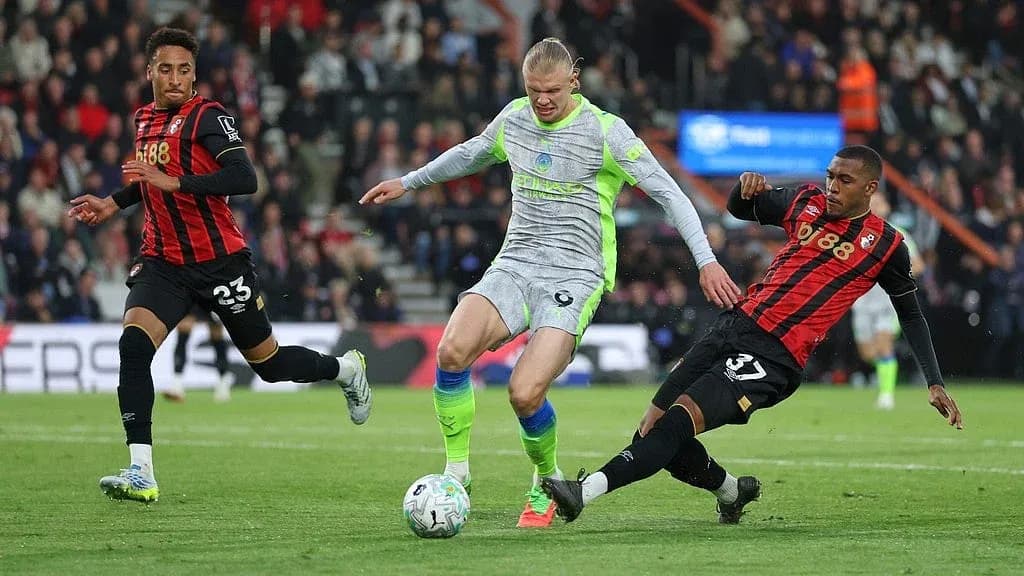
The “Hunter vs Shield” duel was clear: Haaland, the division’s most ruthless finisher, against a Bournemouth defence that overall concedes 1.4 goals per game but just 1.1 at home. Senesi and Hill had to manage not just the Norwegian’s movement but the constant threat of cut-backs from Doku and Semenyo. Haaland’s season numbers – 240 duels, 129 won – suggest a striker who relishes physical contact, but Bournemouth’s compact block and Petrovic’s command of his area limited him to scraps for long stretches, even if City eventually found their equaliser.
On the other side, the “Engine Room” battle pitted Rodri and Kovacic against Adams and Scott. Rodri’s ability to dictate tempo was challenged by Adams’ willingness to step out and disrupt. Bournemouth’s plan hinged on forcing City’s pivot into rushed decisions, then using Kroupi’s intelligent movement – 13 league goals, 21 key passes – as the release valve. Kroupi’s profile as both finisher and connector made him the natural conduit whenever Bournemouth broke City’s first line.
From a statistical prognosis standpoint, City still project as the side with the higher underlying xG across most matches: 2.1 goals scored on average overall, conceding just 0.9. Bournemouth, at 1.5 scored and 1.4 conceded overall, live on a finer margin. Yet this game showed how context and structure can bend those probabilities. Bournemouth’s home resilience, their 11 clean sheets overall and only 7 total failures to score, combined with Iraola’s brave 4-2-3-1, allowed them to compress the gap in expected goals and turn the contest into something closer to a coin flip than the table might suggest.
Following this result, City’s title push absorbs another bruise, while Bournemouth’s European dream gains another layer of credibility. The numbers still say City are the more reliable xG machine, but on nights like this at the Vitality Stadium, structure, intensity and a fearless squad can make even a 43-goal-difference giant look human.