Arsenal’s Tactical Mastery in 1-0 Victory Over Burnley
Arsenal’s 1-0 win over Burnley at Emirates Stadium was a controlled, possession-heavy performance built on Mikel Arteta’s 4-3-3 structure and a disciplined high line, rather than attacking volume alone. With 61% of the ball, 13 total shots and an xG of 1.03, Arsenal produced just enough incision to justify the scoreline, while completely suffocating Burnley’s ability to threaten (0 shots on goal, xG 0.21).
The decisive moment came on 37 minutes: K. Havertz finished a move created by B. Saka, a pattern that summed up Arsenal’s right-sided bias. Saka, starting high and wide in the 4-3-3, repeatedly received early switches from the back four and from D. Rice, isolating Burnley’s left-back Lucas Pires. Havertz, nominally the central forward, consistently drifted into the right half-space to link with Saka, which is exactly how the goal materialised: Saka supplied, Havertz attacked the central channel.
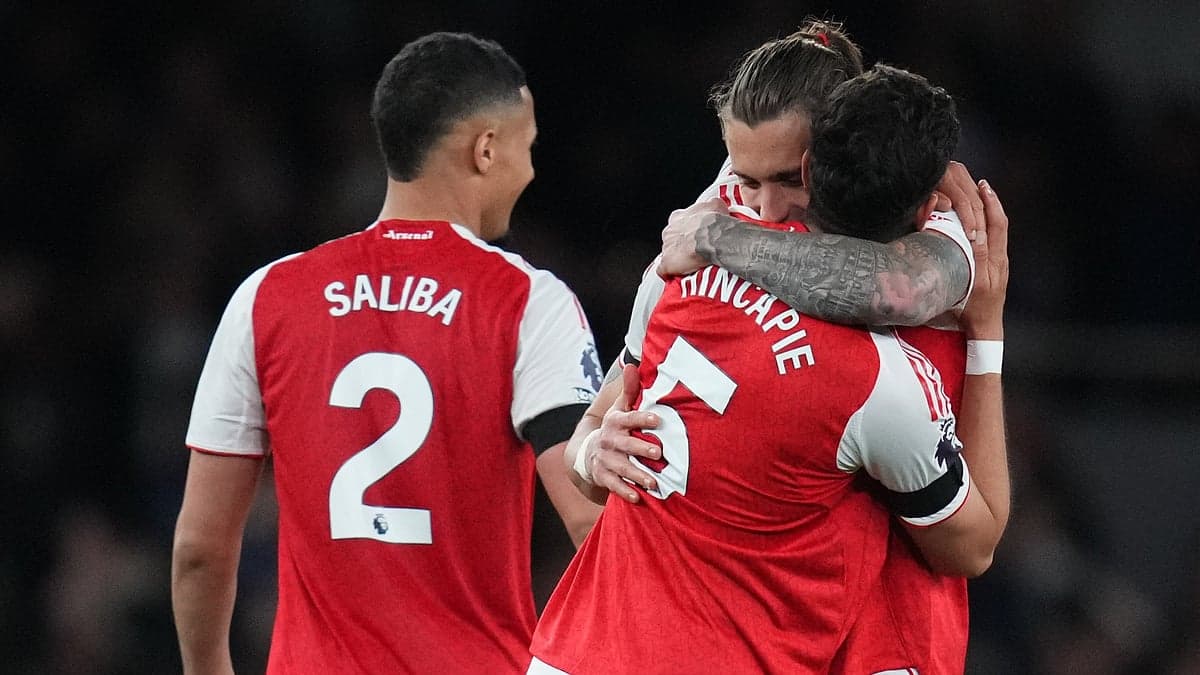
Structurally, Arsenal’s back four of C. Mosquera, W. Saliba, Gabriel and R. Calafiori operated almost as a three in settled possession. Calafiori tucked inside alongside Gabriel to form a narrow rest-defence, with Mosquera given licence to push higher on the right. This allowed M. Odegaard and E. Eze, as the advanced interiors ahead of Rice, to occupy pockets between Burnley’s double pivot (Florentino and L. Ugochukwu) and their band of three. The result was territorial control and repeated entries into the box: 9 of Arsenal’s 13 shots came from inside the area.
Burnley, in Mike Jackson’s 4-2-3-1, defended deep and narrow, aiming to compress the central zones where Odegaard and Eze operate. Their problem was progression. With only 39% possession and just 325 passes (254 accurate, 78%), they struggled to connect their midfield to Z. Flemming up front. L. Tchaouna and J. Anthony started as wide midfielders but were forced so deep that transitions rarely progressed beyond the halfway line. The fact that Burnley did not register a single shot on target underlines how effectively Arsenal’s rest-defence and counter-press pinned them back.
The discipline data reinforces that territorial imbalance. Burnley committed 16 fouls to Arsenal’s 7, and their three yellow cards all came from reactive or game-state situations: at 28', Hannibal Mejbri was booked for “Time wasting”, a telling sign of Burnley’s early inclination to slow the game; in added time, Zian Flemming (90+1') and Lucas Pires (90+4') were both cautioned for “Foul” as Burnley chased lost causes. Arsenal, by contrast, picked up a single yellow when Kai Havertz was booked for “Foul” on 67', a rare moment where their press was a fraction late.
Substitutions from both managers were tactical adjustments to the evolving rhythm rather than game-changing swings. Jackson’s first move at 70' saw H. Mejbri (OUT) replaced by Z. Amdouni (IN), a shift towards more attacking threat between the lines. One minute later, L. Ugochukwu (OUT) made way for J. Laurent (IN), fresh legs in the pivot to cope with Arsenal’s midfield rotations. At 78', Florentino (OUT) was replaced by J. Ward-Prowse (IN), adding set-piece quality and a more progressive passing profile. Finally, at 82', a double change: L. Tchaouna (OUT) for J. Bruun Larsen (IN) and M. Esteve (OUT) for B. Humphreys (IN), nudging Burnley towards a more aggressive final push without altering the basic 4-2-3-1 shell.
Arteta’s substitutions were more about game management and preserving structural integrity. At 72', R. Calafiori (OUT) was replaced by P. Hincapie (IN), a like-for-like left-sided defender who maintained the compact back line. A minute later came a double attacking refresh: K. Havertz (OUT) for V. Gyökeres (IN), and E. Eze (OUT) for M. Lewis-Skelly (IN). Gyökeres offered more direct running in behind to stretch Burnley’s higher late line, while Lewis-Skelly added energy and defensive coverage in midfield. In added time at 90+3', L. Trossard (OUT) was replaced by G. Martinelli (IN), and M. Odegaard (OUT) made way for M. Zubimendi (IN), effectively adding a second holding midfielder to close the game out and protect the 1-0.
From a statistical standpoint, Arsenal’s passing and control were the foundation. They completed 440 of 510 passes (86%), circulating the ball with patience and forcing Burnley into lateral defensive shifts. The 3 corner kicks and 3 blocked shots underline sustained pressure, even if the final ball was not always precise. Crucially, Arsenal’s defensive structure meant D. Raya did not have to make a single save (0 goalkeeper saves), yet his goals prevented figure of 0.85 indicates that the underlying shot quality Burnley might have generated was effectively neutralised by positioning and defensive interventions before shots could truly test him.
On the other side, M. Weiss made 2 goalkeeper saves and matched Raya’s goals prevented value of 0.85, which aligns neatly with Arsenal’s xG of 1.03 and the single goal conceded. Burnley’s defensive unit, particularly the central pairing of A. Tuanzebe and M. Esteve before his substitution, limited Arsenal to 3 shots on target from 13 attempts, suggesting that while Arsenal dominated territory, Burnley’s last line did not collapse.
In summary, this was a textbook example of a big side controlling a game through structure and circulation rather than sheer shot volume. Arsenal’s 4-3-3, with Rice anchoring and Havertz linking to Saka on the right, created enough to edge ahead and then manage the tempo. Burnley’s 4-2-3-1 remained compact but lacked verticality and incision, reflected in their 0 shots on goal and low xG. The card profile (Arsenal 1, Burnley 3) and foul count further emphasise a contest where Arsenal dictated, and Burnley mostly reacted, without ever truly unsettling the home side’s defensive organisation.