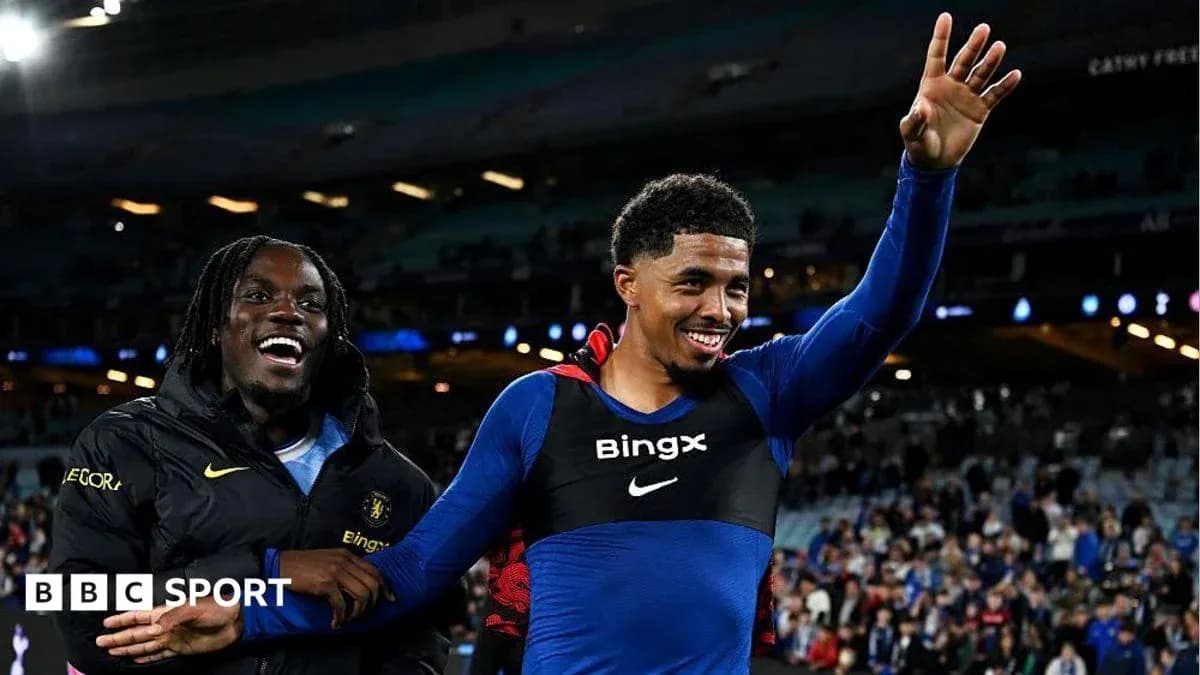
Wesley Fofana: Finding Stability at Chelsea
Wesley Fofana has cried on the pitch, been hammered for laughing on the bench and forced to confront racist abuse on his phone. Now he is talking about something Chelsea have not known for years.
Stability.
The 25-year-old centre-back has lived through almost every twist of the club’s chaotic new era since arriving from Leicester City in a £75m deal in 2022. That fee made him a lightning rod. So did the injuries. So did the mistakes. So did the optics of that clip in Paris.
Yet somehow, he is still here.
With Marc Cucurella gone to Real Madrid, Fofana is now Chelsea’s longest-serving senior outfield signing, behind only academy captain Reece James. For a club that has churned through squads, managers and ideas at breakneck speed, that is a remarkable sentence.
“Football is like this. It moves fast, but it is a good stat,” he says. “For me, some years were difficult, but now I'm back. I'm playing, I'm fit.”
He pauses, then undercuts himself with a grin.
“Well, almost. Thanks, Filip.”
The joke is aimed at goalkeeper Filip Jorgensen, whose punch in an aerial challenge last season left Fofana short of the completely clean bill of health he craved. It still counts as progress. This is a defender who broke his leg at Leicester, then fought through an ACL injury and hamstring surgery at Chelsea. He calls them “small details” in his fitness work, but the scars tell a different story.
“For me, the most important thing last season was to be fit, just to remove this from my head – the injuries and other things,” he explains.
From dream move to easy target
Fofana makes no attempt to hide what Chelsea means to him. Growing up in Marseille, he idolised Didier Drogba and supported the Blues from afar. Joining them was, in his own word, a “dream”.
The reality has been harsher. Chelsea finished 10th in the Premier League last season and ended the campaign without a trophy. The mood turned sour. Someone had to carry the blame.
Fofana knows many fans chose him.
The image that stuck came from a brutal Champions League defeat by Paris St-Germain in March, when cameras caught him laughing on the bench. The context barely mattered once the clip hit social media.
He insists it was nowhere near as serious as it was made to look and says people inside the club “know my mentality”. Still, he does not duck the reaction.
“When the team is not doing well, we need to find someone [to blame]. I can accept that,” he says. “The club bought me for a very big transfer [fee]. I came with the ambition to be the best in my position and to help the team. So, when things go badly, I accept being the guy [people blame].”
He could easily have spun the spotlight back on Chelsea. Former manager Enzo Maresca departed after a breakdown in relations with the hierarchy. His replacement, Liam Rosenior, lasted four months, failed to win any of his first five games, failed to score in them as well, and lost the backing of large parts of the dressing room.
Fofana does not hide behind that either.
“Of course we can use this as an excuse, but I think it's the players,” he says. “We didn't give everything. We lost some games, we produced some poor performances and we missed a lot of things.
“Of course you can't bring that into the new season, but I think everyone knows what was wrong last season. Everyone looked at themselves in the mirror.”
The line he refuses to let anyone cross
Criticism of performances is one thing. What arrived in his direct messages was something else.
Fofana, a Muslim whose father is from Ivory Coast, received racist abuse on Instagram last season and again highlighted messages in March 2025. The screenshots were sickening. He says they still hurt when they land, but he has no intention of staying quiet.
“It is not a big thing to expose people who do that,” he says. “For me, it is very important. For me and other players, we need to show what people are saying.
“We need to educate people. I think the people behind Instagram need to work on that. I exposed this on Instagram and Twitter [now called X] because I think they need to be more aware and more conscious of this problem.
“It is not only football. I think the world is a little bit like this and it is too easy to say some things.”
What strikes him most is the hypocrisy.
“Sometimes I receive messages and I don't think these people are racist,” he says. “They send monkey emojis because they are unhappy with the result and then, if I score in the next game, the same people support me.
“We need to educate people because it is not normal to talk like this. I understand that if I get a red card, you can be disappointed, but you cannot say these things.”
Younger team-mates have shown him similar messages and then shrugged, choosing not to act. Fofana has been receiving abuse like this since he was a teenager. He has decided he will keep speaking out, even if it invites more judgement of his character.
Fighting for a place in a crowded room
On the pitch, there is another battle. Xabi Alonso has used what looks close to his strongest XI in three of Chelsea’s five pre-season games. Fofana started all three.
That is the good news. The complication? Chelsea now have Maxence Lacroix through the door and nine centre-backs on their books. The club also holds an internal list of “untouchable” players, those considered not for sale. Fofana is not on it.
He does not flinch when told.
“Yes we have a lot, I think there are nine or 10,” he replies. “Everyone needs to be good, to train well and after the manager takes the decision. It's like this for everyone.
“Maybe some guys will leave, others will come again. For myself, it is about training well, trying to be fit and we will see what the manager does. If the club tells me they don't need me anymore, it is like this. Of course I will be sad but this is football. You can't say 'I have my place and I am sure to play'.”
Right now, that scenario feels distant. Fofana wants to stay. He talks about an “amazing” future at Chelsea if the club finally sticks to a plan. He is not alone.
Experience, edge and the Alonso project
Inside the dressing room, there is a sense that the club has recognised the cost of its own volatility. Sporting directors and board members have spoken to senior players about a reset in direction. The proof is arriving in the shape of Jordan Henderson and Danny Welbeck.
Henderson is 36, Welbeck 35. Both arrive with scars and medals, and Fofana believes they can change the temperature of the training ground.
He says they “know how to win big games”, insists they will be “important in training sessions” and hints that one or two team-mates might get “a kicking” if standards dip.
Yet for all the talk of leadership and experience, Fofana keeps circling back to one theme.
Xabi Alonso.
The new head coach has already made Fofana central to his pre-season plans and, in doing so, has offered the defender something he has rarely felt at Chelsea: continuity.
“I think everyone knows we need stability,” Fofana says. “We talked last season with the directors and they said the same thing. They think the same way as the players. We need stability.”
For a club that has burned through managers and squads, the message is blunt. If Chelsea really want to see the best of a player who has fought through injuries, criticism and abuse to stand his ground in blue, they might finally have to slow down.