How the U.S. Team Prepares for Australia After World Cup Win
For the United States, the answer this week has not been to bask in the glow of a 4-1 opening win over Paraguay, or to replay Folarin Balogun’s historic brace on loop. It has been to rewind the tape to a far rougher night: a bruising friendly against Australia seven months ago, when Mauricio Pochettino stormed into the dressing room at halftime and let his players have it.
The stakes then were minimal. The tone was not.
Australia had come after the U.S. from the opening whistle, turning a “non-counting” friendly into a scrap. At the break, with the score 1-1, Pochettino tore into his squad. In a video later released by the team, his message was blunt: the Socceroos “come and they fight. When are we going to fix that?”
The U.S. did respond that night, grinding out a 2-1 win. But the rant stayed with them.
Sebastian Berhalter still hears it.
“I think one is that we’re American, we don’t take s---,” the midfielder said this week, asked what stuck from that meeting. “I think that’s something that [Pochettino] really put in, and you know, he’s, even though he’s Argentinian, he has that mindset of like, ‘Look, this is what we do, and this is who we are, and this is what America is about.’”
That edge, Berhalter said, is something Pochettino “really drills into us.”
A New Stage, Same Demands
Seven months on, the surroundings could not be more different. This is no friendly. The U.S. arrives at its second group game with momentum, history, and a place in the knockout round all within reach.
The 4-1 dismantling of Paraguay in the opener matched the largest World Cup margin of victory in U.S. history. Balogun’s two goals made him the first American to score multiple times in a World Cup match since 1930. Australia, for its part, opened with a 1-0 win and then added a 2-0 victory over Turkey, bringing its own confidence and bite into Friday’s showdown.
Win, and you’re through. Simple as that.
Inside the U.S. camp, though, there is little appetite for self-congratulation. Pochettino’s post-Paraguay message, as relayed by striker Haji Wright, was warm but clipped.
He was “proud,” Wright said. That was it. One game. One win. Nothing more.
Tyler Adams, who has lived the full arc of this group’s growing pains, put it plainly.
“There’s been moments throughout the process where things weren’t going amazing,” the midfielder said. “Now all of a sudden, some people consider [our play] amazing, whatever it is, but we’ve stayed completely humble in our approach to every single game and trusted the process of what we’re going through.”
Trust the process, yes. Forget Australia’s bite? Not a chance.
“They’re tough to break down, they’re dangerous on counterattacks, they have good players at the top of the pitch, and they were able to be effective and damage Turkey,” Wright said. “I think Turkey kind of came into the game a bit overconfident, and I think we won’t make that same mistake.”
The Warning From Last Time
That last meeting with Australia still serves as a cautionary tale. The U.S. had more talent. Australia brought more snarl, at least early. Pochettino’s fury was not about tactics; it was about identity.
This week, that theme has resurfaced as the U.S. prepares for another physical test against a side that relishes the fight and thrives on chaos. The Americans have spent months refining their patterns, their pressing triggers, their rotations. The coach has never let them forget that none of it matters if they lose the duels.
The players have bought in. Berhalter’s “we don’t take s---” line was not bravado for the cameras; it echoed the internal standard Pochettino has been hammering home.
Now they face an opponent that will probe that standard again. Australia has already shown in this tournament that it can sit compact, absorb pressure, and then punish any lapse with direct, ruthless counters. Turkey found that out. The U.S. has the tape — and the scars — to know what’s coming.
The Pulisic Question
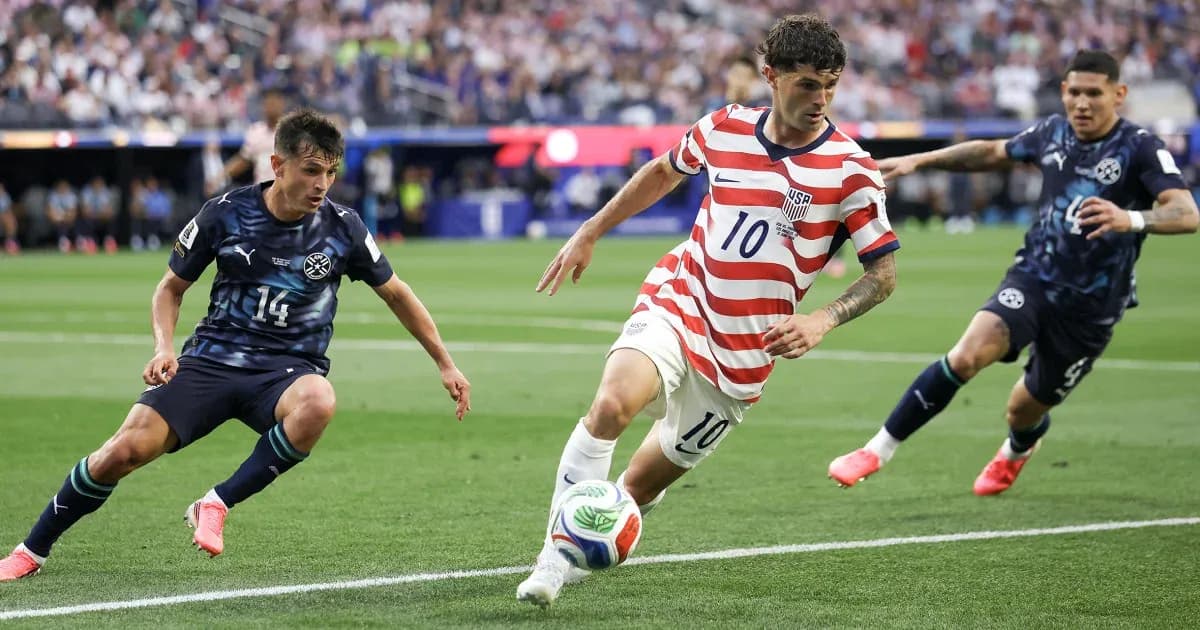
The one cloud over an otherwise emphatic opening night came in the form of Christian Pulisic’s limp.
The U.S. star, who carved open Paraguay with his running and passing and set up the first two goals, did not emerge for the second half. Pochettino explained that Pulisic had picked up a minor knock days earlier, then was kicked again in his left leg during the first half. At the break, he simply couldn’t get warm enough to continue.
Since then, Pulisic has been training off to the side, Tim Weah said. No full sessions with the group. No clear green light.
Asked on Thursday about his status, Pochettino kept it tight: “We’ll see.”
Weah did not hide his concern.
“I’m just praying to God that he feels 100% fit,” he said.
Adams, ever the captain’s voice, tried to steady the room.
“Christian will be ready, everyone, let’s relax,” he said. “He’ll be fine.”
The U.S. has options if Pulisic cannot start, but there is no like-for-like replacement for his gravity on the ball, his ability to draw defenders and open lanes for Balogun, Weah, and Wright. Against a compact, combative side like Australia, his absence would change the picture.
The Edge That Can’t Slip
So the equation is clear. The U.S. has form, confidence, and a statement win behind it. Australia brings familiarity, scars, and a style that dragged the Americans into a street fight last time.
Pochettino’s message then was simple: match the fight, or get run over.
Seven months later, with a World Cup knockout place on the line, the question hangs in the air again. Not about talent, or tactics, or history.
When Australia comes and fights this time, how American will this U.S. team really be?