Tuchel's Fury at England's Left Flank
Thomas Tuchel did not bother with diplomacy. England’s head coach took aim at his entire left flank – winger, full-back, the lot – and made it clear that one side of his team is threatening to derail their World Cup campaign.
Tuchel’s fury with the left side
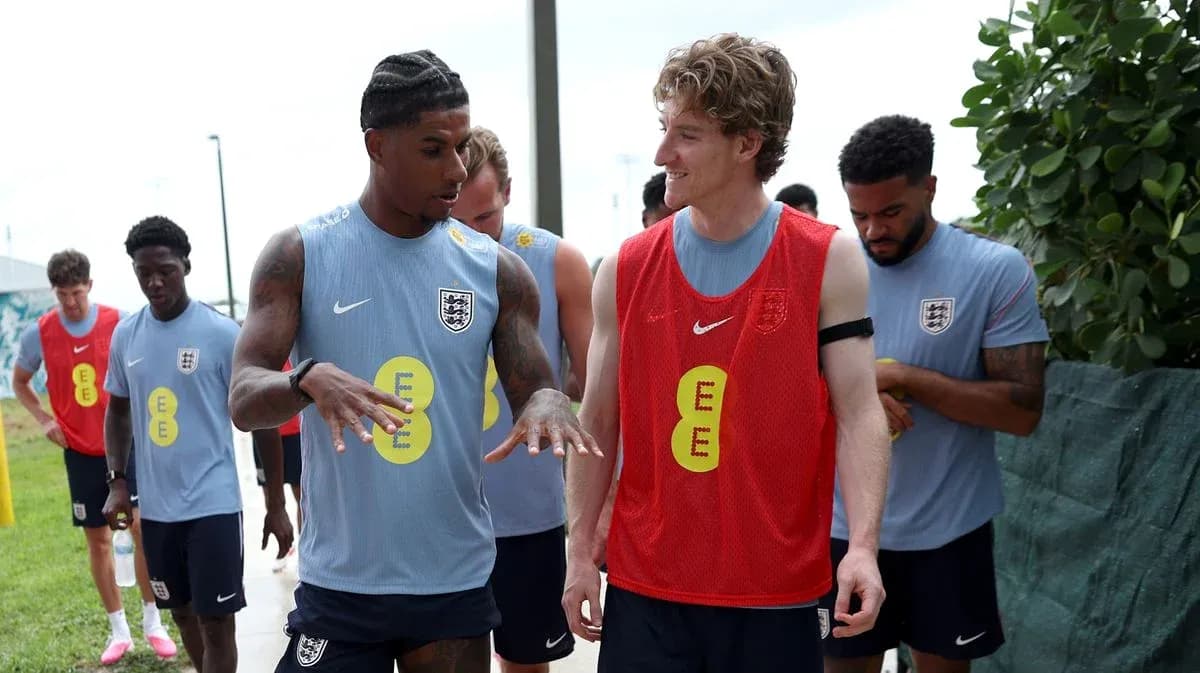
Anthony Gordon and Marcus Rashford were the headline names in the firing line, but this was not just about individuals. Tuchel spoke about “the unit” on that side of the pitch, and his frustration poured out.
He thought the problem had been fixed. Gordon had dazzled in the final warm-up against Costa Rica, combining sharply with Nico O’Reilly at left-back. Tuchel left that friendly believing the issue was solved.
“I saw the game against Costa Rica and thought: ‘OK, left side is solved, this unit, they find their link,’” he said.
Then the tournament began.
Across England’s first two group matches, Tuchel saw almost none of the “connection and penetration” he had banked on. The left side, in his words, “hasn't provided the same quality” and has become a glaring concern.
Rashford has not escaped either. Tuchel was asked directly whether the forward is likely to start against Panama. The answer came with a sting.
“Marcus is in a good place, but when he started he was not as decisive as Anthony, that's just it,” Tuchel admitted.
The numbers and the patterns back him up. When Rashford has started, England’s threat from that flank has dipped. When he has come from the bench, the energy has spiked. Tuchel knows it, and so does Rashford.
“He struggled to have the same influence for us from the start, and yet from the bench he was always pushing,” Tuchel said. “Marcus is just also very good from the bench, and it's sometimes nice to hold someone back.”
The full-backs have come under just as much scrutiny. O’Reilly lost his place to Djed Spence for the draw with Ghana, but the change did not fix the problem. The combinations still misfired. The angles were wrong. The runs lacked conviction.
“It turns out we played the first match and they're not clicking, I’m not even sure why,” Tuchel admitted. “Not the same amount of connection, not the same amount of penetration, not the same amount of verticality, and this was the same in the second match.”
He insists the trust remains. In Gordon, in Rashford, in O’Reilly, in Spence, in the whole left-sided carousel. But the message is unmistakable: whoever plays there against Panama has to deliver more threat, or England’s campaign could tighten very quickly.
“The left side in general, no matter who plays, needs to click a bit more and provide a bit more threat,” he said.
Wrestling with the low block
Tuchel’s anger did not come from nowhere. Ghana had just held England to a goalless draw, a result that leaves his side still sweating on finishing top of the group. The performance reopened an old debate: how do elite teams break down deep, disciplined defences when the stakes are high and the space is tight?
He did not pretend to have a magic formula.
“It is difficult to accelerate the match against these low blocks,” Tuchel said. “You see this in the Champions League as well, you see it in the Premier League. I saw many matches that looked like this.”
The problem was not volume of possession. It was what England did with it. Crosses lacked precision. Runs into the box came half a second too late. Shots from distance were too rare to cause chaos.
“It needs this one moment of quality and a bit more precision with the crossing,” Tuchel explained. “A bit more timing with the crosses, maybe a bit more awareness with the crosses.
“Who is arriving with the cross? Are we arriving aggressively enough with the cross? How can we shoot more from outside the box, have a deflection and force this goal in.”
He is still searching for what he called the “perfect recipe”.
“I haven’t found the recipe where ‘they do this, then we do this - and then we are fine.’ Maybe I am proven wrong but I don’t think anyone likes to play against Ghana.”
Ghana, under Carlos Queiroz, revelled in the arm-wrestle. They celebrated every foray over the halfway line as if it were a goal. At full-time, at 0-0, they reacted like victors. England trudged away frustrated.
“We did enough to win the Ghana game and we also had to control their counter attacks. Twice they were dangerous,” Tuchel said. “Once Ghana came over the halfway line they celebrated like it was a goal.”
The draw, though, has triggered a familiar chorus. Why no Cole Palmer? Why no Trent Alexander-Arnold? Why not a technician like Phil Foden to unlock a packed defence?
Tuchel has heard all of it. He chose not to indulge it.
“I cannot engage this after a draw,” he said, pointing to the fact that Spain, Brazil and Portugal have all stumbled in their own group games. “It’s a reflex, things don’t go well and then the guys on the bench are suddenly the winners or the guys at home are the winners. That’s not it.”
Behind the scenes, a message from a “very famous” and “very well respected” coaching colleague had already warned him what was coming once Queiroz took charge of Ghana.
“Your most difficult game is now the second game, I tell you that,” the text read.
Tuchel took that seriously. He wants others to do the same.
“I have a bit of respect for what we’re playing here, and then we need to trust also our players and respect them. It helps no-one if we question things now.”
Panama, pressure and a nagging flaw
There is no time to dwell. England must now beat Panama at the MetLife Stadium to be sure of winning the group. On paper, they are favourites. On grass, Tuchel expects another grind.
Panama sit 42nd in the FIFA rankings, 23 places above Ghana. They will not arrive to trade punches in an open game. Tuchel is preparing for another deep defensive block, another long night of probing and patience.
“We will try to find a very active and aggressive approach now against Panama but we cannot just be stupid and naive,” he said. “We will face another deep block in another kind of formation. We now see a back five. For many moments in the match we see a back six, we see a back seven.”
He has lived this before in the Champions League, away to disciplined sides in Copenhagen or Leipzig, where one slip can turn a stale 0-0 into a damaging defeat. The lesson, as he sees it, is emotional control.
“The highs should not get too high. The lows should not get too low. I don’t think it was a low,” he reflected on the Ghana draw. “It is time to believe and time to keep on going.”
Belief, though, must now be matched by solutions. England’s right side looks functional. The spine looks solid. The question hangs stubbornly over that left flank.
Tuchel has called them out. Now he needs that “unit” to finally click, or this World Cup could start asking questions England are not ready to answer.