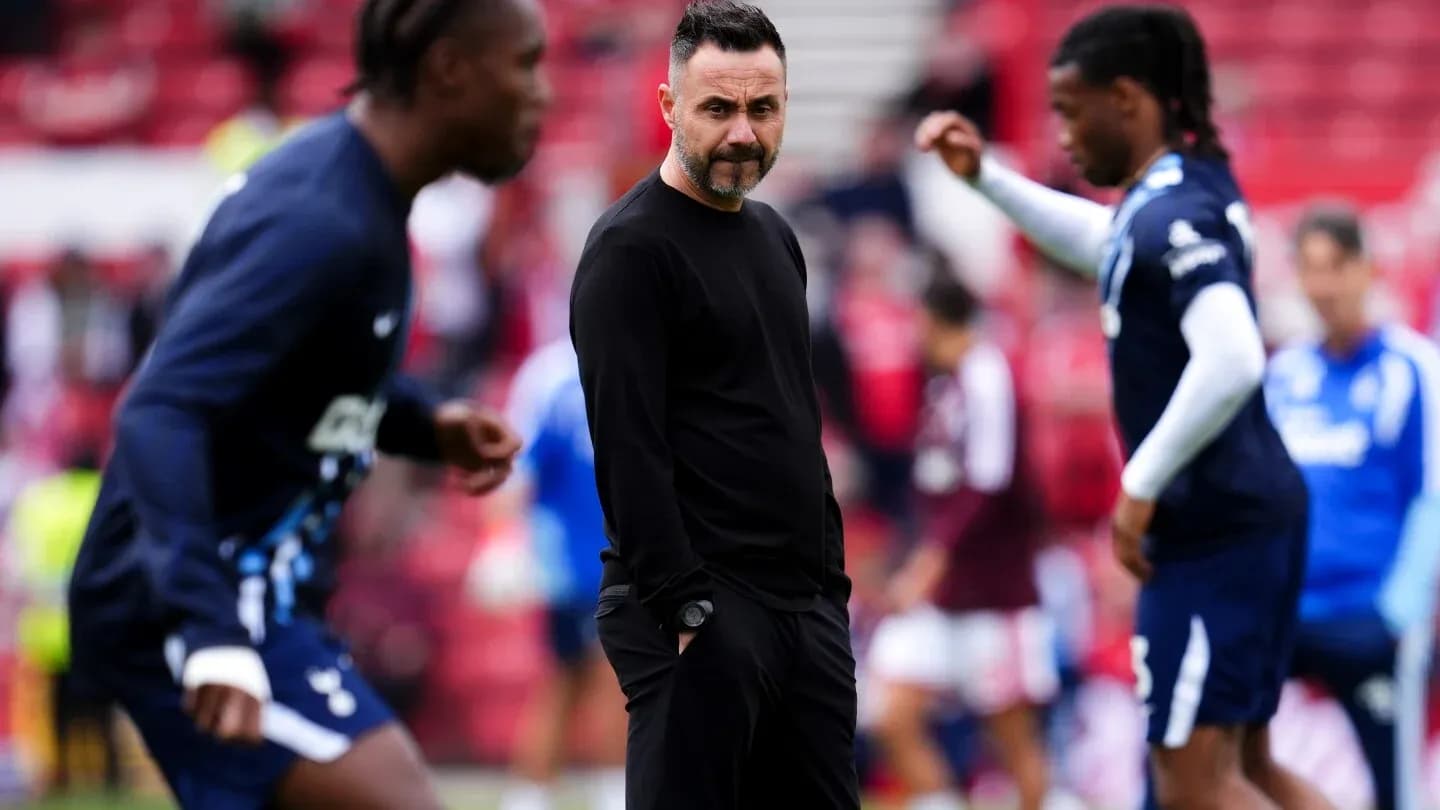
Tottenham's Goalless Draw: De Zerbi's Mixed Feelings
Tottenham finally have something on the board. Not a win, not a goal, but a point – and for Roberto De Zerbi, that felt like the start of something rather than another dead end.
At the City Ground, Spurs and Nottingham Forest swung and scrapped their way through a goalless draw that was heavy on collisions and light on quality in front of goal. It was rugged, it was messy, and it said one thing loudly: this Tottenham side will not shy away from a fight.
De Zerbi: Happy with the performance, not the result
“Disappointing for the result, but for the performance, very happy,” De Zerbi said afterwards. His words came with a reminder: he only started working with this group on Thursday.
Considering that, he saw enough.
“Considering we started working together on Thursday for the first time, we played well. I think we can improve in the last pass. If we approve in the last third, I think we can score many, many goals because we have the players with big qualities. Now it’s a tough moment to accept this result, because I think we played well.”
That “last third” line is the heart of Tottenham’s problem. They can move, they can build, they can pass. Then they reach the edge of the box and everything tightens.
“It’s not to unlock [the final third]. It’s the mistakes. We have to work in this part,” he continued. “I think we played very well with the ball, we found the solutions because they press [our defenders] with three, but one of our full backs was always alone and we found him always in 90 minutes. So in build-up, we played very well. In the last third, I think we can be… better. Much better.”
Risk at the back, nothing at the front
De Zerbi’s system is built on calculated risk. The back line is asked to live on the edge, to accept uncomfortable situations so the attackers can enjoy superior numbers and better spaces higher up. When it clicks, the reward outweighs the jeopardy. When it doesn’t, the defenders are left exposed for no real gain.
Right now, Spurs are living that downside. The upside is that Micky van de Ven is built for this kind of football. He relishes those one-on-one duels, those long recovery runs, those moments where a single misstep is fatal. Playing alongside compatriot Jan Paul van Hecke, he has started the season strongly.
Even in last week’s defeat to Newcastle, Tottenham’s open-play defending held up. It was set pieces that undid them in what was otherwise another solid, if unspectacular, display. Van de Ven, more than anyone in this squad, raises the floor. He stops bad days from becoming disasters.
The ceiling, though, is another story.
A blunt edge and no creator
Right now, the way Spurs operate in the final third, that ceiling feels painfully low. De Zerbi praised the attacking talent on paper, but he knows matches are not won on squad lists or slick graphics.
The squad has been heavily reshaped from last season, yet the same old issue lingers. There is no true creator in midfield. Without that hub, Spurs struggle to play through the middle. The ball keeps getting funnelled wide, which gives opponents time to shuffle across, settle into shape and pack the box.
Forest read it early. They pressed high at the start, then dropped deep and defended with nine or even 10 men clustered around their own area. It became a red wall around that white rectangle Spurs keep circling but never quite piercing.
Tottenham’s attack, full of mercurial dribblers but without a natural no. 10, had no convincing response. They could beat a man, maybe two, but not an entire block that knew the ball was never coming through the centre with any real craft.
Substitutions, balance and a work in progress
De Zerbi also pointed to a turning point after the break.
“The second half, I’m sorry because the medical stuff pushed to change Savio and Udogie after 60 minutes,” he said. “Kudus and Robertson played very well, but maybe two substitutions in that moment was not so good. But now we can’t take risk with injuries again. Savio is too important for us, the same Destiny. Maybe we lost some balance, some connection [when they came off].”
The logic is clear: protect key players now or lose them for weeks. But the change cost Spurs rhythm. The connections De Zerbi is trying to build were cut just as the game reached the point where one moment of understanding could decide it.
Defensively, though, he saw progress.
“I think today we defended very, very well. We have to improve the physical condition [of some players], the connection between the players. We changed, I don’t know how many players in this transfer window. We brought very, very good players, but the team doesn’t adjust like the names on paper or Football Manager.”
Names, profiles, transfer buzz – none of that guarantees fluency. This is still a group learning how to be a team.
The white rectangle that won’t open
Strip it all back and the issue is brutally simple. That white rectangle, the goal, might as well have a lock on it for Spurs at the moment.
De Zerbi was blunt: his side played very well in two-thirds of the pitch and poorly in the other. The build-up works. The patterns to escape pressure work. The full backs are found, the press is broken, the ball advances.
Then what?
Without a true playmaker, Tottenham keep ending up in the same cul-de-sac. The ball goes wide, Forest shuffle across, the box fills, and every cross or dribble runs into a forest of legs. The lack of variety makes it easy to defend, even if it looks pretty between the lines.
Maybe James Maddison returns soon and, against the odds, snaps straight back to top form after effectively missing a year. Maybe he becomes the connector this system cries out for.
More likely, this is what much of the season looks like until Spurs prove they can actually score, drag opponents out of that deep shell and turn all that neat build-up into something that finally counts.