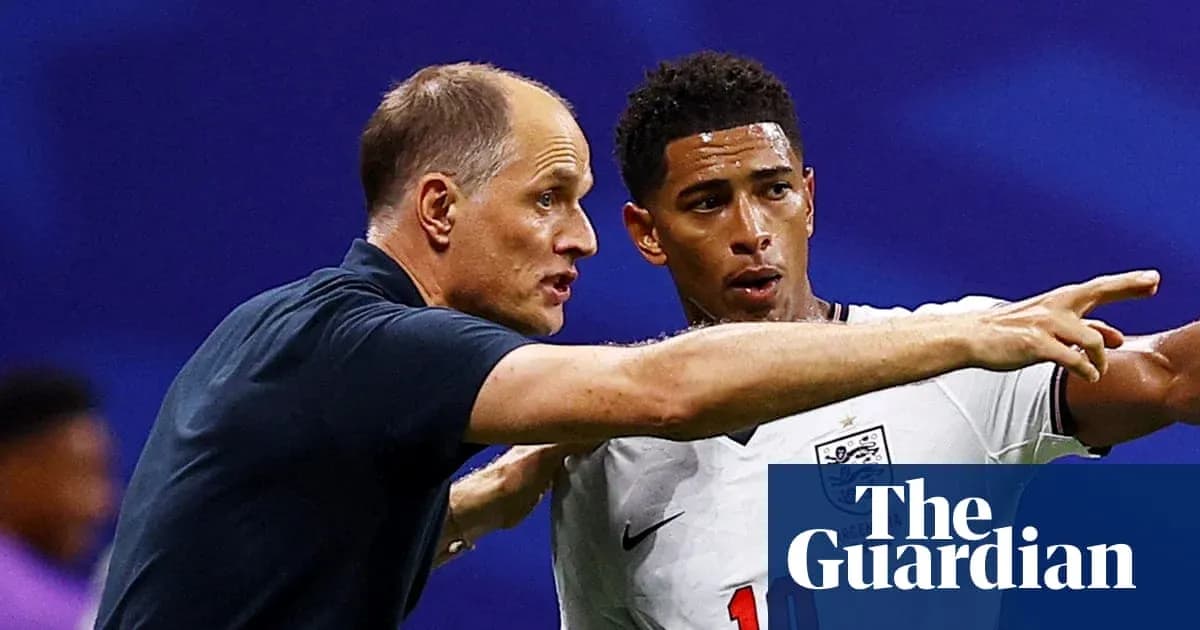
Thomas Tuchel's Challenge Ahead of Euro 2028
Thomas Tuchel has been a familiar face again around Premier League grounds this season, drifting through directors’ boxes and VIP lounges. In one of them, he summed up his summer in a line to a colleague.
“People are killing me,” the England manager said. Still.
Two months have passed since England’s 2-1 World Cup semi-final defeat by Argentina in the United States, but the emotion has not drained away. It lingers. Heartbreak, anger, disbelief. A sense that something precious slipped through English fingers with five minutes to play.
The scars feel permanent.
On one side, a vocal chunk of the fanbase cannot forgive the collapse of that 1-0 lead. For them, the blame sits squarely with Tuchel: the substitutions, the retreat, the sight of England pinned back as Argentina raged forward.
On the other, a different reading. This was only the fourth World Cup semi-final in England’s history. Tuchel’s team had shown personality, resilience, and flashes of thrilling football. The last-16 win over Mexico at the Azteca Stadium, with all the altitude and chaos, will live long in the memory. So will the nerve-shredding extra-time victory over Norway in Miami in 40C heat. The opening win over Croatia was a wild ride. And when England beat France in the third-place playoff, they secured their best World Cup finish since 1966.
Both truths run alongside each other. The fury and the perspective. Tuchel hears both, but the rage cuts deeper. He is still bruised by the fallout, still slightly stunned that a semi-final with a third-place finish could be framed as failure for a nation that does not reach that stage as a habit.
Yet here he is again, at the start of another cycle, carrying that tension into the run-up to Euro 2028, when England will be co-hosts. On Friday he names his squad for the first four Nations League fixtures: Spain at Wembley, Czechia home and away, and Croatia in Zagreb.
He wants to look ahead. So do the Football Association. He probably has to. Living inside the Argentina defeat will only warp what came before and what has to come next.
The England job has long been called impossible. Not because of tactics or talent, but because of the weight. The expectation that every tournament must end in confetti, the forensic blame after every defeat, the way one bad night can poison the mood around everything else. It is a vicious circle. There is no solving it. Only surviving it.
What Tuchel does have is the FA’s unwavering backing. Its confidence in him is not conditional on a single result. Even that fraught last-32 tie against the Democratic Republic of the Congo, when England trailed 1-0 with 15 minutes left and Tuchel himself wondered if this was the end, did not shake it. Harry Kane’s two late goals turned the night from Iceland 2016 redux into another escape act. On that alone, some around the camp joke he should be handed the Ballon d’Or.
The FA loved Tuchel’s in-game interventions at the World Cup, not just in that tie. It loved the atmosphere he fostered. The “brotherhood”, as he called it, was not a branding exercise; it was real, and the players bought into it. That matters to the FA. It considers any suggestion that Tuchel should have resigned or been dismissed after reaching a semi-final to be absurd.
Tuchel had set his sights high. He spoke openly before the tournament about adding a second star to the shirt. When the dream died in the semi-final, the rhetoric sharpened the pain. Did he go too hard, too early? Maybe. But what would the reaction have been if he had said the quarter-finals or semi-finals would be enough?
Inside Wembley, FA executives knew the numbers. England were the fourth seeds. Quietly, they feared that winning the whole thing might be a step too far, especially after the draw landed. England’s schedule brought a late start, a big gap between the first and second group games, then a brutal, condensed run in the knockout rounds. Long-haul flights, extreme heat, altitude. They knew it would take a toll.
Which brings everything back to that second half against Argentina.
Tuchel could not coax another surge from his players once Argentina flipped into all-out fury mode. That is on him. But the legs were gone. England had played at altitude against Mexico with 10 men. They had gone 120 minutes against Norway in suffocating conditions. By the time they reached the semi-final, the tank was close to empty.
England started dropping deeper long before the second-half hydration break. The line retreated, the clearances grew more desperate. When Tuchel replaced winger Anthony Gordon with defender Ezri Konsa and moved to a back five, it only confirmed what everyone could see: this was now survival football.
He could not change the flow. He could not get his players on the ball. That, too, is on him.
The choice to reinforce the defence was cold and calculated. Tuchel looked at the data, the distances covered, the state of his players. It felt like the percentage move, the least bad option. It failed. And when it failed, it looked terrible. The optics were of a manager shrinking from the moment.
Would a bolder change have altered the ending? No one can say. What is clear is that by the final whistle, England had been overwhelmed.
Now comes the reset. The Nations League returns England to Group A, with Spain at Wembley next Saturday the standout test. The last campaign, spent in Group B facing Ireland, Finland and Greece, did more damage than the FA anticipated. The games lacked edge, the standards dipped, and even then Greece came to Wembley and won 2-1. World Cup qualification had been gentle too. This time, the FA wants sharper tools to cut into Euro 2028.
Tuchel’s squad announcement will not be straightforward. Four World Cup players are likely to miss out through injury: John Stones, Dan Burn, Djed Spence and Jordan Henderson. That opens doors in defence for Tino Livramento, Levi Colwill, Jarrad Branthwaite and Lewis Hall, all pushing hard for recalls.
Midfield poses its own dilemma. Does Kobbie Mainoo keep his place after a World Cup that never really caught fire for him? His form for Manchester United has been one of the few bright spots in their poor start. Alex Scott and Myles Lewis-Skelly are also in the frame for returns.
Higher up the pitch, Cole Palmer and Phil Foden are vying again for the No 10 role. Eberechi Eze and Noni Madueke, by contrast, have not restarted strongly at Arsenal, which may cost them. There is real noise around Josh King and Ryo Ngumoha, with Dominic Calvert-Lewin and Liam Delap also building momentum.
All of which makes Friday more than a simple list-reading exercise. Every name will be parsed, every omission dissected. Yet it might be Tuchel’s voice, not his choices, that tells the real story.
If he sounds defensive again, the knives will stay sharp. If he sounds like a manager ready to drag England forward, scars and all, the new campaign might finally start to feel like one.