Sunderland's Struggles in 1939 Amid Rising Tensions
By late August 1939, Bill Murray was still feeling his way into the Sunderland job. He had only taken over from Johnny Cochrane in March, stepping into a club that still measured itself against the glittering standards of the 1936 league title and 1937 FA Cup win. Those years felt close enough to touch, yet the decline of Cochrane’s final season had left a jagged edge. Murray’s task was simple to state and hard to execute: restore Sunderland to what they had been.
An opening‑day victory over Derby County hinted that he might just manage it. The mood around Roker Park flickered with optimism. Maybe the slide had been checked. Maybe this was the start of the climb.
Huddersfield expose a fragile Sunderland
Town walked away with both points and, more importantly, with the air of a side that knew exactly what it was doing. Sunderland did not. Huddersfield’s shape, discipline and organisation underlined how far Murray’s team still had to travel before anyone could call them contenders again.
At the back, Sunderland hesitated. Marking was loose, decisions slow, and Huddersfield were allowed to probe without enough resistance. Up front, the gears barely meshed. Attacks sputtered, never quite catching light.
Newspaper reports the next day did not spare the officials, accusing them of letting a series of borderline Huddersfield challenges slide. That didn’t help Sunderland’s forwards, who struggled to find rhythm. But the real concern lay elsewhere.
Raich Carter, the captain and heartbeat of the side, took a knock and could not move with his usual authority. Once that happened, the whole team sagged. Rather than rally in his stead, too many players shrank. The criticism was sharp: Carter was struggling, and almost nobody stepped into the space he normally commanded.
Only one Sunderland player emerged with any real praise. Goalkeeper Johnny Mapson was widely judged blameless for both Huddersfield goals and was credited with keeping the score respectable. That in itself told a story.
A disputed opener, a decisive finish
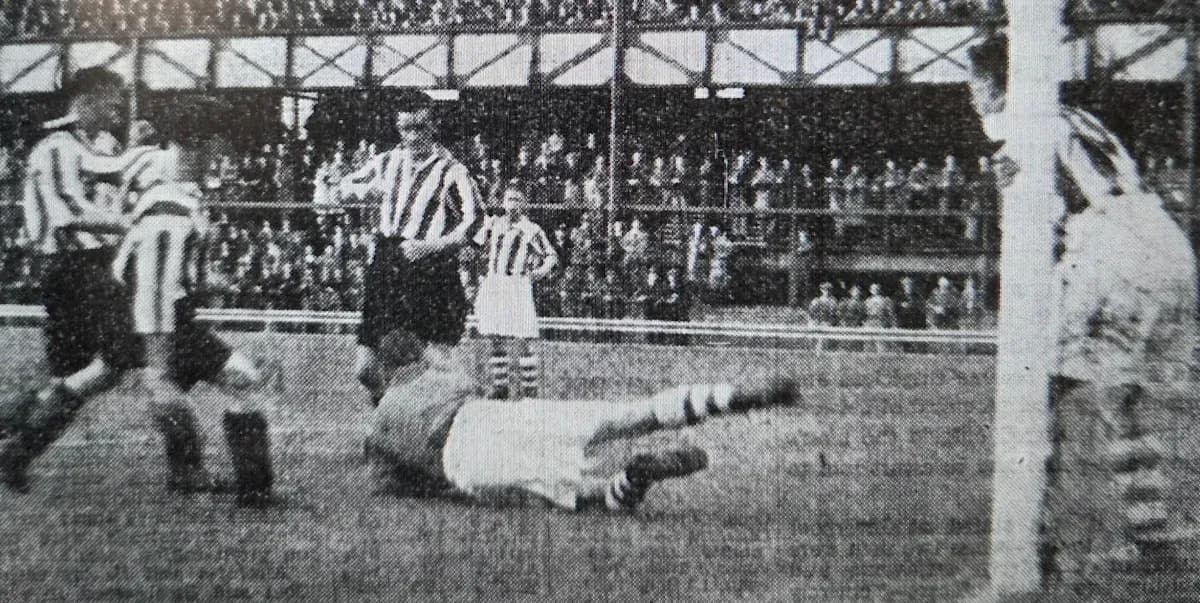
Huddersfield’s first goal came early and carried a whiff of controversy. Billy Price met a cross with a header that some in the ground were adamant had gone straight in. The referee, though, ruled it an own goal off Jimmy Gorman, who had challenged Price in the air. Clem Stephenson’s side didn’t care how it went down in the book. They had the lead.
Carter dragged Sunderland level just after the half-hour mark, briefly lifting the mood inside Roker Park. For a while, the game hung in the balance, Sunderland straining to impose themselves, Huddersfield calmly holding their shape.
The pressure finally told at the wrong end. With ten minutes left, Price struck again, this time with no argument about the scorer. His late winner felt conclusive. When the final whistle went, few in the 16,315 crowd could honestly claim their side had deserved anything more.
They drifted away from Roker Park with familiar questions about inconsistency and rebuilding. But another, far darker uncertainty was starting to drown all of that out.
Football in the shadow of war
Anyone who had bought a newspaper before kick-off knew the match was being played under a gathering storm. Front pages were dominated by rising international tension and the grim possibility of another world war.
The Sunderland Echo and Shipping Gazette told of French radio being handed over to military authorities and of urgent diplomatic exchanges across Europe. A stark photograph showed workmen stacking sandbags in front of the Royal Infirmary, a defensive wall against whatever might come from the skies.
Inside, there was a chillingly practical article on helmets and respirators for parents in Sunderland. Demonstration and collection points were listed at schools across the town: Redby, Hudson Road, Cowan Terrace, Thomas Street, Commercial Road, Hylton Road, Diamond Hall, High Southwick, James William Street and Barnes. Children, even infants, were to be fitted with specially adapted equipment. Everyday addresses, suddenly part of an air-raid plan.
It was the kind of reading that seeps into the back of the mind and refuses to leave, no matter how badly people want 90 minutes of escape.
Roker Park, uniforms in the stands, and a fading escape
Among the crowd at Roker Park that day were soldiers and sailors already called up under the emergency measures. They were given half-price admission, provided they were willing to enter via what was usually the boys’ gate. Grown men in uniform squeezing through a turnstile meant for children: a small, almost absurd detail, yet a sign of how quickly normal life was bending.
The match itself did little to lift local spirits. Sunderland were flat, Huddersfield ruthless enough, and the nagging thought that this might be the last game for a while hovered over the terraces. Some supporters will have tried to savour every minute, sensing that their next visit to Roker could be months, even years, away.
They did not have to wait long for events to overtake them.
By the time Sunderland travelled to Arsenal the following weekend, German forces had invaded Poland. War on a far larger scale was no longer a threat but a reality. The game at Highbury went ahead, but only just, and under altered conditions. Kick-off was pushed back to 17:00, later than originally planned, to ease pressure on emergency public transport and to allow a hastily organised evacuation of local children to be completed.
Football slipped firmly into the background. Within weeks, the results against Derby, Huddersfield and Arsenal were wiped from official records, as if they had never been played.
Bill Murray’s job changed overnight. Instead of plotting a patient rebuild and chasing the standards set by Cochrane’s great sides, he turned his attention to fitness work for troops stationed in County Durham. Roker Park itself, quickly designated an evacuation zone, sat largely idle for the next two years.
On 30 August 1939, Sunderland lost 2-1 at home and worried about form, selection and standards. Within days, those concerns felt small. The season hadn’t just been interrupted; it had been swallowed by history.
Saturday 30 August 1939
Football League Division One
Sunderland 1 (Carter 33')
Huddersfield Town 2 (Gorman o.g. 4', Price 80')
Sunderland: Mapson; Gorman, Hall; Housam, Lockie, Hastings; Duns, Carter, Robinson, Smeaton, Burbanks.
Roker Park, attendance 16,315.