Spain Defeats France in World Cup Semifinal
ARLINGTON, Texas — The end came without drama, without defiance, without so much as a punch thrown.
France, the bookmakers’ darlings and the tournament’s most talent‑rich squad, walked into Jerry Jones’ vast Texas palace as World Cup favorites and walked out looking ordinary, beaten 2-0 by a slick, ruthless Spain. For the first time all tournament they fell behind. They never looked like getting back up.
It wasn’t just the end of a campaign. It was the end of an era.
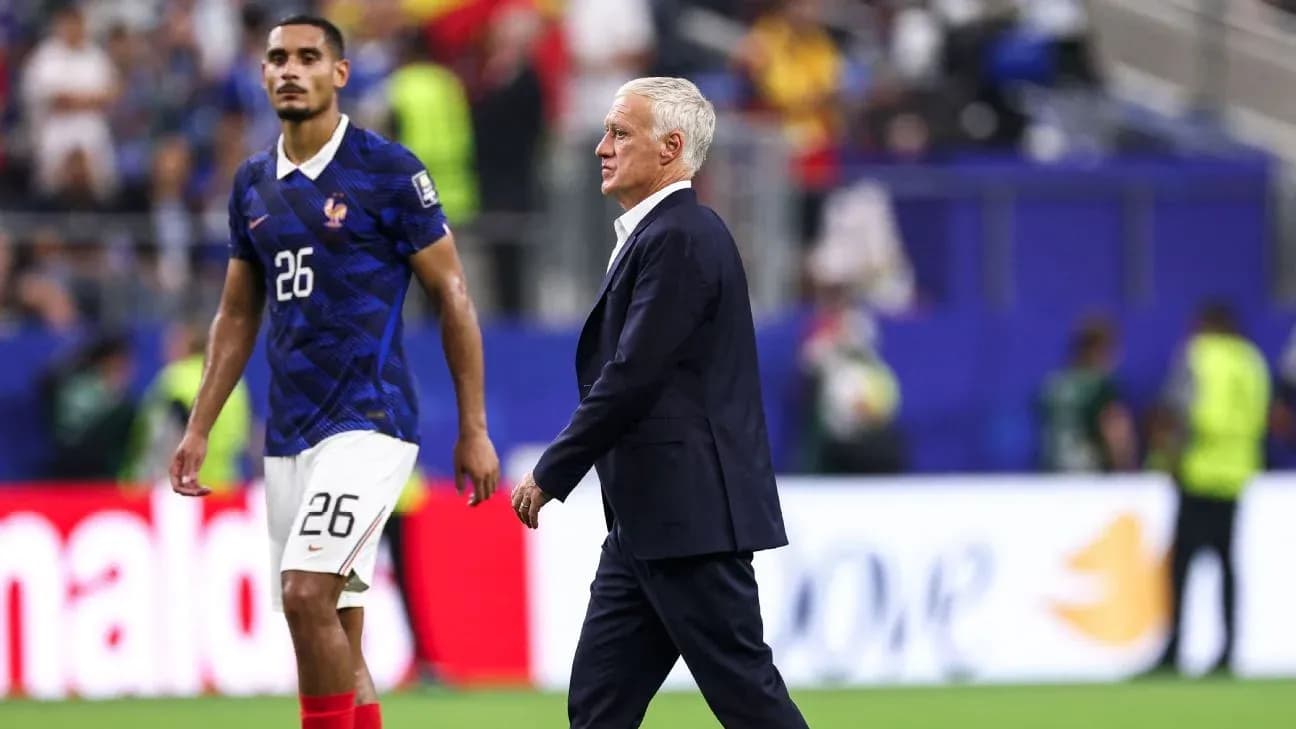
Didier Deschamps, 14 years, 184 games, three major finals and a UEFA Nations League title into one of international football’s great tenures, watched his team go out with a whimper. The same man who stood one Randal Kolo Muani chance away from joining the tiny club of two-time World Cup–winning coaches now leaves amid a performance so flat that many France fans are openly counting the days to the Zinedine Zidane handover.
Spain expose France’s hollow core
You can lose to Spain. This Spain, in particular. Luis de la Fuente’s side are not far behind France in pure talent, and they are far ahead in cohesion.
What you cannot do is exit a World Cup semifinal looking this timid.
France were outplayed everywhere. The numbers underline the eye test with brutal clarity: across the first 64 minutes, Les Bleus’ much-hyped front four combined for 0.04 expected goals. That isn’t just inefficiency. That’s non-existence.
Spain passed, probed and pulled France around. They dominated the ball, squeezed the space, and stripped Deschamps’ team of the two things elite attackers need to hurt you: possession and room to run. Once those vanished, so did the aura. Michael Olise, usually a creative menace, looked only marginally more threatening than a bystander.
You could see this coming. Everyone could.
Spain were always going to play. They were always going to circulate the ball, overload midfield and wait for their moments. The question sat with France: adapt or impose? Change shape, add a midfielder, press higher, tweak the structure? Or trust the stars, stick to the plan and dare Spain to cope?
Deschamps backed his talent. Spain cashed the bet.
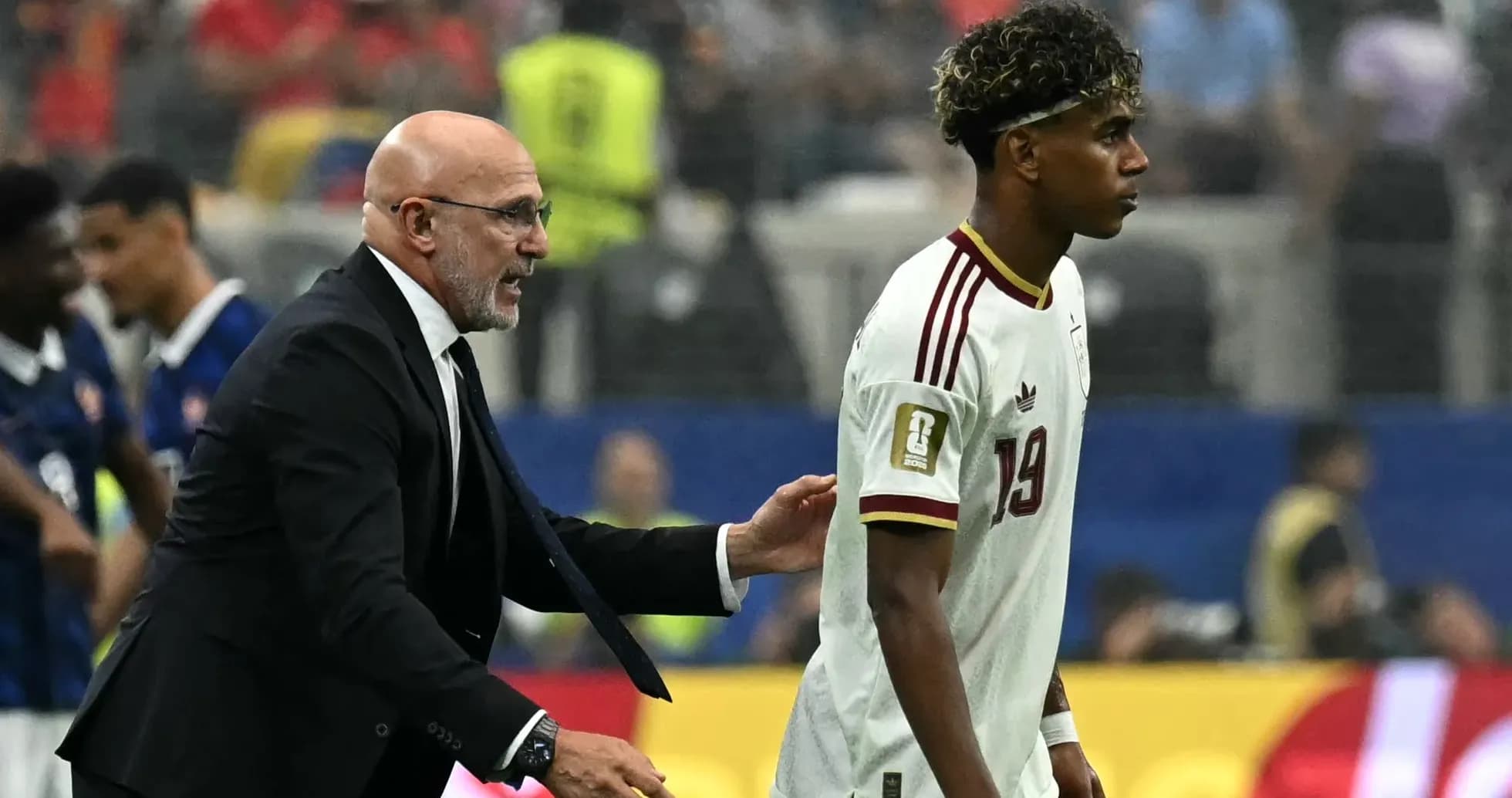
De la Fuente, Deschamps’ recurring nightmare
This wasn’t a one-off tactical beating. It was a pattern hardened into habit.
Three times in three years, Luis de la Fuente has taken Deschamps apart: the Euro 2024 semifinal, the wild 5-4 Nations League game in 2025 (Spain led 5-1 at one stage), and now this World Cup exit. Different tournaments, same outcome. The bespectacled, bald, bearded coach in the opposite dugout has become Deschamps’ personal kryptonite.
And Deschamps, for all his experience, never really adjusted.
His philosophy has always been clear and, for the most part, effective: keep the dressing room content, keep the tactics simple, and let superior talent decide low-scoring games. It worked when he played alongside Zinedine Zidane, Patrick Vieira and Thierry Henry in 1998. It worked as a coach in 2018 and 2022. It’s the conventional wisdom of a man who trusts players more than chalkboards.
But conventional wisdom has limits. When the opponent monopolizes the ball and suffocates space, your stars don’t get to be stars. They become extras.
That’s when a coach has to intervene. Shift the structure. Change the angles. Break the rhythm. Deschamps never truly has been that coach. Not in his best days, and certainly not here.
Even his in-game changes felt pre-written: Manu Koné, a more progressive passer, for Adrien Rabiot; Désiré Doué for the struggling Bradley Barcola. Logical, yes. Predictable, absolutely. Substitutions as predictive text — you could see them coming long before the fourth official lifted the board.
On nights when France’s baseline level is enough, that stability is reassuring. On nights like this, it only stretches out the suffering.
Loyalty, and its cost
The same traits that built Deschamps’ empire helped dismantle it.
His loyalty to certain players has long been both his greatest strength and his biggest blind spot. Rabiot remains the prime example, a fixture in midfield almost regardless of form. Olise, enduring a nightmare on the ball and off it, stayed on long enough for the damage to feel permanent.
These are not reckless decisions. They are the choices of a coach who believes in trust, hierarchy and continuity. Those principles carried France to trophies and finals. They also left them frozen when a more flexible hand was needed.
In the end, Deschamps exits with a résumé that most international managers can only dream of. Yet he does so having fallen short with the deepest, most gifted squad he has ever had.
Enter Zidane, with questions attached
Now comes Zidane. Or at least, that is the expectation, the storyline that has hovered over this team for years.
On paper, his credentials glisten: three UEFA Champions League titles, two LaLiga crowns with Real Madrid. A coach who managed egos the size of small planets and kept them aligned long enough to conquer Europe repeatedly. A legend who knows what it is to carry France on his shoulders.
But scratch the surface and the picture is less straightforward.
Zidane has not worked in five years. His last trophy came in 2020. Every day he spent on a touchline was at Real Madrid, a club that operates in its own universe. There, if a player doesn’t fit, you replace him. If a squad needs refreshing, you buy again. You see the group every day, shape them, fine-tune.
International football offers none of those comforts. You get windows, not seasons. You inherit, you don’t build. You cajole, you don’t overhaul.
Zidane, like Deschamps, preferred simplicity in Madrid. Clear roles, minimal tactical clutter, and a heavy reliance on individual brilliance and dressing-room chemistry. It’s tempting to assume he will be a smoother, more glamorous continuation of what France already had.
That wouldn’t necessarily be a bad thing. Deschamps’ record proves as much. But if this semifinal taught Zidane anything as he watched from afar, it should be this: there are moments when talent alone is not enough, when balance matters more than star power, when the collective has to be engineered, not just trusted.
He knows this better than most. He lifted the World Cup in 1998 with Stéphane Guivarc’h leading the line — a reminder that a perfectly calibrated team can win with a functional striker, not just a galáctico.
A new standard, or more of the same?
France’s next chapter will not start from scratch. Zidane, assuming he takes the job, will inherit a squad bursting with attacking options, a production line of talent that shows no sign of slowing. He will also inherit the weight of Deschamps’ achievements: a World Cup, another World Cup final, and deep runs as standard, not exception.
Match that, and he will be judged a success.
But the bar in France is no longer simply about results. It is about how this extraordinary generation is used, about whether the team can be more than the sum of its parts when the opposition refuses to give them the ball or the space to breathe.
Spain just offered a brutal reminder of what a well-drilled collective can do to a group of superior individuals left to fend for themselves.
The Deschamps era ends there, under the bright lights of Arlington, with questions hanging in the Texas air. The Zidane era, if and when it begins, will be measured by how many of those questions he is brave enough — and sharp enough — to answer.