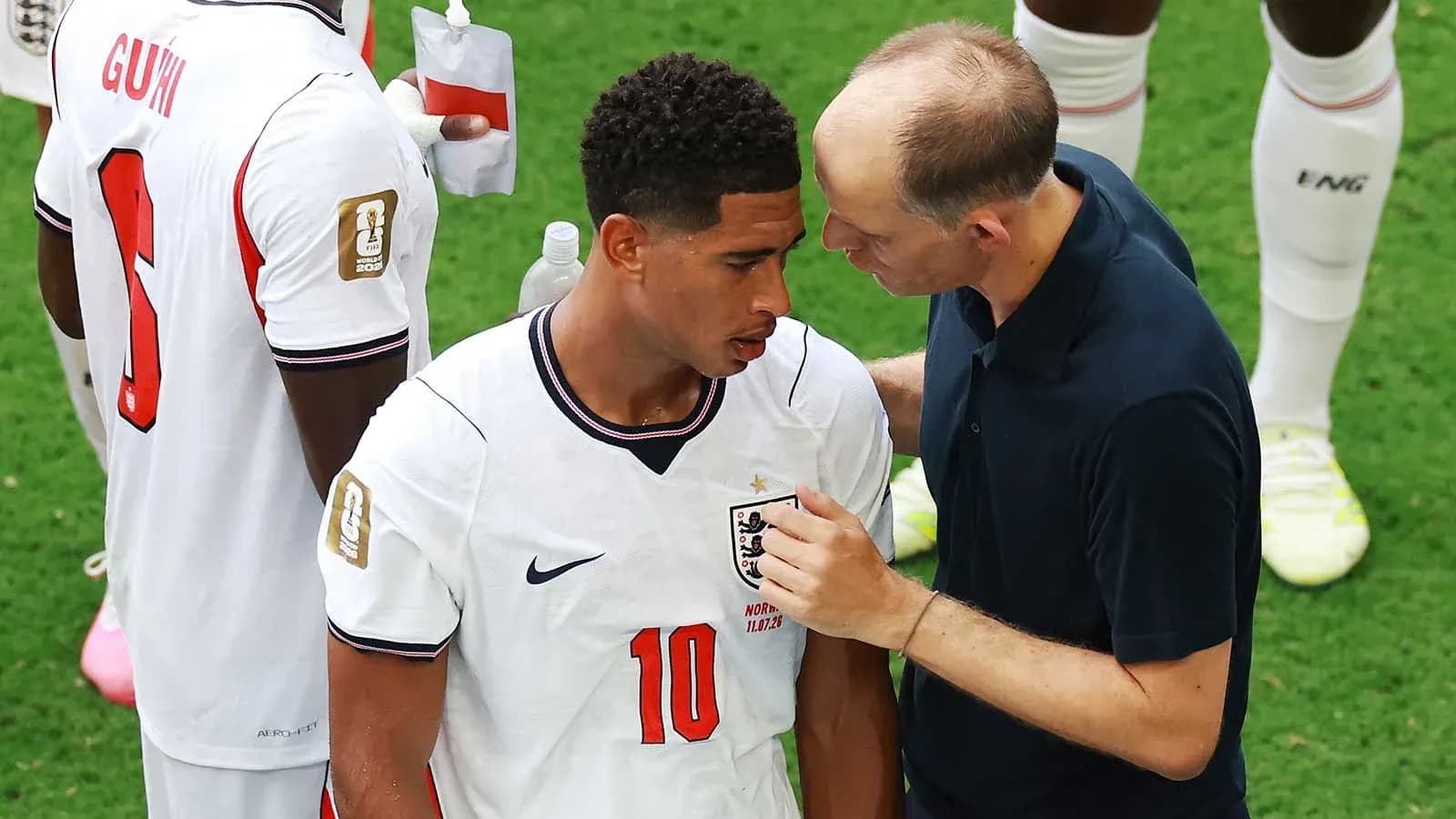
Tuchel and Bellingham: Navigating Tensions Ahead of Argentina Semi-Final
Thomas Tuchel walked into England’s semi-final week with a storm already swirling around him and his star midfielder. Again.
The dynamic between the German head coach and Jude Bellingham has lived under a magnifying glass ever since Tuchel’s mother described some of the midfielder’s on-pitch behaviour as “repulsive” last summer. An apology followed, the noise died down, and both moved on. Or so it seemed.
Then came Norway.
England squeezed past them 2-1 after extra time in a draining quarter-final, a night of 120 minutes that left legs heavy and emotions raw. The result was good. Tuchel’s verdict was not. He admitted he was “not happy with the team performance,” a line that cut through the post-match glow and landed squarely on a dressing room that felt it had emptied the tank.
Bellingham pushed back, calling for more positivity. The flash interview became fuel. The narrative wrote itself: rift, fracture, superstar versus coach.
Tuchel saw it building and moved quickly.
The following day, he gathered the squad for what he described as a clear-the-air meeting, determined not to let a few clipped quotes bleed into their preparations for a semi-final against Argentina. Speaking to talkSPORT, he bristled at the idea that the situation had spiralled.
“I wonder who blows these things up, eh?” he said. “So, there is nothing to blow up and if it's blown up, it's blown up in the media, of course.”
He did not hang Bellingham out to dry. Quite the opposite. Tuchel leaned into the context: a knockout game, 120 minutes, a player who had “literally given everything” only to be told, in a reduced version of events, that his coach thought he was sloppy.
“What do you expect of a player that just played 120 minutes and gave literally everything if you shorten the comment of his coach, if you don't tell him that ‘he was world class,’ if you don't tell him that ‘he has world class actions,’” Tuchel said.
Strip away the praise, keep only the sting, and the reaction becomes inevitable.
“If you just cut all this and tell him ‘oh, your coach said you were sloppy’ what do you expect?” he continued. “Yeah, of course you get the comment that you get and then you try to blow it up and people try to create misunderstandings and cracks where no cracks are. We come from the same place. We come from being competitive and I am a competitive coach. I push this team to the limit and that was my assessment.”
That word – competitive – is the thread that ties them together. Bellingham plays on the edge, Tuchel coaches on it. Neither backs down easily, especially with a microphone in their face and adrenaline still raging.
Tuchel also took aim at the way the question was framed to his midfielder in the mixed zone.
“I think the question was unfair in this moment towards Jude because he cut all the compliments out of my assessment and just asked about the critical points, so I can understand,” he said. “What do you expect of a player that just gave everything and stands there in front of a microphone in a flash interview?”
Bellingham’s response had a sharper edge. In his post-match comments, he appeared to jab at Tuchel’s modest playing career, suggesting “maybe he doesn't know what it's like to play in those kind of conditions” or to face a striker of Erling Haaland’s calibre. It was a pointed line, the kind that lingers.
Tuchel did not bite. He dismissed any notion that his lack of an elite playing résumé weakens his authority or his understanding of the game. For him, the bond with his 23-year-old talisman remains strong, the relationship hardened rather than cracked by a public disagreement.
“It's just what it is but we're as close as ever, and close more than ever before,” he said. “You can see that on the field. The energy and mentality in camp is excellent in the last days and we are ready to go for it tomorrow.”
Behind that confidence sits a coach who still carries the scars of a dream that never fully materialised. Tuchel is open about it. He wanted to be out there, not on the touchline.
“I would still like to have a player's career, that was my dream,” the former Chelsea manager admitted. “I never thought about being a coach, never dreamt about being a coach on that kind of level, so I think this is basically the dream. I just feel also on the sideline very humbled, and from time to time it just strikes me on the sideline right before the match ‘I couldn't play here on this occasion.’”
He does not, though, accept that you must have lived the game at the highest level to read it, shape it, and win it.
“I don't think that you have to play [to be a coach]. A funny quote, you don't have to be a horse to be a good jockey!” he joked.
The lines are drawn clearly now. A fiercely ambitious coach, a fiercely ambitious midfielder, and a semi-final against Argentina that will test both their tempers and their trust.
If England are to go any further, Tuchel and Bellingham will have to prove that all that fire really does burn in the same direction.