Socceroos Progress to Round of 32 but No.9 Role Raises Concerns
The Socceroos are through, but the alarm bells are ringing.
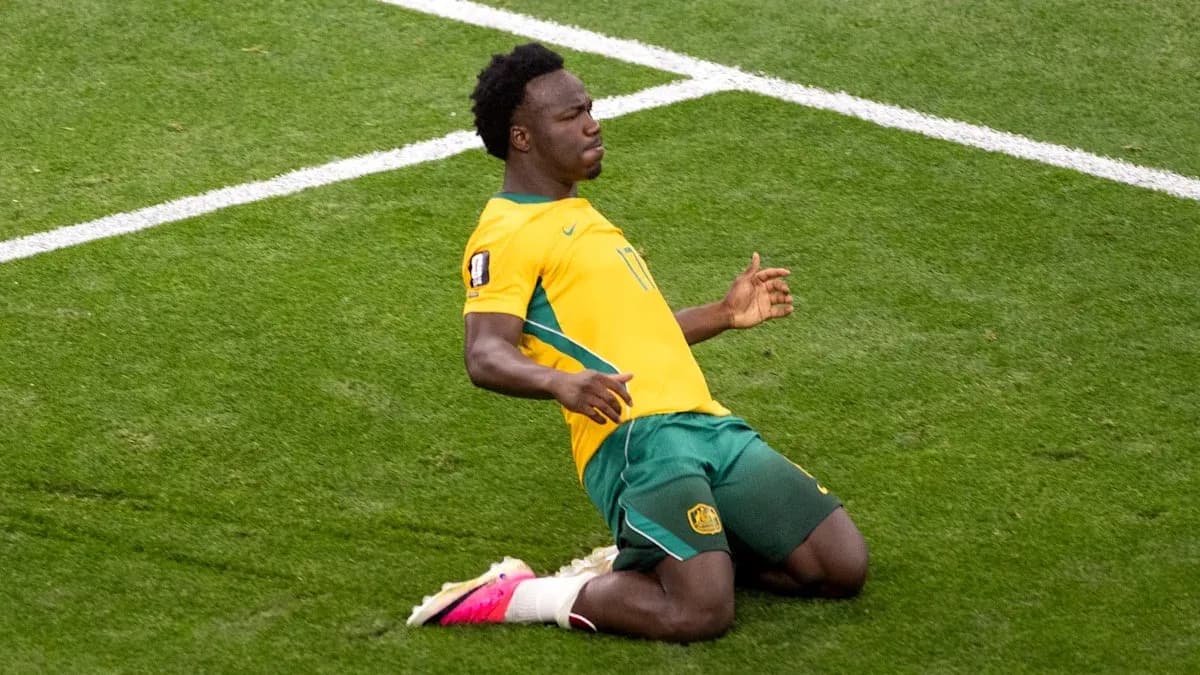
Australia’s 0-0 draw with Paraguay sealed progression to the round of 32 at the FIFA World Cup, a professional job done against rugged South American opposition. Yet as the players walked off with the result they needed, the loudest applause belonged not to a striker or a playmaker, but to a 21-year-old fullback thrown into an unfamiliar role.
Jordan Bos, shifted to the right after Jacob Italiano’s late injury withdrawal, became Australia’s most dangerous outlet. That, for two former Socceroos, is exactly the problem.
Bos the unexpected spark
Tony Popovic’s reshuffle was bold. With Italiano ruled out, Bos came in on the right, while Melbourne City left-back Aziz Behich slid across to plug the gap on the opposite flank. It was the kind of selection call that had hovered over this squad for weeks, a tactical dilemma waiting for its moment.
Popovic backed Bos. The youngster repaid him.
Bos attacked with conviction, drove at defenders, and repeatedly offered the outlet Australia needed to escape Paraguay’s suffocating press. His energy down the right gave the Socceroos width, urgency, and a hint of unpredictability.
But as the match wore on, the pattern became uncomfortable: the most threatening Australian in a World Cup knockout race was a converted fullback.
“Up front is a bit of a worry when we’re looking at Jordy Bos as one of the most threatening (for Australia),” Robbie Slater said on Stan Sport’s Added Time, cutting straight to the heart of it.
Scott McDonald, sitting alongside him, didn’t disagree.
No.9 role under the microscope
McDonald pointed out the obvious imbalance. On a night when the headlines should have circled around Mo Toure or Nestory Irankunda, the attacking conversation kept drifting back to Bos.
Toure stayed on the bench against Paraguay. Irankunda, usually a winger, was pushed into the No.9 role, asked to lead the line against a physically imposing back three.
For McDonald, that experiment has clear limits.
“There is a problem in terms of the No.9. Not bringing (Mo) Toure on instead of Tete Yengi tells me today that there’s no trust there,” he said. It was a striker’s reading of a manager’s decision, and a blunt one.
“Does he go and start him (Toure) out of the blue in the next game? You just can’t tell with Tony. But as a striker, being Toure, I don’t like that. That doesn’t fill me with confidence that my coach trusts me.”
The picture up front looked even bleaker when McDonald described the role as “a thankless task.” Irankunda, he argued, lived off scraps, starved of clean service, battling for half-chances rather than clear ones.
“No matter who we put up there, it’s a thankless task up there. Look at Nestory (on Friday), he had very little and was living off scraps,” McDonald said.
The tactical knock-on was obvious. With Irankunda drifting and searching for the game, the box often stood empty.
“But also when he plays up top, we don’t have a box outlet. Jordy Bos playing on the right-hand side was brilliant and it gave us that outlet.”
Irankunda’s growing pains
Irankunda, just 20, has long been flagged as a potential game-changer for Australia. His pace, power and direct running from wide areas have lit up domestic football and stirred genuine excitement about his ceiling.
Yet McDonald has always seen a risk in pushing him centrally.
He described Irankunda as “always going to be a concern” when moved into a No.9 or even a No.10 role, not because of talent, but because of the different demands those positions carry. Against Paraguay’s snarling, physical defence, that concern crystallised.
“Look, he’s gotta hold it up a little bit better,” McDonald said. “I think at times he struggled because it’s not his natural game.”
The issue wasn’t effort. It was geometry. Space vanished quickly against Paraguay’s back three. Irankunda’s instinct is to pull wide, attack the channels, isolate a fullback. On this night, those channels barely existed.
“He wants to get in those wider areas and drift but with the way Paraguay were set up as well with the back three, it is very hard for him to get down the sides of the opposition. There was no space.
“They were aware of his threat also, with three taking care of him. But he probably sometimes needs to be more in central positions and wait for things to happen.”
That last line cut to the core of the No.9 debate. The best strikers, McDonald argued, think differently.
“As we see the best strikers in the world – like Erling Haaland – they’re not interested any more. They just get into the right areas and allow others and trust others to do the dirty work then get on the end of things.”
“That’s not naturally probably where (Irankunda) thinks. He wants to be the guy creating that and doing things, getting on the edge of the box and having shots. So if you’re gonna play that role, you just need to play it a little bit more smarter and be a bit more patient.”
The old-school striker warning
McDonald spoke like a man who has lived the role and felt the bruises. He admitted he didn’t like the current set-up either, recalling a career built on partnerships and structure.
“I mean, for the majority of my career it was always you played off the big man or whatever.”
Then came the line that will sting any Australian forward dreaming of that No.9 shirt.
“But I’ve always said it, if you can head it, you’ve got a better chance of being a No.9 for the Socceroos. It’s as simple as that.”
Australia has its ticket to the round of 32. The defence looks organised, the wide areas suddenly alive thanks to Bos. Yet the central question remains brutally clear.
Who is going to own that No.9 role when the stakes rise again?