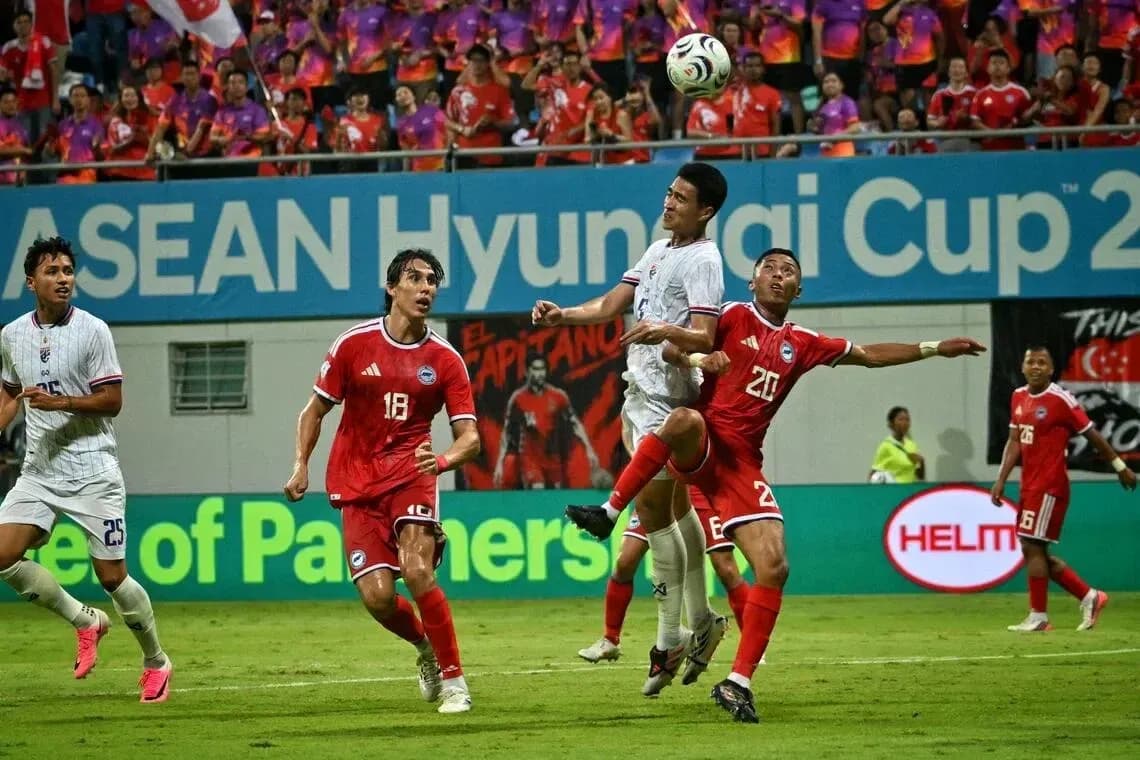
Singapore's ASEAN Championship Hopes Diminished by Thailand
SINGAPORE – The noise never really stopped at Jalan Besar, but Singapore’s ASEAN Championship dream took a heavy blow all the same.
A 3-1 defeat to seven-time champions Thailand in the first leg of the semi-final on Aug 15 has left the Lions clinging to the tie, their hopes of a first final in 14 years reduced to a sliver rather than a stride.
Roared on, but punished
Gavin Lee’s side walked out to a crackling, sold-out home end – 5,358 in the ground, tickets snapped up in minutes, resale prices rocketing online – and began like a team determined to ride that wave. They pressed high, bit into tackles and tried to hem Thailand in.
For a while, it worked. Thailand barely saw the ball, finishing with just 28 per cent possession. But possession without composure can be cruel.
One mistake turned the night.
In the 14th minute, Kyoga Nakamura lost the ball in his own half. Thailand forward Teerasak Poeiphimai needed no second invitation, steering a low finish into the bottom corner. Jalan Besar fell flat.
Twelve minutes later, the damage deepened. Teerasak, left unmarked, rose to guide a header past Izwan Mahbud. Two chances, two goals. Singapore’s bright start shredded.
“We will hold our hands up and say we put ourselves in quite a few unnecessarily difficult moments and made it easy for them,” said Lee. “And when they have players of that quality, yeah, they will punish you.”
Missed lifeline, deeper trouble
The Lions had a golden chance to claw their way back before the break. A long throw from Lionel Tan caused chaos in the Thai box, and the video assistant referee spotted a shove by Yotsakorn Burapha on Shawal Anuar.
Penalty. A lifeline.
Shawal stepped up in the 35th minute, but Kampol Pathomakkakul guessed right and pushed the spot kick away. The groan from the stands said everything.
Thailand, who had made six changes from the side that beat Myanmar 2-0 on Aug 8, could then afford to withdraw their two-goal tormentor at half-time. On came Patrik Gustavsson, and the pattern barely changed.
Five minutes after the restart, Gustavsson outpaced Tan down the flank and squared for Seksan Ratree to sweep in Thailand’s third. Clinical. Brutal. The kind of moment that separates a seasoned regional powerhouse from a team still learning how to live with that weight of expectation.
“It was a frustrating game and there were a lot of tackles flying in,” Thailand coach Anthony Hudson said. “I have to give credit to the players because they defended well and took their opportunities. We could have scored one or two more goals and that was the disappointing part.”
Ilhan cracks the door open
By then, Singapore were reeling. Individual errors had crept in, the early intensity dulled by the scoreboard. Only Izwan’s sharp saves stopped Thailand from running away with the tie entirely.
Lee turned to his bench. On came Ilhan Fandi, one of three players initially left out from the XI that drew 1-1 with Indonesia on Aug 7, as the coach searched for a spark.
It arrived late, but it arrived.
In the 84th minute, Ilhan bent a shot in off the post, his fourth goal of the tournament and the first Thailand have conceded in four competitive matches. For a moment, Jalan Besar rediscovered its voice. The deficit was cut to two. The tie, just about, stayed alive.
“Ultimately, we reduced the deficit by one, and with this group that we have, anything is possible,” Lee said. “Knowing the boys, they are kicking themselves, but they will recover as best as they can, and they will want to right the wrong.”
A growing buzz, a harsh lesson
This was Lee’s first defeat in nine competitive games since replacing Tsutomu Ogura in June 2025, a run that had helped reignite interest in the national team.
Singapore’s surge to a maiden Asian Cup qualification for the January 2027 finals, secured in November 2025, and their gritty progress to this ASEAN Championship last four – including a 0-0 draw with defending champions Vietnam and a 1-1 stalemate with Indonesia in the group stage – had stirred something.
The presence of President Tharman Shanmugaratnam and his spouse Jane Ittogi in the stands underlined the sense that this was more than just another semi-final. More than 4,000 home tickets gone in seven minutes, scalpers trying to flip a pair of Category 1 seats worth around $100 for as much as $2,500 – the Lions had become hot property again.
But Thailand remain Thailand.
Even with a squad that is “far from their best”, as the narrative around the War Elephants has gone, the world No. 94 side have looked solid, this their fifth straight win of the tournament. They absorbed pressure, struck when invited, and left with a scoreline that did not flatter them.
Hudson knows they can still go up a gear.
“We are at our best when we have closer connections and shorter passes, and we have players with the ability to run behind the line,” he said. “In semi-finals and finals, it’s about winning the game, recovering, getting to Bangkok, and putting in an even bigger performance.”
History, and a mountain, in Bangkok
The numbers are stark. World No. 148 Singapore, four-time ASEAN champions but without a title since beating Thailand 3-2 on aggregate in 2012, now head to the Rajamangala Stadium on Aug 18 as clear underdogs.
They have history with the War Elephants in this competition – triumphs in the 2007 and 2012 finals – but the format does them no favours. Since two-legged knockout ties were introduced in 2004, teams have overturned a first-leg deficit to progress only five times. None have done it from two goals down.
The reward for the survivors of this semi-final is a date with either Vietnam or Malaysia, who begin their own last-four battle in Kuala Lumpur on Aug 16 before the return leg in Hanoi three days later.
For now, Singapore’s task is simpler, and far more daunting.
They must go to Bangkok, against a side that has barely been troubled all tournament, and produce something this new-look Lions team has not yet delivered on a stage this big: a near-perfect away performance under intense pressure.
Lee, 35, knows exactly what is at stake, and who helped keep his team going on a bruising night.
“They kept singing, cheering and pushing us, and the boys kept going because of that,” he said of the fans. “We spoke about it in the dressing room – if the fans didn’t give up on us, we cannot give up on ourselves.”
The deficit is heavy. The odds are longer than the queue that snaked around Jalan Besar on ticketing day.
The question now is whether this resurgent Singapore side can turn one defiant second-half flicker into the kind of statement in Bangkok that would rewrite the region’s recent history.