Raphinha's Transformation: From Ballon d’Or Snub to Barcelona's Star No.9
A year ago, Raphinha was limping through a season, his hamstrings betraying him, his World Cup wrecked, his Ballon d’Or dream gone. Now he’s tearing through defences as Barcelona’s new centre-forward, and his coach is openly furious he’s not on world football’s most prestigious shortlist.
“He is far too good not to be on that list, but we can’t change it,” Hansi Flick snapped, the words landing with the certainty of a man who knows what he’s watching.
He has a point.
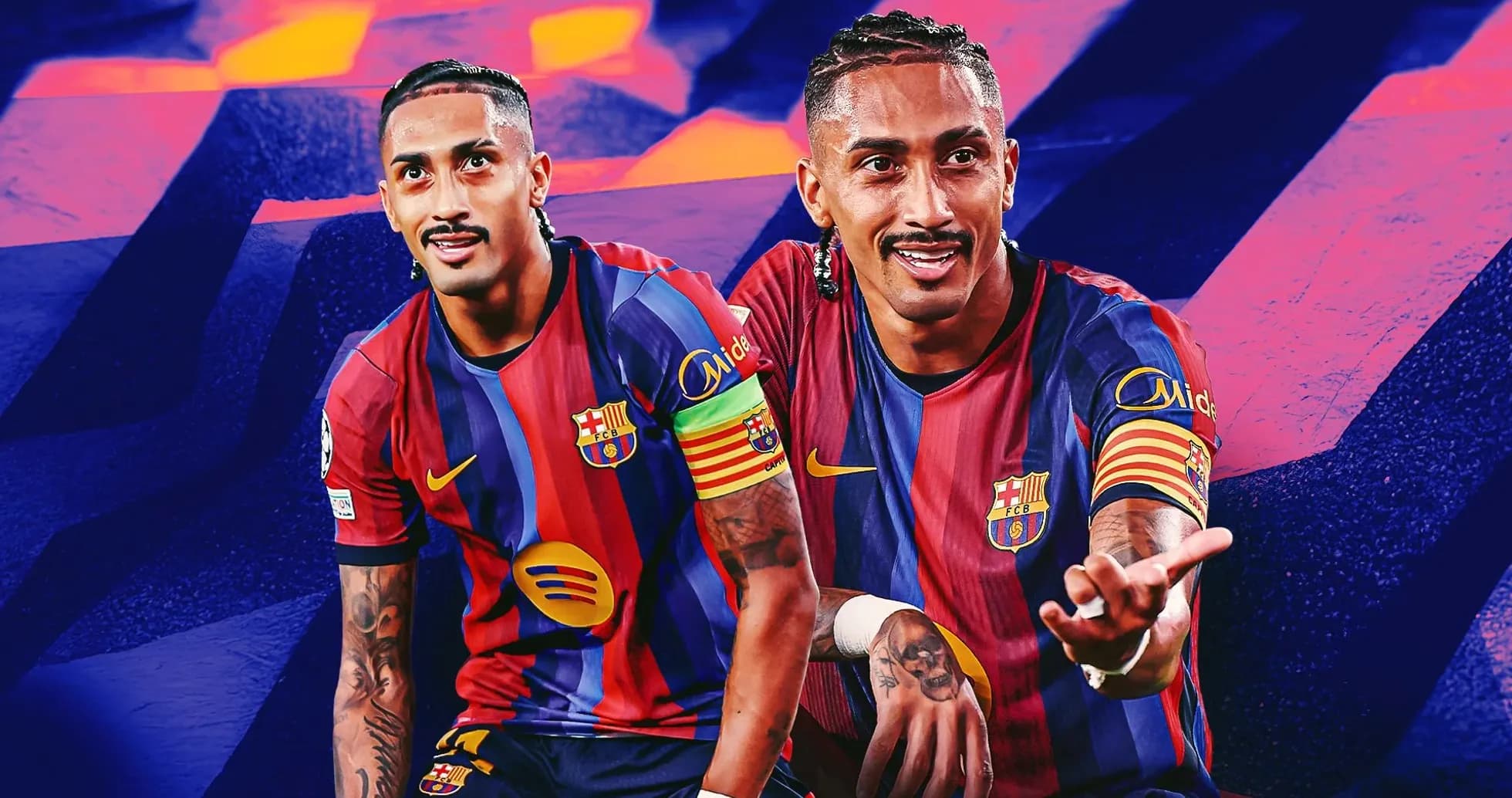
Raphinha, once a touchline winger, now looks like the most explosive central attacker in Europe.
From sidelined star to central force
The numbers tell the story of a career swinging wildly between brilliance and frustration.
In 2024-25, Raphinha put up a scarcely believable 60 goal contributions. He played like a man sprinting towards the Ballon d’Or podium. Then his body gave way. Persistent hamstring problems kept him out for 125 days last season, cutting his tally down to 29 goal contributions and ruining his World Cup in the process.
He stayed decisive when fit, but the rhythm was gone. The Ballon d’Or panel didn’t even include him in the final 30 this year.
Flick hasn’t forgotten. And Raphinha is making sure nobody else does either.
Shifted into a central role, the 29-year-old has started this campaign like a man on a mission. Eleven goals already — a mark no Barcelona player has reached this quickly in the last 60 years.
Lionel Messi managed 10 in his first seven games of 2012-13, and twice hit nine at the same stage. Ronaldo Nazário hit nine in 1996-97. Raphinha has gone past them both.
A Champions League statement
The turning point in the wider conversation came on a Champions League night that felt like a personal manifesto.
Against Feyenoord, Raphinha didn’t just score twice. He announced himself as Barcelona’s new reference point.
His first goal was pure theatre. A slightly loose pass from Lamine Yamal, one defender beaten, then a glide into the box. He shaped to shoot, froze two more Feyenoord defenders with a cold-blooded dummy, and only then rolled the ball into the corner with a calm that bordered on arrogance.
The second was straight out of a centre-forward’s manual. He first moved towards Dani Olmo, drawing his marker, then spun and bolted into the space behind. Olmo’s pass arrived on cue, Raphinha took it in stride and drilled a low shot across the helpless goalkeeper.
Barcelona ran out 5-1 winners. Raphinha walked away with Player of the Match and the sense that something had fundamentally shifted. He looked untouchable. He looked like the best player in the world.
“Rapha has played fantastic,” Flick said. “He’s on another level – he’s unbelievable.”
On current evidence, that’s not hyperbole.
The perfect spearhead for Flick’s chaos
Robert Lewandowski gave Barcelona a classic No.9: back to goal, penalty-box predator. Ferran Torres offered movement and subtlety, darting in behind. Raphinha is something else entirely.
He roams. He floats between the lines, appears on the shoulder, then drops into midfield to link play. His acceleration rips defensive shapes apart; his first touch and close control turn tight spaces into open roads.
His movement creates corridors for Yamal on one flank and Anthony Gordon on the other. Then, when defenders finally step out to deal with the wide threats, Raphinha knifes into the gap they leave.
The Racing Santander game in La Liga underlined the point with brutal clarity. Barcelona won 7-2. Raphinha scored a hat-trick.
Two came from the spot. The third was the kind of goal that shows why Flick trusts him with the entire attacking structure. Again, Olmo was the architect. Raphinha drifted between the two centre-backs, waited, then burst into the channel at exactly the right moment. One touch to set himself, then a measured half-volley into the corner.
Nothing flashy in the finish. Everything ruthless.
And when Barcelona don’t have the ball, he becomes the first defender. The press starts with him, and it’s relentless. He sprints, harries, forces panicked clearances and bad passes. He makes Flick’s high-octane vision possible.
No wonder the coach is quietly relieved that the club’s pursuit of Julián Álvarez never materialised. The frontline is humming, the system looks coherent, and Barcelona can now point their transfer budget at other weak spots.
Walking in the shadow of R9
Barcelona’s history with Brazilian superstars is rich and glittering: Romário, Rivaldo, Ronaldinho, Neymar. Yet for all that talent, one season still stands alone — Ronaldo’s single, devastating year in 1996-97.
Ronaldo arrived from PSV for a then-world record $19.5m fee at just 20. In 49 games he scored 47 goals, shredded La Liga, and dragged Barcelona to the Copa del Rey, UEFA Cup Winners’ Cup and Supercopa de España.
He bullied defenders with raw strength, scorched them with pace and finished with chilling accuracy. Thirty-four league goals brought him the Pichichi and the European Golden Shoe. The 1997 Ballon d’Or followed, almost inevitably.
His highlights have become part of club folklore: the solo run against SD Compostela, the hat-trick that turned a Copa del Rey quarter-final against Atlético Madrid into a 4-3 comeback classic.
“He is the most spectacular player I’ve ever seen,” Sir Bobby Robson said at the time. Laurent Blanc called him “a freight train coming at you with a ball at his feet.”
Ronaldo, the beloved ‘R9’, was a fixed target in the box in a way Raphinha is not. Yet the parallels are hard to ignore. The same directness. The same hunger for goal. The same ability to cut through a defence in seconds.
If Raphinha sustains this level, his numbers could begin to echo Ronaldo’s. The bigger question is whether he can turn it into something even more valuable: a treble that would define an era.
Captain, work in progress, driving force
For all the fireworks, Raphinha insists he’s nowhere near the finished product.
“I will never say I am performing well; I always strive to improve everything I can,” he said after the Racing rout. “I am happy with the goals, and with the win, and that is the most important thing, but we have to keep improving.”
He feels “comfortable” through the middle, and he knows exactly who to thank for the transformation.
“He is the coach who changed the way I think and how I see myself,” Raphinha said of Flick. “I am extremely grateful.”
That relationship changed the course of his Barcelona career. Under Xavi, his first two seasons at Camp Nou were underwhelming. He never fully nailed down a starting spot, never quite convinced that he was central to the project. A departure in 2024 felt likely.
Flick arrived and ripped up the script. He saw a leader, not a luxury. After Marc-André ter Stegen left on loan to Ajax, Flick didn’t hesitate: Raphinha became Barcelona’s permanent captain.
The first Brazilian ever to wear the armband in Catalonia. So far, he’s playing the role as if he’s been preparing for it his whole life.
His intensity sets the tone. His pressing demands that others follow. His willingness to take responsibility in big moments gives younger players a roadmap. He doesn’t just score; he drags games in Barcelona’s direction.
A squad built to protect its star
Flick’s attack is no one-man show, even if Raphinha is the headline act.
Despite losing Lewandowski and Torres and sending Marcus Rashford back to Manchester United, Barcelona look sharper going forward than at any point in recent years. New arrivals Anthony Gordon, Karim Adeyemi and Gabriel Jesus have all slotted in quickly. There’s also 18-year-old Hamza Abdelkarim, promoted from Barça B, adding yet another option through the middle.
“Raphinha, Gabby and Hamza are three different profiles, but there are other ways we could play,” Flick has said. “Anthony and Karim can also play in this position (as striker). Or Dani Olmo. Dani has showed us in last two years he can play there – the same with Fermin [Lopez]. We have a lot of options.”
Those options matter. So does the way Flick uses them.
He has been careful with Raphinha’s minutes, substituting him early against Feyenoord and in league wins over Athletic Club and Racing. The scars from last season’s injuries are still visible in the way the staff manage him. They know his legs may decide Barcelona’s season.
The same caution applies to Yamal. Playing closer to Raphinha has unlocked a terrifying partnership: one movement from Yamal, one glance from a centre-back, and the ball is slipped into the space where Raphinha is already sprinting.
Their understanding looks instinctive. Their threat, almost unmanageable.
Yamal doesn’t seem bothered about ceding centre stage either. In a dressing room loaded with star power, egos remain in check. The collective comes first, and that unity is starting to feel like Barcelona’s most dangerous weapon.
Raphinha embodies that edge — the relentless pressing, the ruthless finishing, the refusal to be satisfied.
From Ballon d’Or snub to the most feared forward in Spain, he is rewriting his own story in real time. If this level holds, the only real question is not whether he joins Ronaldo in Barcelona’s Hall of Fame, but how quickly his name gets carved into the wall.