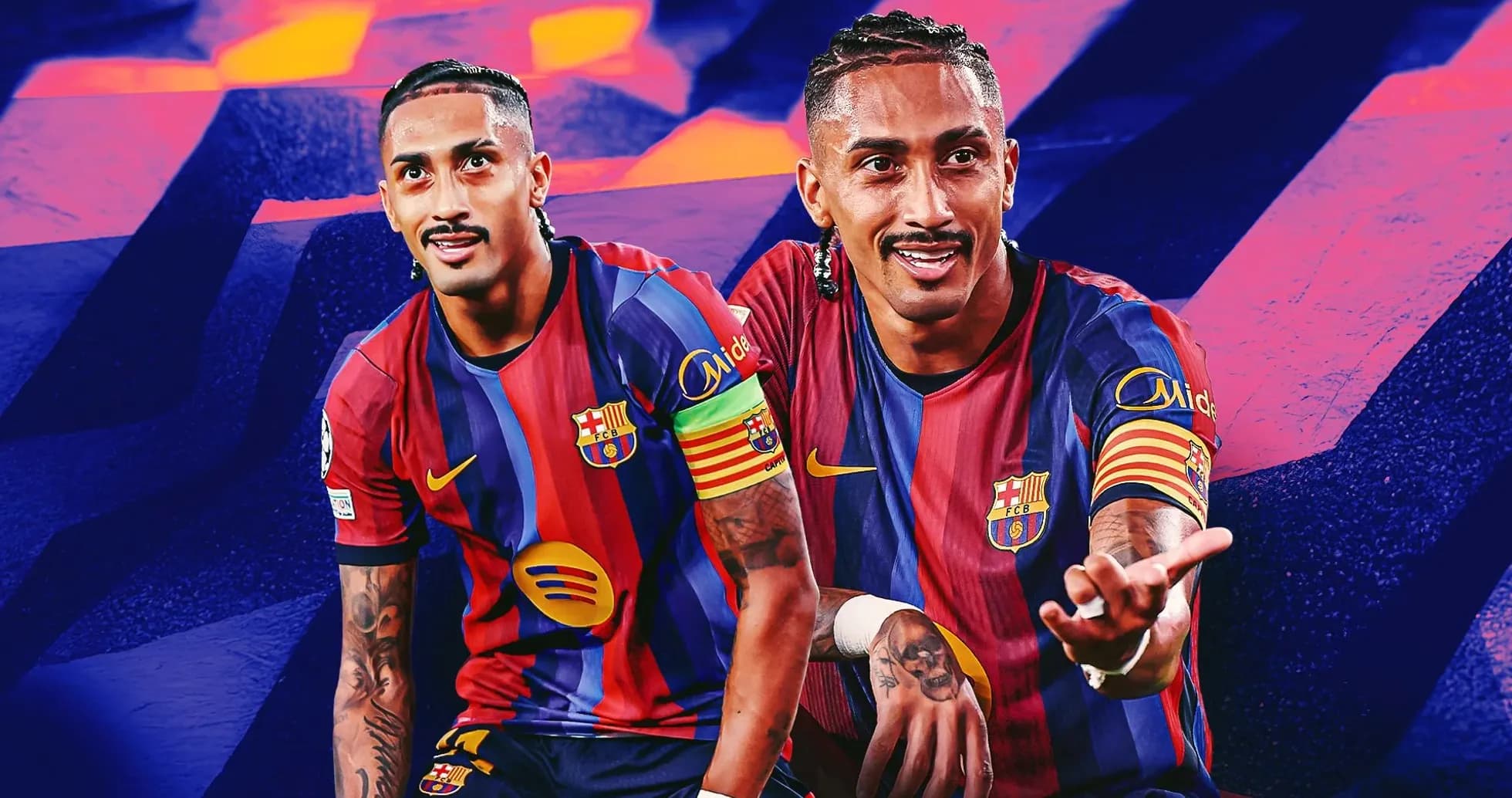
Raphinha’s Revenge Season: From Injury Heartbreak to Barcelona’s New Star
Hansi Flick has moved Raphinha inside and, almost overnight, Barcelona have found a new reference point. Not on the left touchline, where he toiled and sparkled in flashes, but right through the heart of the pitch.
A year ago, the Brazilian’s story was about what he’d lost. Sixty goal contributions in a sensational 2024-25 campaign, a Ballon d'Or near-miss, then a body that betrayed him. Persistent hamstring problems cost him 125 days, chopped his output to 29 contributions, and wrecked his World Cup.
Now the story is very different. Now it’s about whether Barca have just unleashed a centre-forward capable of chasing Ronaldo-level numbers.
Flick’s fury and a Champions League statement
The Ballon d'Or snub cut deep inside the club. Raphinha didn’t even make the 30-man shortlist this year. Flick didn’t hide his feelings.
“He is far too good not to be on that list, but we can’t change it,” the Barca coach said, brimming with conviction after watching his new No.9 dismantle Feyenoord in the Champions League opener.
Raphinha didn’t just score twice. He performed.
The first goal was pure theatre. He gathered a slightly wayward pass from Lamine Yamal, rolled past one defender, surged into the area and shaped to shoot. Then came the pause, the dummy, and the collapse: two Feyenoord defenders on the turf, a lane of daylight, and a cool finish into the corner.
The second was the type of movement that makes centre-backs hate this sport. When Dani Olmo picked up the ball in the centre-circle, Raphinha initially darted towards him, dragging his marker with him. Then he spun and exploded into the opposite channel. One slick through ball later, he was in stride, lashing a shot across a helpless goalkeeper.
Barca ran out 5-1 winners. Raphinha walked away with Player of the Match and the aura of a man playing the game at his own tempo. For long stretches, he looked like the best player in the world — and carried himself like it too.
“Rapha has played fantastic,” Flick said. “He’s on another level – he’s unbelievable.”
The numbers are backing him up.
Historic start, new role, new Barca
Raphinha already has 11 goals this season. No Barcelona player in the last 60 years has started a campaign like that. Not even Lionel Messi.
Messi hit 10 in his first seven games in 2012-13, and twice reached nine by this stage in other seasons. Ronaldo matched nine in 1996-97. Raphinha has gone beyond them all.
His instant adaptation through the middle has changed everything for Flick. Robert Lewandowski was a master with his back to goal. Ferran Torres stretched teams with clever runs in behind. Raphinha gives Flick something different: a roaming spearhead for a fluid, aggressive system.
The 29-year-old doesn’t stay fixed between the centre-backs. He floats, slipping between lines, using his acceleration and tight control to drag defenders out of shape and stitch attacks together. That movement carves out room for Yamal on one flank and Anthony Gordon on the other, while Raphinha himself keeps finding the gaps no one else sees.
The pattern repeated in La Liga in brutal fashion. Racing Santander were the latest victims, shredded 7-2 as Raphinha helped himself to a hat-trick.
Two came from the penalty spot. The middle one told the real story. With Olmo again orchestrating, Raphinha ghosted into the space between Racing’s centre-backs, waited, and waited. When the pass arrived, he needed just one touch to set and a half-volley to guide the ball into the corner. No fuss. No panic. Just clarity.
On the ball he makes elite defending look ordinary. Off it, he sets the tone. Barca’s press now begins with their captain harrying centre-backs, chasing lost causes at full throttle, forcing hurried clearances and bad decisions.
Flick wanted intensity and dynamism. Raphinha has given him both – plus a ruthless edge in front of goal. Quietly, the German must be relieved that the club’s pursuit of Julian Alvarez never materialised. The frontline is humming, and the transfer budget can now be aimed at other areas in the coming windows.
Walking in Ronaldo’s shadow
Whenever a Brazilian lights up Camp Nou, the comparisons arrive on cue. Romario, Rivaldo, Ronaldinho, Neymar – the lineage is rich. Yet one year still stands apart: Ronaldo’s 1996-97 season.
Arriving from PSV for a world-record $19.5m fee at just 20, Ronaldo tore through Spain and Europe. Forty-seven goals in 49 games, the Copa del Rey, UEFA Cup Winners’ Cup, Supercopa de España, the Pichichi with 34 league goals, the European Golden Shoe, and the 1997 Ballon d'Or.
He didn’t just score; he stunned. The solo run against SD Compostela. The hat-trick that dragged Barca from 3-0 down to a 4-3 win over Atletico in the Copa del Rey. Defenders bounced off him. Goalkeepers froze.
“He is the most spectacular player I’ve ever seen,” Sir Bobby Robson said at the time. Laurent Blanc described him as “a freight train coming at you with a ball at his feet.”
Ronaldo – R9 – was a fixed reference point up top, the tip of every attack. Raphinha is looser, more fluid. Yet the parallels are creeping in.
He shares Ronaldo’s killer instinct, his directness, that sense that a game can be ripped open in a single, brutal movement. If he sustains this level, the idea of matching Ronaldo’s output over a season no longer sounds outrageous. With Barca chasing major honours on multiple fronts, the stage is set for something even bigger than a one-year wonder.
The captain who almost walked away
None of this felt inevitable. Raphinha’s first two seasons at Camp Nou were uneven. He fought for minutes under Xavi, flashed quality, but never fully convinced. In 2024, a departure felt like a real possibility.
Flick changed the script.
The German saw potential, not frustration. He handed Raphinha more responsibility from day one and, after Marc-Andre ter Stegen left on loan for Ajax in the summer, he made a bold call: Raphinha would be Barcelona’s new permanent captain.
The first Brazilian ever to wear the armband in Catalunya is now playing like he was born with it. He leads with work rate and aggression, not just words. He grabs games, drags team-mates with him, and offers a relentless example to the club’s younger talents.
Raphinha himself refuses to treat this as a finished story.
“I will never say I am performing well; I always strive to improve everything I can,” he said after the Racing rout. “I am happy with the goals, and with the win, and that is the most important thing, but we have to keep improving.”
He also stressed how natural the central role feels now, and he didn’t hesitate to credit the coach who reshaped his career.
“He is the coach who changed the way I think and how I see myself,” Raphinha said of Flick. “I am extremely grateful.”
Depth, protection and a terrifying partnership
Flick has built an attack that doesn’t live or die with one player’s fitness. Losing Lewandowski and Torres, and allowing Marcus Rashford to return to Manchester United, looked risky on paper. On the pitch, Barca are sharper than ever going forward.
New arrivals Gordon, Karim Adeyemi and Gabriel Jesus have slotted in quickly. From La Masia’s pipeline, 18-year-old Egyptian striker Hamza Abdelkarim has stepped up from Barca B and now gives Flick another live option through the middle.
“Raphinha, Gabby and Hamza are three different profiles, but there are other ways we could play,” Flick has said. “Anthony and Karim can also play in this position (as striker). Or Dani Olmo. Dani has showed us in last two years he can play there – the same with Fermin [Lopez]. We have a lot of options.”
That depth is no luxury; it’s a shield. Those hamstring problems still linger in the background. Flick is managing his captain with care, withdrawing him early against Feyenoord and in league wins over Athletic Club and Racing. The message is clear: Barca need Raphinha fresh in April and May, not just flying in September.
The same logic applies to Yamal. The teenager has become even more dangerous playing closer to Raphinha. Their understanding is telepathic.
The pattern repeats: a centre-back shifts a shoulder to track Yamal, the youngster slips a pass inside, and Raphinha is already cutting across the blind side into the channel. One look, one movement, and defences are undone.
Yamal, for all his talent, seems happy to let Raphinha take centre stage. That matters. Flick has star power to spare, but the dressing room is running on collective hunger, not individual ego.
At the heart of it all stands Raphinha – captain, finisher, first defender, and standard-bearer for a new-look Barca.
The club’s Hall of Fame already has a seat reserved for R9. If this season continues on its current trajectory, how long before Raphinha takes his place alongside him?