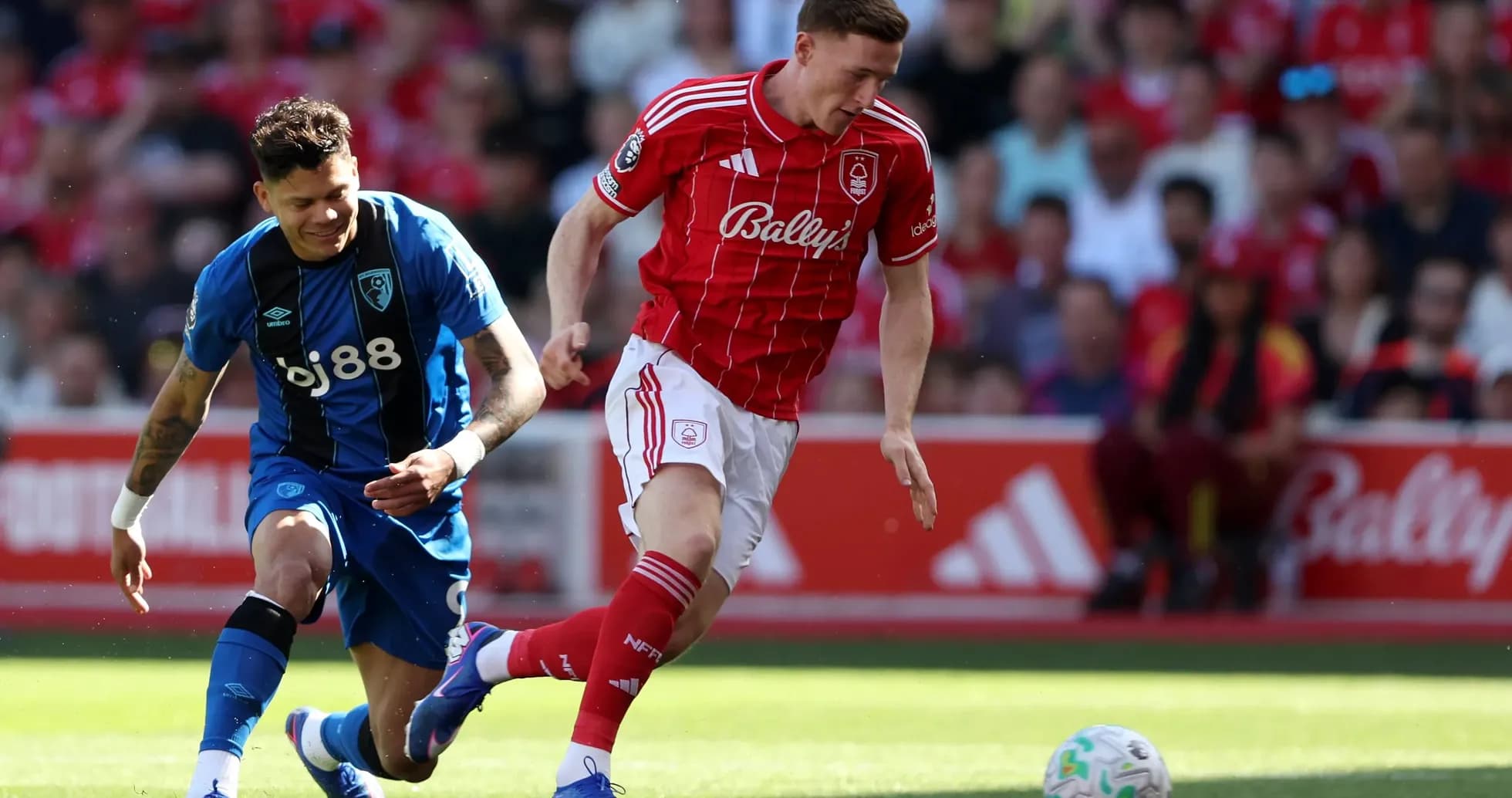
Nottingham Forest vs Bournemouth: Tactical Analysis of 1-1 Draw
Nottingham Forest and Bournemouth closed their Premier League campaigns at City Ground with a 1-1 draw that neatly reflected the underlying balance of the contest: Forest’s more direct, penalty-box focused 4-4-2 against Bournemouth’s structured 4-2-3-1 possession game. Forest led 1-0 at half-time and generated the higher xG (1.87 to 1), but Bournemouth’s territorial control and second-half adjustment earned them a deserved equaliser and a share of the points.
Forest’s 4-4-2 under Vitor Pereira was built around verticality and occupation of central channels. Chris Wood and Igor Jesus played as a classic front pair, with M. Gibbs-White drifting infield from the right of midfield and O. Hutchinson offering width and penetration from the opposite side. The double pivot of I. Sangare and E. Anderson sat behind them, screening and then feeding early passes into the front four. The shot profile underlines this intent: 10 of Forest’s 15 attempts came from inside the box, with 5 on target and 5 blocked. Rather than recycling, Forest were happy to finish moves quickly once they reached the final third.
First Half
The opening goal on 34 minutes encapsulated their plan. After Bournemouth’s back line was drawn narrow, Hutchinson received in an advanced wide area and attacked the half-space, slipping a decisive pass into Gibbs-White, who had ghosted between the lines from his nominal midfield berth. Gibbs-White’s finish gave Forest the 1-0 lead and validated the use of him as a free, interior creator rather than a touchline winger.
Out of possession, Forest’s 4-4-2 mid-block tried to funnel Bournemouth into wide zones. The front two screened passes into T. Adams and A. Toth, while the narrow midfield four squeezed the central corridor. This structure limited Bournemouth to 6 shots inside the box from 17 total efforts; many of the visitors’ attempts were from distance (11 shots outside the box), a sign that Forest’s central compactness was largely effective.
Bournemouth, under Andoni Iraola, leaned into their 4-2-3-1 as a possession platform. With 55% of the ball and 483 passes (405 accurate, 84%), they sought to progress methodically. A. Truffert and A. Smith provided width from full-back, allowing the attacking midfield trio of M. Tavernier, E. J. Kroupi and Rayan to drift into pockets. Adams anchored the build-up, dropping to receive from the centre-backs and creating a 3+1 structure at times.
Early on, Bournemouth struggled to access Evanilson between Forest’s lines, forced instead into lateral circulation. The first-half yellow card for James Hill on 33 minutes for “Foul” came as Bournemouth tried to counter-press aggressively after a turnover, but Forest’s willingness to play quickly through the first line meant Bournemouth’s defensive shape was often stretched.
Second Half
The second half, however, showed Iraola’s capacity to adjust. The equaliser on 54 minutes was a product of more assertive full-back usage and better timing in the half-spaces. Truffert advanced high on the left and, rather than simply overlapping, cut inside to act as an auxiliary playmaker. His assist for Tavernier came after Bournemouth successfully pinned Forest’s back four deep, with Tavernier arriving from the left-sided attacking midfield slot into the inside channel to finish. The move reflected a subtle shift: Bournemouth were now overloading one flank to destabilise Forest’s previously solid block.
Substitutions then reshaped both teams’ tactical profiles. For Bournemouth, A. Toth (OUT) was replaced by B. Gannon-Doak (IN) at 57', which tilted the visitors further towards attacking intent by sacrificing some midfield control for an extra forward option. Later, at 73', a triple change re-energised the front line: Evanilson (OUT) for E. Unal (IN), E. J. Kroupi (OUT) for J. Kluivert (IN), and Rayan (OUT) for A. Adli (IN). These moves injected pace and direct running into the final third, aiming to exploit any fatigue in Forest’s back four and to attack more aggressively in transition.
Forest’s response was to adjust their own structure around the hour mark. At 62', C. Wood (OUT) made way for T. Awoniyi (IN), adding more depth running and physicality against Bournemouth’s centre-backs. One minute later, Cunha (OUT) was replaced by L. Netz (IN), a like-for-like defensive change that freshened the left side of the back four. The double change on 65' — E. Anderson (OUT) for R. Yates (IN) and I. Sangare (OUT) for N. Dominguez (IN) — subtly rebalanced the midfield. Yates brought more ball-winning and second-ball aggression, while Dominguez offered calmer distribution, helping Forest cope with Bournemouth’s growing pressure. On 78', Hutchinson (OUT) for J. McAtee (IN) introduced a more central, combination-oriented profile on the flank, suggesting Pereira wanted to regain some control through short passing rather than pure wing running.
Disciplinary Moments
The disciplinary moments reflected contrasting approaches. Bournemouth finished with 7 fouls and 1 yellow card — James Hill (Bournemouth) booked at 33' for “Foul” — indicating a generally controlled defensive game despite their higher line. Forest, with 11 fouls and 1 yellow, showed more edge in duels, particularly after the break. Taiwo Awoniyi (Nottingham Forest) was cautioned at 67' for “Foul”, a sign of Forest’s attempt to disrupt Bournemouth’s rhythm as the visitors pushed for a winner.
Goalkeeping Performance
In goal, M. Sels (Nottingham Forest) made 3 saves, aligning with Bournemouth’s 4 shots on target and underlining his steady, if not spectacular, contribution behind a defence that blocked 5 shots and forced many attempts from range. At the other end, D. Petrovic (Bournemouth) also registered 3 saves against Forest’s 5 shots on target, his interventions helping to hold the score at 1-1 despite Forest’s higher xG and superior shot quality.
Statistical Overview
Statistically, the draw sits at the intersection of two contrasting game plans. Forest, with 45% possession, 396 passes (307 accurate, 78%), and a higher xG of 1.87, executed a clear strategy of direct, box-focused attacks, maximising the value of their phases in the final third. Bournemouth, with more of the ball, cleaner passing, and a slightly higher shot volume but lower xG (1), emphasised structure and circulation but struggled to consistently penetrate Forest’s compact central block.
In tactical terms, Forest will feel they created enough to win, especially given their shot locations and the way their 4-4-2 generated central overloads via Gibbs-White. Bournemouth, however, can point to their second-half control, the effectiveness of Iraola’s substitutions in re-energising the attack, and the way their full-backs and attacking midfielders eventually prised open Forest’s shape for the equaliser. The 1-1 at City Ground ultimately reflects a match in which Forest’s chance quality and Bournemouth’s territorial dominance cancelled each other out.