Ninety-Five Years Since John Thomson's Tragic Death
In football, people throw the word “tragedy” around too easily. A late equaliser, a cup final defeat, a relegation. None of that comes close to what happened at Ibrox on 5 September 1931.
That afternoon, Celtic goalkeeper John Thomson went out to play an Old Firm match and never came home.
He was 22.
From the Fife Pits to Celtic’s Goal
John Thomson was born on 28 January 1909, not in the mining village where his name is now sacred, but in Kirkcaldy. His family moved to Cardenden before his first birthday, and it was there, in the shadow of the pits, that his life and legend took shape.
Cardenden was a mining community in every sense. The colliery dominated the skyline and the working lives of its people. Thomson followed the path of so many local boys, heading down Bowhill Colliery as a teenager to work as a labourer. The mines paid his wages. Football carried his dreams.
He stood out early in school football, but it was in the Juniors that his reputation began to travel. First with Bowhill Rovers, then from 1925 with Wellesley Juniors, he turned performances on muddy pitches into headlines in the local press. Reporters tipped him for the top level, a bold prediction for a young keeper from Fife.
Raith Rovers and Cowdenbeath both brought him in for trial matches. Neither would be his future. That changed in October 1926, when Celtic scout Steve Callaghan went to watch an East of Fife Cup tie against Denbeath Star. Callaghan had gone to look at another goalkeeper. He came back talking about Thomson.
On 1 November 1926, Celtic signed the 17‑year‑old for £10. The story has become part of club folklore: the teenager persuaded by a tramcar journey to Glasgow’s east end, then signing his contract on top of a fuse box. A working‑class boy stepping out of the pit and into Parkhead.
A Star Between the Posts
Thomson made his Celtic first‑team debut on 12 February 1927 at Dens Park, where Celtic beat Dundee 2–1. Supporters and coaches were impressed. He was not. He blamed himself for the Dundee goal and vowed to do better. That relentless standard would define him.
By the end of that season, he had his first major medal. Celtic lifted the 1927 Scottish Cup with a 3–1 win over East Fife in front of almost 80,000 fans, Thomson guarding the goal. In 1931 he added a second Scottish Cup, Celtic defeating Motherwell 4–2 in a replay after a 2–2 draw in the first match.
Trophies kept coming. So did appearances. Between 1927 and 1931 he played 188 times for Celtic, winning three Glasgow Cup medals and becoming the fixed point of the side. His presence gave Celtic licence to attack. They knew what stood behind them.
Scotland noticed. Between 1930 and 1931, Thomson won four caps. He kept three clean sheets and conceded just one goal. An extraordinary return for such a young keeper.
His debut came in Paris, where Scotland beat France 2–0. His last international was just as emphatic: a 2–0 win over England at Hampden, played in front of 131,000 people. He also turned out four times for the Scottish League XI, another nod to his growing stature.
Word travelled beyond Scotland. English clubs circled, with Arsenal in particular said to be keen to tempt him south. Celtic, and their support, knew exactly what they had.
Courage, Fear and a Mother’s Warning
Thomson’s greatness lay in more than shot‑stopping. He was agile, quick off his line and, above all, fearless. In an era when goalkeepers enjoyed little protection, he repeatedly threw himself into situations where boots flew and bones broke.
That bravery thrilled fans. It terrified his mother.
Her fears sharpened after an injury against Airdrie in 1930. Thomson had already taken heavy punishment in his short career. The concern that his courage might one day cost him dearly was very real in the family home.
Those worries would soon prove horribly justified.
Ibrox, 5 September 1931
That Saturday, Thomson left his flat in Victoria Road on Glasgow’s southside. His destination lay a short distance away: Ibrox Park, where Celtic were to face Rangers in an Old Firm league match.
By half-time the game was goalless. Thomson had been typically assured, organising his defence and allowing Celtic to push forward against their Light Blue rivals.
Then came the moment that would change Scottish football forever.
Early in the second half, Rangers forward Sam English broke through the Celtic back line. Thomson saw the danger instantly and surged from his goal, diving at English’s feet in an attempt to smother the ball. Both men went full‑blooded into the challenge.
They collided with huge force. English’s leg caught Thomson on the head.
At first, many inside Ibrox thought it was just another heavy collision, the kind that punctuated matches in that brutal era. Thomson lay still. Then the mood shifted.
He did not get up.
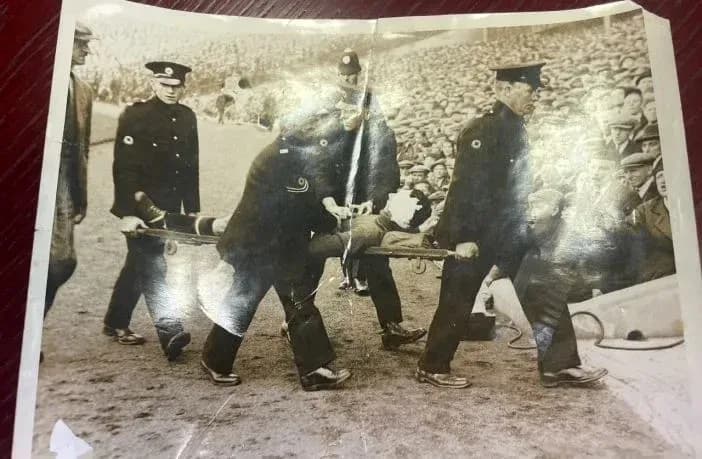
Medical staff sprinted onto the pitch. Thomson was carried away on a stretcher, motionless. In a decision that jars with modern sensibilities, the match went on. With no substitutes allowed, Celtic defender Chic Geatons, another Fifer, pulled on the goalkeeper’s jersey.
The game ended 0–0. By then, few cared about the score.
A Life Lost, a Game United
Thomson was taken to the Victoria Infirmary. Doctors fought to save him, but the damage was catastrophic. He had suffered a fractured skull and severe brain injuries.
A car was dispatched to Fife to bring his parents to Glasgow. Shortly after they reached the hospital, their son died.
He was 22 years old.
An inquiry later ruled the death accidental. Those present were clear: Sam English had done nothing wrong. It was the awful outcome of two committed professionals attacking the same ball with full conviction.
That truth did not lessen the shock.
The news of Thomson’s death reverberated across Scotland. Celtic supporters, Rangers fans and neutrals alike shared a raw sense of loss. At a memorial service held at Trinity Church in Glasgow’s west end, both Celtic and Rangers attended, Sam English among them. The crowds outside were so large that police had to help the teams get into the building.
Four days after the collision, on 9 September 1931, Cardenden said goodbye to its most famous son. Around 40,000 people attended Thomson’s funeral. Thousands travelled from Glasgow, some walking the 55‑mile journey to Fife.
His Celtic teammates carried the coffin. They had lost not just their goalkeeper, but a friend.
On his gravestone, one line stands out:
“They never die who live in the hearts they leave behind.”
For Celtic supporters, that inscription became part of his story.
The Weight on Sam English
The tragedy did not end with Thomson’s death. It clung to Sam English as well.
English continued his football career, but he never escaped the memory of that day at Ibrox. Opposing fans taunted him, cruelly ignoring the findings of the inquiry and the words of Thomson’s own parents, who publicly forgave the Rangers forward and refused to blame him.
Two lives, in very different ways, were altered forever on that September afternoon.
Grief, Legacy and a Prince Remembered
In the months that followed, Celtic struggled to absorb the loss. The club eventually replaced Thomson on the pitch, bringing in Canadian goalkeeper Joe Kennaway. They never truly replaced him in their hearts.
Poems and songs were written about the Fife goalkeeper. Many are still sung today, woven into the culture of the club. Writers returned to his story time and again, producing articles and books that kept his memory alive.
Supporters still travel to Cardenden to visit his grave. Some make the journey part of charity events, turning remembrance into something tangible and communal.
For all the trophies and titles that have passed through Celtic’s history, the death of John Thomson stands apart. It is a reminder that, beneath the noise and rivalry, the game is played by young men with families, hopes and futures.
On 5 September 1931, a goalkeeper lost his life while playing for Celtic. Decades later, the club’s fans still speak of him as their “Prince of goalkeepers.”
Ninety‑five years on, the question lingers: how can a club so steeped in glory ever measure a loss like that against anything that happens on the pitch?