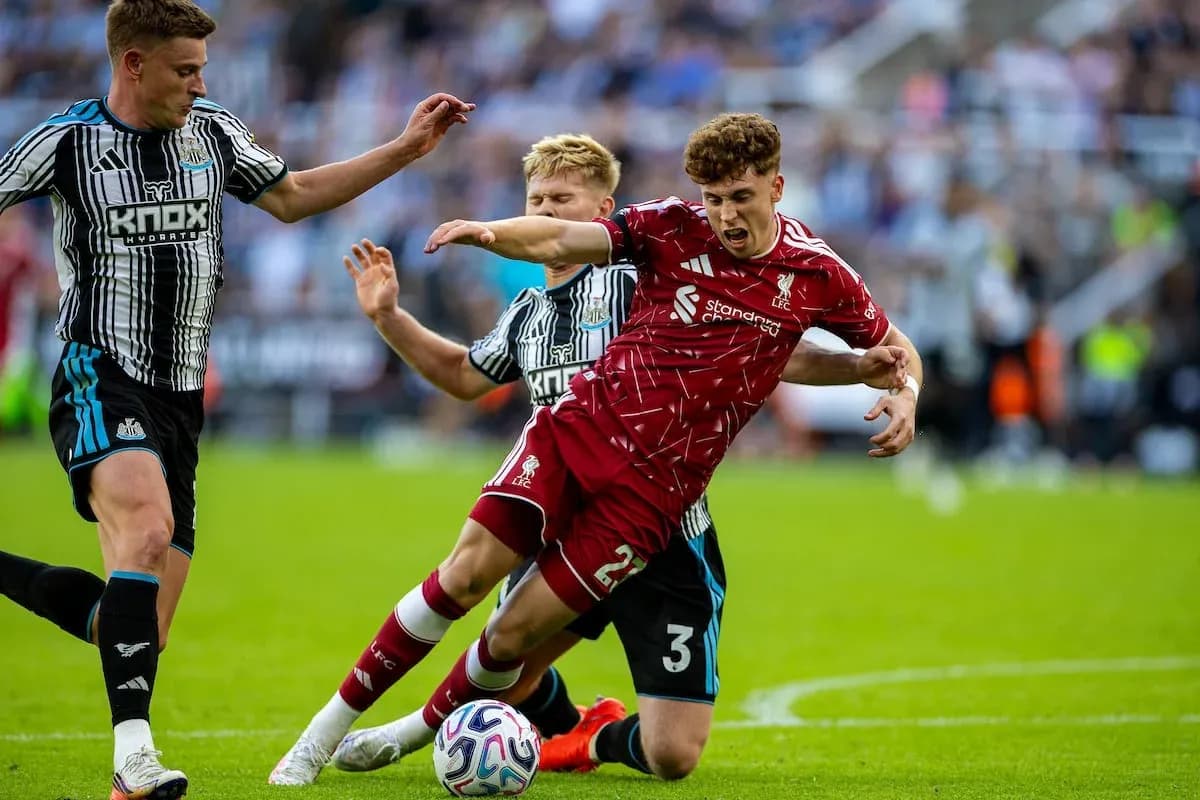
Newcastle and Liverpool Draw 2-2 in Premier League Opener
The new Premier League season opened at St James’ Park with a fixture that felt more like a tactical unveiling than a routine Round 1 meeting. Newcastle and Liverpool, both under new management, shared a 2–2 draw that hinted at the identities Matthias Jaissle and Andoni Iraola are trying to build.
I. The Big Picture – Two 4-2-3-1s, one frantic narrative
Following this result, both sides sit on 1 point, level on goal difference at 0 after scoring 2 and conceding 2 overall. Newcastle are 11th, Liverpool 10th, the table reflecting only alphabet rather than superiority.
What matters more is the way both coaches leaned into a mirrored 4-2-3-1. Newcastle’s shape was built on verticality and transition: L. Hornicek in goal behind a back four of A. Dedic, M. Thiaw, S. Botman and L. Hall, with S. Steur and L. Miley as the double pivot. Ahead of them, a mobile band of three – A. Elanga, Y. Wissa and H. Barnes – worked to feed lone forward W. Osula.
Liverpool answered in kind. Alisson anchored a line of J. Frimpong, J. Jacquet, V. van Dijk and M. Kerkez. In midfield, D. Szoboszlai and R. Gravenberch formed a technical double pivot, with R. Ngumoha, F. Wirtz and C. Gakpo supporting A. Isak at centre-forward. On their travels so far, Liverpool have scored 2 and conceded 2, with an away average of 2.0 goals both for and against, underlining the end-to-end nature of this opener.
Newcastle’s home profile after this game is simple and symmetrical: at home they have played 1, drawn 1, with 2 goals for and 2 against, averaging 2.0 scored and 2.0 conceded. Both sides failed to keep a clean sheet and both have yet to taste defeat, the numbers suggesting high-event football rather than controlled dominance.
II. Tactical Voids – The absences that shaped the game
The absentees list explains some of the structural choices. Newcastle were without Joelinton and V. Livramento, both listed as missing this fixture through injury. Joelinton’s absence stripped Jaissle of a powerful, ball-carrying presence who could have added ballast to the midfield duels and late box arrivals. Without him, Newcastle leaned on the youth and energy of L. Miley and the industry of S. Steur, accepting a little less chaos and a little more positional discipline.
For Liverpool, the defensive and rotational depth was thinned. C. Bradley, J. Gomez and G. Leoni all missed out with knee or unspecified injuries, while H. Ekitike was also unavailable with an Achilles tendon issue. The knock-on effect was clear: J. Frimpong and M. Kerkez had to offer both width and defensive security, with fewer like-for-like defensive options on the bench. It placed more responsibility on V. van Dijk and J. Jacquet to marshal a high line against Newcastle’s runners.
Discipline-wise, Newcastle’s season-long card map already shows a spread of yellow cards across the match, with 20.00% of their yellows arriving in each of the 16–30, 31–45, 61–75, 76–90 and 91–105 minute windows. That pattern hints at a side that maintains aggression throughout the contest. Liverpool’s early-season profile is different: 66.67% of their yellows have arrived between 16–30 minutes, with 33.33% in the 76–90 window, suggesting an early bite in the press and a late edge as legs tire.
III. Key Matchups – Hunter vs Shield, Engine Room battles
Hunter vs Shield
For Newcastle, the attacking “hunt” is more distributed than focused through a single striker. A. Elanga and J. Willock already share the team’s early scoring spotlight with 1 goal each overall. Elanga, starting from the right, offers direct running and end product: in his 76 minutes he scored 1, hit the target with both of his shots, and won 5 of 9 duels. His threat from wide areas forced Liverpool’s left side – M. Kerkez and C. Gakpo – to constantly track runs in behind.
W. Osula, while not yet on the scoresheet, has announced himself as a creative fulcrum. Overall he has 1 assist, 5 completed passes with 1 key pass and, crucially, 2 successful blocks – evidence of a forward willing to defend the box and press from the front. His movement between V. van Dijk and J. Jacquet asked questions of Liverpool’s central pairing, pulling them into uncomfortable zones and creating space for late midfield runs.
On the Liverpool side, the creative hunter is R. Gravenberch. With 1 assist overall and 47 passes at 91% accuracy, including 1 key pass, he was the conduit between build-up and the advanced trio. His willingness to step beyond D. Szoboszlai and connect with F. Wirtz and A. Isak gave Liverpool a staggered midfield line that could overload Newcastle’s double pivot.
Engine Room – Control vs Disruption
The central duel between Newcastle’s L. Miley and S. Steur and Liverpool’s R. Gravenberch and D. Szoboszlai framed much of the contest. Miley’s numbers tell the story of a young midfielder already influential: overall he has 36 completed passes with 2 key passes at 83% accuracy, plus 1 tackle, 1 block and 1 interception. He also carries a yellow card, underlining the edge he brings to his defensive work.
Newcastle’s bench options in this zone – J. Ramsey and J. Willock – changed the rhythm when introduced. Ramsey, who has 1 yellow card overall, added pressing energy and defensive coverage, recording 2 tackles, 1 block and 1 interception in his 34 minutes. Willock, meanwhile, gave Newcastle a late-running threat from midfield: in just 34 minutes he scored 1 goal from 1 shot on target, completed 7 passes with 1 key pass and won 3 of 8 duels. He is already ranked among the league’s top scorers and profiles as Jaissle’s ideal “third-man runner” to exploit tired defences.
Liverpool’s engine room is more about control than disruption. Gravenberch’s 10 duels (4 won), plus 2 interceptions and 1 tackle, show a player equally comfortable breaking lines and breaking play. D. Szoboszlai’s presence alongside him allowed Liverpool to maintain a technical base, even as the game stretched.
On the flanks, Y. Wissa was Newcastle’s two-way workhorse. Overall he has 1 assist, 4 shots (1 on target), 17 passes with 1 key pass and a remarkable 19 duels contested, winning 11. He also carries 1 yellow card, reflecting the combative edge he brings. His ability to drive at J. Frimpong, track back and still arrive in advanced positions made him central to Newcastle’s left-sided threat.
IV. Statistical Prognosis – High event, fine margins
Following this result, both teams share an identical statistical skeleton: overall they have played 1, drawn 1, scored 2 and conceded 2. Newcastle’s home average stands at 2.0 goals scored and 2.0 conceded; Liverpool’s away average mirrors that at 2.0 for and 2.0 against. Neither side has kept a clean sheet, and neither has failed to score.
Liverpool’s penalty record is perfect so far: they have taken 1 penalty overall, scoring it for a 100.00% conversion rate, with no penalties missed. Newcastle, by contrast, have yet to earn a spot-kick this season.
The disciplinary and duel data suggest that future meetings between these sides will continue to be high-intensity. Newcastle’s yellows are spread across the game, while Liverpool’s cluster early and late; Newcastle’s wide players like Wissa and Elanga engage in a high volume of duels, while Liverpool’s midfield looks to control through passing volume and positional play.
In tactical terms, this 2–2 feels less like an anomaly and more like a baseline. Two coaches committed to proactive 4-2-3-1 structures have produced a match where both sides scored twice, both conceded twice, and both left with enough encouragement to double down on their ideas. If the underlying numbers hold, future clashes between Newcastle and Liverpool this season promise more of the same: aggressive pressing, wide runners, creative midfielders dictating tempo, and a scoreboard that rarely stands still for long.